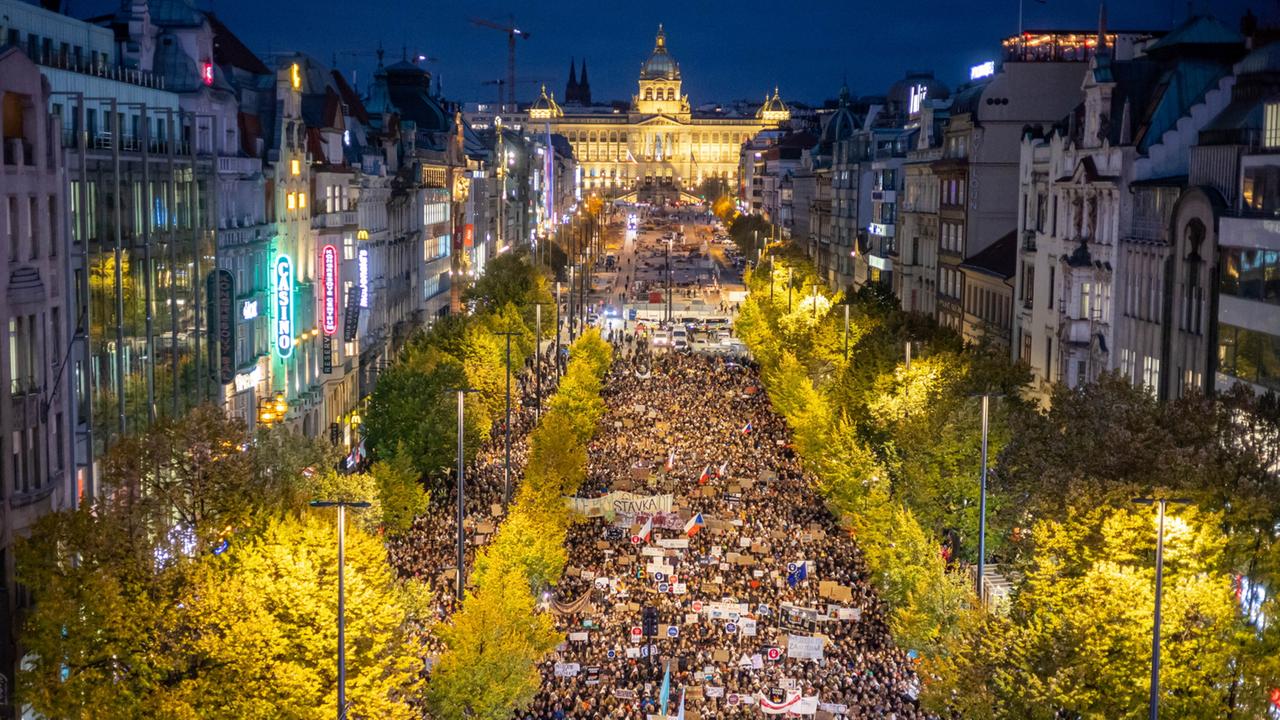
Prague, Czech Republic – November 3, 2026 – A wave of public dissent and industrial action has swept across the Czech Republic as thousands took to the streets in Prague and other major cities to protest a controversial government plan to fundamentally alter the funding of public service broadcasters. The proposed legislation, championed by Prime Minister Andrej Babiš, seeks to shift funding for Czech Television (ČT) and Czech Radio (ČRo) away from direct household fees and towards state budgetary allocations. Critics argue this move represents a significant threat to the independence of these vital media outlets, potentially paving the way for political influence and a chilling effect on journalistic integrity.
The proposed changes have already triggered a significant response from within the affected institutions. Employees of Czech Television and Czech Radio have initiated strikes, disrupting programming and highlighting the gravity of the situation. The 24-hour news channel of Czech Television, for instance, broadcast a stark image of a darkened newsroom with presenters dressed in black, a silent but powerful statement of protest against what they perceive as an assault on their autonomy.
The demonstrations, which saw large crowds converging from media houses towards Prague’s iconic Wenceslas Square, have become a focal point for a broader national debate about the future of press freedom in the Czech Republic. Students and other concerned citizens have joined the media workers, carrying signs and wearing distinctive triangular paper hats, a symbol derived from a beloved Czech animated character that has become an emblem of the burgeoning protest movement. Their message is clear: the government’s proposed financial restructuring is a thinly veiled attempt to undermine the editorial independence of public service broadcasters, a cornerstone of a healthy democracy.
A Shift in Financial Tides: From Fees to State Funds
The crux of the government’s proposal, which advanced to its first reading in the Chamber of Deputies (the lower house of the Czech Parliament) at the end of October, is a transition from a system of mandatory broadcasting fees paid by citizens to direct financial contributions from the state budget. While the government insists this change will not compromise the editorial independence or program content of the broadcasters, critics remain deeply skeptical.
The proposed legislation, if it successfully navigates the remaining parliamentary hurdles – including a crucial vote in the Senate (the upper house) and eventual signing by the President – is expected to result in a budget cut of approximately 15 percent for the public service media in the coming year. This reduction, according to media representatives, would force their budgets back to levels not seen in two decades, severely hampering their operational capacity and investigative journalism efforts.
The government’s rationale, as articulated by Prime Minister Babiš’s administration, centers on the assertion that public service media have become biased and partisan. The ruling coalition, comprising two right-wing populist parties, has long voiced its discontent with the current media landscape, accusing public broadcasters of presenting a skewed perspective. The announcement of a reform of public service broadcasting was a prominent feature of their agenda upon taking office in December of the previous year.
Echoes of Orbán and Fico: Concerns Over Political Influence
The proposed reforms have drawn sharp criticism from a range of national and international organizations dedicated to upholding press freedom and journalistic standards. The European Broadcasting Union (EBU), the European Federation of Journalists (EFJ), and Reporters Without Borders (RSF) have all voiced serious concerns, warning that the new financing model could expose public service media to undue political pressure.
These organizations point to the experiences of neighboring countries, particularly Slovakia and Hungary, as cautionary tales. The reforms in the Czech Republic are being viewed by many as mirroring the strategies employed by Slovak Prime Minister Robert Fico and former Hungarian Prime Minister Viktor Orbán, leaders who have been widely criticized for their efforts to exert political control over national media landscapes.
Jan Moláček, a reporter for Czech Television, articulated these fears to Reuters, stating, "This proposal, if adopted, will equip the governing coalition with tools to politically influence the content of both public media." He emphasized that the proposed 15 percent budget cut, which broadcasters deem unsustainable, would significantly cripple their ability to function effectively and independently.
A Chronology of Concern: From Announcement to Mass Protests
The recent wave of protests is the culmination of growing apprehension following the government’s announcement of its reform plans. While the specific legislative process began in earnest with the first reading in the Chamber of Deputies at the end of October, the underlying sentiment of unease has been building since the current coalition took power.
- December [Previous Year]: The current coalition government, led by Prime Minister Andrej Babiš, assumes office. Among its stated objectives is a reform of public service broadcasting, citing perceived bias in existing media outlets.
- Early [Current Year] – Mid [Current Year]: Discussions and preliminary proposals regarding the reform of public service broadcasting funding begin to circulate, generating initial concerns among media professionals and press freedom advocates.
- Late October [Current Year]: The Czech Chamber of Deputies passes the controversial broadcasting reform bill in its first reading. This move significantly escalates tensions and triggers widespread public concern.
- Early November [Current Year]: Large-scale protests erupt in Prague and other Czech cities, with thousands of citizens, media workers, and students demonstrating against the proposed changes. Strikes commence at Czech Television and Czech Radio, leading to programming disruptions.
This timeline highlights a rapid escalation from policy proposal to widespread public outcry, underscoring the deeply held convictions regarding the importance of independent media in Czech society.
Supporting Data and Expert Opinions: The Stakes of Independence
The proposed financial overhaul is not merely an abstract political maneuver; it carries tangible implications for the operational capacity and journalistic output of Czech public service media. The projected 15 percent budget cut translates into a significant reduction in resources for newsgathering, program production, and technological investment.
According to internal assessments by Czech Television and Czech Radio, such a cut would necessitate a substantial scaling back of their journalistic operations. This could include a reduction in investigative reporting teams, fewer foreign correspondents, and a diminished capacity for in-depth analysis and documentary filmmaking. The ability to provide comprehensive coverage of national and international affairs, a core mandate of public service broadcasting, would be severely compromised.
Furthermore, the shift to state budgetary funding introduces a new layer of vulnerability. While the government claims this will not impact editorial independence, historical precedents in other countries suggest otherwise. When public broadcasters become reliant on direct government funding, the temptation for political interference, subtle or overt, increases significantly. Funding can be used as a lever to influence editorial decisions, potentially leading to self-censorship among journalists who fear repercussions for reporting critically on the government.
The EBU, in its statements, has repeatedly emphasized the importance of stable and independent funding mechanisms for public service media. These mechanisms are designed to insulate broadcasters from short-term political whims and ensure their ability to serve the public interest without fear or favor. The proposed Czech model, critics argue, moves in the opposite direction, creating a direct channel for political influence.
Official Responses and Counterarguments: Government’s Stance
The Czech government, led by Prime Minister Babiš, has maintained a consistent defense of its proposed reforms. The primary justification offered is the need to address perceived bias and partisan reporting within Czech Television and Czech Radio. Government officials have repeatedly stated that the current system allows for undue influence from specific political or ideological factions.
In their public statements, the government assures that the new financing model will not lead to political interference. They argue that the budgetary process, while involving state allocation, will be managed transparently and with safeguards in place to protect journalistic independence. The emphasis is on "professionalization" and ensuring that public service media are accountable to the public, not to specific interest groups.
However, these assurances have been met with widespread skepticism. Critics point to the composition of the ruling coalition and its past rhetoric regarding the media as evidence that the reforms are politically motivated. The argument that the current system is inherently biased is seen by many as a pretext for gaining greater control over a significant platform for public discourse.
The government also contends that the proposed budget cut is a necessary measure to ensure fiscal responsibility and to align the broadcasters’ budgets with broader economic realities. They suggest that the media organizations have become inefficient and that the proposed reduction will incentivize them to operate more leanly and effectively.
Implications for Democracy and the Public Sphere: A Crucial Juncture
The ongoing debate surrounding the future of public broadcasting in the Czech Republic is not merely an internal political matter; it has profound implications for the health of the nation’s democracy and the vibrancy of its public sphere. Independent and well-funded public service media play a crucial role in informing citizens, fostering public debate, and holding power to account.
If the government’s proposed reforms are enacted, the potential consequences are far-reaching:
- Erosion of Trust: A perceived loss of independence could lead to a significant decline in public trust in Czech Television and Czech Radio, diminishing their role as reliable sources of information.
- Weakening of Democratic Oversight: With reduced investigative capacity and potential political pressure, public service media may be less equipped to scrutinize government actions and expose corruption, thereby weakening democratic oversight.
- Polarization of Information: If public service media become more susceptible to political influence, the media landscape could become even more polarized, with citizens retreating into echo chambers that reinforce their existing beliefs.
- International Standing: The Czech Republic’s commitment to democratic values and press freedom will be closely watched by its international partners and European institutions. Any perceived backsliding could impact its standing and influence within the EU.
The widespread protests and strikes demonstrate that a significant portion of the Czech population recognizes the critical importance of independent public service broadcasting. The coming weeks and months will be crucial in determining whether the country can safeguard this vital pillar of its democratic infrastructure or if it will follow a path that mirrors the erosion of press freedom observed in other parts of Europe. The outcome of this legislative battle will undoubtedly shape the future of information and public discourse in the Czech Republic for years to come.