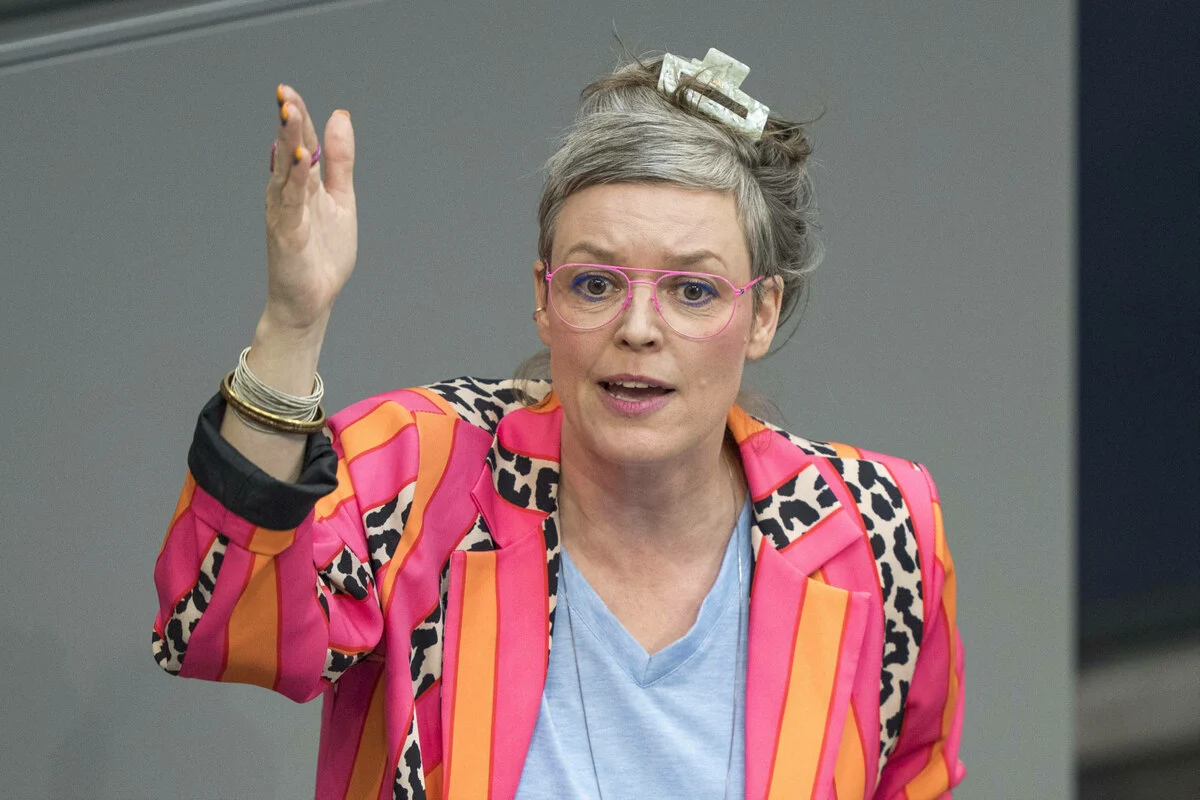
Berlin, Germany – A deepening ideological rift within Germany’s Left Party (Die Linke) has culminated in a stark demand from a prominent Bundestag member, Katalin Gennburg, for the resignation of Berlin state parliamentarian Vanessa Emde. Gennburg asserts that Emde’s alleged solidarity with an individual accused of "terror glorification" and her refusal to unequivocally affirm Israel’s right to exist have crossed an unacceptable boundary, imperiling the party’s credibility and fostering severe internal divisions. The explosive call underscores the profound challenges Die Linke faces in navigating the highly sensitive discourse surrounding the Israeli-Palestinian conflict, a debate that has already seen the party grappling with accusations of antisemitism and internal fragmentation.
Speaking to the taz, Gennburg, a former member of the party’s federal executive board, declared, "For me, a point has been reached where I think, enough is enough. We must draw a line under this unspeakable debate and thereby end the campaign against our party itself." Her unequivocal statement targets Emde’s alleged alignment with Ibrahim Ibrahim, an individual Gennburg explicitly accuses of "glorifying Hamas." This, she argues, makes Emde’s continued tenure as an elected representative untenable.
The controversy is not merely an isolated incident but the latest flashpoint in a series of disputes that have plagued Die Linke, particularly since the October 7th Hamas attacks on Israel. The party, known for its strong left-wing and anti-militarist stances, has found itself deeply divided over how to respond to the escalating conflict, with some factions emphasizing Palestinian rights and criticism of Israeli policy, while others, including Gennburg, prioritize the condemnation of terror and the affirmation of Israel’s right to exist. Gennburg’s demand represents a significant escalation, pushing for concrete consequences for those deemed to have violated the party’s core principles.
The Core Dispute: Allegations of Terror Glorification and Israel’s Right to Exist
At the heart of Gennburg’s demand lies the accusation that Vanessa Emde has demonstrated solidarity with Ibrahim Ibrahim, whom Gennburg explicitly links to "terror glorification," specifically referencing Hamas. While the interview does not delve into the precise details of Ibrahim’s alleged statements or actions, the context implies severe allegations that are considered beyond the pale for a mainstream German political party. Gennburg’s primary contention is that Emde’s refusal to distance herself from such an individual creates an untenable situation, dragging the entire party into disrepute.
Gennburg did not mince words: "If members of Die Linke solidarize with people like Ibrahim Ibrahim, as the Berlin parliamentarian Vanessa Emde does, they cross a line. Vedi [Vanessa Emde’s nickname] refuses to distance herself from Ibrahim, which is why I am of the opinion that she should give up her mandate." She stressed the urgency of the situation, adding, "This Ibrahim glorifies Hamas. We cannot accept being associated with terror glorifiers as an entire party because of such isolated statements."

Beyond the specific association with Ibrahim Ibrahim, Gennburg also criticizes Emde for allegedly denying Israel’s right to exist – a position that is considered an absolute taboo across the German political spectrum and often interpreted as antisemitic. Gennburg outlined what she considers an acceptable, critical but principled stance: "She could say something like: ‘Of course, we stand by Israel’s right to exist. Furthermore, I believe that left-wing state criticism is important.’ That would be perfectly fine. But she hasn’t done that." For Gennburg, Emde’s failure to draw a clear line against individuals and organizations seen as glorifying terror necessitates a "stop sign."
A Chronology of Controversy: Emde’s Contentious Stance
Vanessa Emde’s controversial positions on the Israeli-Palestinian conflict are not new. She has faced criticism on multiple occasions, indicating a pattern of behavior that has fueled internal dissent within Die Linke.
From Election Party to Spiegel Interview: Escalating Tensions
One significant point of contention mentioned by Gennburg was an "election party in September," where Emde’s conduct or statements presumably drew fire. While the specific details of this incident are not elaborated in the interview, it is presented as part of a recurring pattern of controversial behavior. Such incidents have evidently contributed to a growing sense of unease and frustration among party members.
The immediate catalyst for Gennburg’s public demand, however, appears to be a recent Spiegel interview with fellow Die Linke politician Elif Eralp. Gennburg explicitly stated, "That became clear last week with Elif Eralp’s Spiegel interview. That changed something, for me personally too." Eralp’s interview evidently detailed experiences of fear and threats related to her political work, which deeply resonated with Gennburg.
Gennburg elaborated on her personal connection to Eralp’s plight, revealing her own experiences with political intimidation: "I know what it’s like to be afraid as a politician. I, too, as a politician, had to take protective measures because of threats when there were calls to publish my address in right-wing chats." She also recalled feeling vulnerable when challenging powerful construction companies: "Even when I took on the biggest construction moguls, I thought: ‘Oh God, oh God, am I actually putting myself in danger when I put a stop to such powerful people?’" Hearing that Elif Eralp "fears, also for her family, deeply shook me." This shared experience of vulnerability and political pressure seems to have solidified Gennburg’s resolve to demand a clear stance from the party and its members. The perception that Emde’s actions contribute to an atmosphere where colleagues feel unsafe adds another layer of gravity to the internal conflict.
The Mandate and Party Discipline: A Question of Principle
Gennburg’s arguments extend beyond the immediate issue of Emde’s statements, touching upon fundamental principles of party discipline, collective responsibility, and the very nature of a political mandate within Die Linke.
Rebellious Spirit vs. Collective Responsibility
Die Linke prides itself on its grassroots democratic approach and a "rebellious" spirit, often allowing for robust internal debate and dissent. Gennburg, herself a seasoned politician who has previously challenged figures within her own party, such as Klaus Lederer, acknowledges this core aspect of Die Linke’s identity. "Yes, of course, I am totally for rebellious, grassroots democratic politics," she affirmed.
However, Gennburg draws a critical distinction between legitimate internal opposition and outright defiance of fundamental party decisions. She emphasizes the inherent responsibility that comes with holding an elected office: "But I have always ultimately supported the joint decisions. It is the damned duty of politicians to do exactly that; we are, after all, elected representatives." This highlights a tension between individual freedom of expression and the collective mandate of the party.
From Gennburg’s perspective, a political mandate is not a personal platform but a trust bestowed by the party and its voters. She articulated a key principle of Die Linke’s self-conception, particularly prevalent on its left wing: "A mandate is not private property, but is always won in cooperation with the party, supported by many activists." This perspective suggests that an elected representative has a duty to uphold the party’s agreed-upon positions and values, even when they might personally hold differing views. When an individual consistently deviates from these core tenets, especially on issues as sensitive as "terror glorification" or the existence of a state, their mandate becomes problematic.
Gennburg went further, accusing Emde of prioritizing personal gain over party unity: "But Emde is no longer concerned with substantive issues, but only with self-profiling and division." This suggests that Emde’s actions are perceived not as principled dissent but as a deliberate attempt to carve out a distinct, potentially divisive, political identity at the expense of party cohesion.

Red Lines: Ibrahim Ibrahim and Israel’s Right to Exist
For Gennburg, Emde’s actions constitute a breach of explicit "red lines" for Die Linke. The two central violations, as identified by Gennburg, are Emde’s "solidarity with Ibrahim Ibrahim" and her alleged "denial of Israel’s right to exist." These are not seen as mere differences of opinion but as fundamental departures from core party values and broader democratic consensus in Germany.
The German political landscape places a high premium on Israel’s security and its right to exist, largely due to Germany’s historical responsibility concerning the Holocaust. Any perceived denial of this right or solidarity with groups deemed terroristic is met with severe condemnation. Gennburg’s insistence on Emde explicitly affirming Israel’s right to exist, while allowing for "left-wing state criticism," highlights this delicate balance. Emde’s failure to do so, according to Gennburg, makes her position within the party untenable. "She draws no line to Ibrahim Ibrahim and terror-glorifying organizations. A stop sign must be set there," Gennburg reiterated, emphasizing the need for unambiguous clarity.
The Path to Exclusion: Precedents and Reluctance
While Gennburg directly calls for Emde’s resignation from her mandate, the natural next question involves her status within the party itself. When asked if she also advocated for Emde’s party exclusion, Gennburg stated, "That is the task of other people." However, she quickly added that she would support such a move.
A Reluctant Endorsement of Party Expulsion
Gennburg’s stance on party exclusion is informed by her past experiences with similar internal conflicts. She revealed, "I co-filed the motion for Sahra Wagenknecht’s party exclusion back then because there was no other way. I’m really not keen on constantly filing motions for party exclusions." This statement is significant, as the attempt to expel Sahra Wagenknecht was one of the most high-profile and divisive internal battles in Die Linke’s recent history, ultimately leading to Wagenknecht’s departure and the formation of her own party. Gennburg’s reference to this precedent suggests that she views Emde’s case as similarly intractable and damaging to the party’s future.
The Wagenknecht case highlighted the profound difficulties Die Linke faces in managing internal dissent, particularly when it touches upon fundamental ideological questions or when prominent members are perceived to be actively undermining the party’s cohesion and public image. Gennburg’s reluctance to engage in another expulsion process, yet her willingness to support it, underscores the gravity of the current situation with Emde. It implies that for Gennburg, Emde’s actions have reached a point where the damage to the party outweighs the internal costs of an expulsion process.

Electoral Impact and Party Unity: The Neukölln Debate
The internal conflict also touches upon the strategic question of electoral success and the party’s appeal to diverse voter bases. Some argue that Emde’s outspoken "Palestine-solidary" positions might have contributed to Die Linke’s success in certain districts, such as Neukölln, which has a significant immigrant population. Gennburg strongly challenges this narrative.
Challenging the "Palestine Solidarity" Narrative in Neukölln
Gennburg dismissed the notion that Emde’s specific positions were a decisive factor in electoral victories. "We have no solid election analysis yet, which means it is not at all proven whether Die Linke, for example in Neukölln, was elected for its solidarity with Gaza," she stated.
She provided a historical perspective, emphasizing that Die Linke’s strength in Neukölln predates Emde’s candidacy and the recent escalation of the Middle East conflict. "In the constituency where Vedi ran, Die Linke was strong long before her candidacy; we had almost 30 percent in the previous election," Gennburg explained. She attributed the party’s success in the district to years of sustained grassroots activism: "She didn’t just run and suddenly became the coolest; rather, in Neukölln, long before October 7th and also before Ferat Kocak’s candidacy, members of Die Linke started doing door-to-door campaigns and organizing in the neighborhood years ago. The success in Neukölln was hard-earned over a decade – and not by Vedi Emde."
Gennburg further argued that the overall electoral context in Berlin contributed to Die Linke’s performance, citing a general "mood for change." She concluded that it was "presumptuous and arrogant to stand up and say, because I am so pro-Palestinian, we won Neukölln." This argument aims to decouple Emde’s individual stance from the party’s collective electoral efforts, thereby diminishing the leverage Emde might perceive her popularity to grant her.
The Quest for Internal Cohesion
The potential exclusion of Emde raises concerns about further deepening the party’s internal divisions, especially given the already fragile state of Die Linke after the departure of Wagenknecht and her faction. However, Gennburg believes that addressing the issue directly might, paradoxically, lead to greater unity.

"I know my party very well. We have 130,000 members," Gennburg asserted. "I know that there are many members who are waiting for these squabbles to stop and for the legitimate demand of many members to be met, that we now come together and implement the election promises." This suggests that a decisive action against Emde could be seen as a necessary step to restore focus and morale among the majority of members who are weary of internal disputes.
Gennburg also clarified that Die Linke’s official positions on the Middle East allow for a spectrum of views, but with clear boundaries. "Our decisions allow for a broad corridor of opinion on the Middle East," she said, highlighting that Emde’s positions stand out. "But apart from Emde, there is really no one in the current parliamentary group in the Abgeordnetenhaus who holds such positions."
She drew a contrast with other "Palestine-solidary" members, such as Martha Kleedörfer, who, despite holding "contentious positions" (like proposing to hoist a Palestinian flag in front of Mitte City Hall), has always engaged in "democratic discourse and always within the framework of the party." This distinction is crucial: it’s not about criticizing Israel or expressing solidarity with Palestinians per se, but about doing so within the established democratic and ethical boundaries of the party and German society. "There are many people in Die Linke who say: Palestine solidarity, yes. Terror glorification? No. We as Die Linke now simply have to establish clarity on that," Gennburg concluded, underscoring the urgent need for the party to define its red lines unequivocally.
Implications and Outlook for Die Linke
Katalin Gennburg’s demand for Vanessa Emde’s resignation signals a critical juncture for Die Linke, a party already struggling with its identity and political relevance in Germany. The immediate future holds uncertainty for Emde, who now faces immense pressure from within her own ranks. Her refusal to comply could trigger formal party proceedings, including a potential motion for exclusion, which would likely be a protracted and divisive battle.
A Party at a Crossroads
The broader implications for Die Linke are significant. The party is at a crossroads, forced to confront fundamental questions about its core values, internal cohesion, and public image. Having recently lost a significant faction with Sahra Wagenknecht’s departure, Die Linke can ill-afford further fragmentation. However, allowing positions perceived as tolerating "terror glorification" or denying Israel’s right to exist to persist without consequences could be even more damaging, alienating mainstream voters and reinforcing negative stereotypes about the party.

The dispute also reflects the profound challenge for left-wing parties in Europe to navigate the Israeli-Palestinian conflict, a topic that often exposes deep ideological fault lines between anti-imperialist solidarity with Palestinians and the unequivocal condemnation of antisemitism and terrorism. Gennburg’s call for clarity is an attempt to firmly anchor Die Linke within the consensus of democratic parties in Germany, emphasizing its commitment to combating antisemitism and rejecting violence.
Ultimately, how Die Linke resolves this internal conflict will have lasting consequences. It will determine not only the future of Vanessa Emde but also the party’s ability to present a unified front, rebuild trust with the electorate, and redefine its ideological boundaries in an increasingly complex political landscape. The pursuit of "clarity against terror glorification," as Gennburg frames it, may be a painful but necessary step for Die Linke to secure its future amidst ongoing internal and external pressures.