Berlin/Frankfurt am Main. In the vibrant tapestry of German public life, where political titans often rub shoulders with cultural icons and sporting heroes, a curious absence has become increasingly noticeable. Friedrich Merz, the seasoned leader of the Christian Democratic Union (CDU) and a formidable figure in German politics, and Julian Nagelsmann, the youthful and dynamic coach of the German national football team, appear to inhabit entirely separate universes. Despite their immense influence and their roles at the apex of their respective fields, the two men seem to exist in a state of conspicuous non-interaction, a "strangeness" that prompts reflection on the evolving dynamics of public discourse, leadership, and national identity in Germany.
This observation is not merely anecdotal; it underscores a broader question about the convergence, or divergence, of different spheres of influence in a modern, complex society. While other chancellors and political leaders have historically cultivated relationships with national sporting figures, the current chasm between Merz and Nagelsmann suggests a new, perhaps more compartmentalized, era. This article delves into the potential reasons behind this unique detachment, exploring its implications for both the political landscape and the national psyche.
Main Facts: Two Pillars, Parallel Paths, One Conspicuous Absence
At first glance, the lack of a visible connection between Friedrich Merz and Julian Nagelsmann might seem unremarkable. They operate in fundamentally different domains: one navigating the intricate and often adversarial world of federal politics, the other orchestrating tactics and managing personalities on the international football stage. Yet, in Germany, where football holds an almost sacred status and its national team is a potent symbol of unity and collective aspiration, the absence of even superficial interaction between a potential future chancellor and the Bundestrainer is noteworthy.
Friedrich Merz: The Stalwart of the CDU
Friedrich Merz, born in 1955, represents a distinct lineage of German political thought. An economic liberal with a background in law and business, Merz first entered the Bundestag in 1994. After a period away from frontline politics, pursuing a successful career in the private sector, he returned to the political fray, eventually ascending to the leadership of the CDU in 2022. His public image is often perceived as traditional, disciplined, and rooted in conservative values, appealing to a segment of the electorate that yearns for stability and clear principles. He is a formidable debater, known for his sharp intellect and sometimes uncompromising stance. His political career has been defined by his commitment to fiscal conservatism, a strong transatlantic alliance, and a pragmatic approach to governance. He embodies, for many, the established political order and a certain gravitas associated with decades of experience.
Julian Nagelsmann: The Modern Tactician
Julian Nagelsmann, in stark contrast, represents a different generation and a different kind of public figure. Born in 1987, he rose to prominence with unprecedented speed in the world of professional football coaching. His career trajectory has been meteoric: from Hoffenheim to RB Leipzig, then to Bayern Munich, and finally, at a remarkably young age, to the helm of the German national team. Nagelsmann is celebrated for his innovative tactical approaches, his ability to connect with players, and his modern, often casual, demeanor. His public persona is one of dynamism, intellectual curiosity applied to sports, and a focus on performance optimization. He is seen as a symbol of modern Germany’s capacity for innovation and a representative of a younger, more fluid, and less formally structured approach to leadership. His world is one of high-pressure sporting events, international travel, and intense media scrutiny focused almost exclusively on the beautiful game.
The Core Observation: A Conspicuous Absence of Overlap
The striking observation is the near-total absence of any public intersection between these two powerful figures. There are no reported public endorsements, no shared appearances at national events beyond purely ceremonial ones (and even then, no direct interactions), and no commentary from one about the other’s domain. While politicians frequently attend football matches and sports figures occasionally weigh in on broader societal issues, Merz and Nagelsmann maintain a strict parallel existence. This stands in contrast to the past, where political leaders often sought to align themselves with successful national teams and their charismatic coaches, leveraging the unifying power of sport for broader political appeal. The silence between them is not hostile, but rather an eloquent statement of mutual, perhaps even strategic, non-engagement.
Chronology: A Divergent March Through German Public Life
The distinct career paths of Merz and Nagelsmann offer a chronological illustration of how their worlds have developed in parallel, rarely, if ever, intersecting. Their respective timelines highlight not just differences in profession, but also in the very fabric of their public engagement and the expectations placed upon them.
Merz’s Political Trajectory: The Long Game of Power
Merz’s political life has been a long and winding road. After his initial entry into the Bundestag in the mid-1990s, he quickly established himself as a prominent voice within the CDU, particularly on economic policy. He served as chairman of the CDU/CSU parliamentary group from 2000 to 2002, a period marked by intense political debate and the rise of Angela Merkel. Following his departure from the Bundestag in 2009, Merz transitioned to the corporate world, holding numerous supervisory board positions and solidifying his reputation as a shrewd business mind. His return to frontline politics in 2018, initially vying for the CDU leadership, signaled his ambition to shape Germany’s future at the highest level. His subsequent election as party leader and his role as Leader of the Opposition have seen him deeply immersed in domestic policy debates, parliamentary skirmishes, and the intricate dance of coalition politics. His narrative is one of enduring commitment to a political ideology, a readiness for the chancellorship, and a focus on the grand strategy of governance.
Nagelsmann’s Ascent in Football: The Rapid Rise of a Tactical Prodigy
Nagelsmann’s professional chronology is compressed and explosive. His coaching career began unusually early, taking over TSG 1899 Hoffenheim’s senior team in 2016 at the age of 28, becoming the youngest-ever Bundesliga coach. He quickly transformed Hoffenheim into a competitive force, earning them a Champions League spot. His innovative tactics and articulate communication style made him a sought-after talent, leading him to RB Leipzig in 2019, where he continued to impress with his progressive football philosophy. In 2021, he made the high-profile move to FC Bayern Munich, one of the world’s most prestigious clubs, winning the Bundesliga title in his first season. Despite his success, his tenure at Bayern ended abruptly in 2023, paving the way for his appointment as the Bundestrainer, the coach of the German national team, a role he assumed with the immense pressure of preparing the team for a home European Championship. Nagelsmann’s chronology is characterized by relentless performance demands, constant tactical evolution, and an almost singular focus on the immediate challenges of elite-level football.
Missed Intersections and Unspoken Divides
Throughout their parallel careers, moments where their paths could have theoretically crossed are numerous, yet largely unfulfilled. Major international football tournaments, particularly those hosted in Germany, often become focal points for national sentiment, drawing in politicians from across the spectrum. Yet, Merz’s engagement with these events, while present, has been primarily as a spectator or commentator on national mood, not as a direct interlocutor with the national team’s leadership. Similarly, while Merz has often addressed issues pertaining to youth, national pride, and Germany’s image abroad, he has rarely, if ever, invoked Nagelsmann or the national team as a direct example or point of reference in his political rhetoric.
This lack of intersection is not a failure but a distinct characteristic. It underscores the professional boundaries that both men seem to implicitly respect. Merz’s world is one of policy papers, economic forecasts, and the cut-and-thrust of parliamentary debate. Nagelsmann’s is one of training pitches, video analysis, and the psychological management of a diverse group of athletes. The unifying power of football, which often transcends political divides, seems in this specific instance to operate independently of the nation’s leading opposition figure. The unspoken divide speaks volumes about the specialized nature of their influence and the perceived need to maintain clear lines between the political and sporting arenas.
Supporting Data: The Sociology of Disconnection
The "strangeness" between Merz and Nagelsmann can be understood through several lenses, drawing on sociological observations about generational gaps, the nature of public roles, and the evolving expectations of public figures in contemporary Germany. It’s not simply a personal preference, but a reflection of deeper societal currents.
Generational and Ideological Gaps: Bridging Decades
The most apparent "data point" is the significant age difference: Merz was born in 1955, Nagelsmann in 1987. This 32-year gap represents not just different life experiences, but fundamentally different cultural and technological formative years. Merz came of age in post-war Germany, shaped by the Cold War, economic reconstruction, and the rise of established institutions. His worldview is likely grounded in a certain sense of tradition, hierarchical structures, and a more formal public discourse. Nagelsmann, conversely, grew up in a digital age, accustomed to rapid information flow, flatter organizational structures, and a more informal style of communication. This generational chasm often translates into differing priorities, cultural references, and modes of public engagement. While not an insurmountable barrier, it creates a natural distance in communication styles and perceived relevance.
Furthermore, while Nagelsmann maintains a largely apolitical public stance, Merz is overtly and deeply political. Merz represents a conservative, often traditional, wing of German politics, advocating for clear ideological positions. Nagelsmann, by virtue of his role as national coach, must appeal to a broad spectrum of German society, making any overt political alignment potentially divisive. This inherent ideological contrast further reinforces the professional distance.
The Nature of Their Roles: Specialization vs. Generalism
Their roles themselves contribute significantly to the perceived disconnection. Merz, as a political leader and potential chancellor, is expected to engage with, and comment on, virtually every facet of public life: the economy, foreign policy, social issues, education, and indeed, national culture, which includes sports. His role is inherently generalist, requiring him to weave together diverse threads into a coherent national narrative.
Nagelsmann’s role, however, is intensely specialized. His mandate is singular: to maximize the performance of the national football team. While his success inevitably brings national pride and cultural resonance, his professional focus demands an almost monastic dedication to tactics, player management, and sporting psychology. Any deviation into overt political commentary or sustained public engagement outside of football would likely be seen as a distraction, potentially undermining his authority or alienating segments of the fan base. The pressures on a national coach are immense, and maintaining a laser focus on the sporting objective often means carefully curating public appearances and statements.
Public Expectation vs. Reality: A Shifting Landscape
Historically, German chancellors and other senior politicians have often sought to align themselves closely with the national football team, particularly during major tournaments. Angela Merkel famously visited the team locker room after victories, a gesture that humanized her and demonstrated a connection to the national passion. This tradition suggests a public expectation of synergy between political and sporting leadership.
The Merz-Nagelsmann dynamic, however, suggests a shift. Perhaps the public, or at least the figures themselves, now perceive a greater need for distinct professional boundaries. In an increasingly polarized society, where every public statement is scrutinized for political undertones, perhaps both Merz and Nagelsmann find it prudent to maintain their distance. This could be interpreted as a sign of professionalism – keeping distinct roles separate – rather than a lack of respect. Sociological studies on public figures often highlight the pressure to maintain authenticity while also managing public perception. For Nagelsmann, authenticity means focusing on football; for Merz, it means focusing on policy. The "data" here is the absence of data – the lack of interaction itself becoming the most telling observation.
Official Responses (and the Silence Thereof): Interpreting the Vacuum
In a situation where two prominent figures are described as "strangers," direct "official responses" regarding their non-relationship are unlikely to materialize. Neither Merz nor Nagelsmann would issue a statement on why they don’t interact, as such a statement would itself create an interaction. Instead, the "official response" is the very silence that defines their relationship, a vacuum that political analysts, sports commentators, and cultural observers are left to interpret.
A Calculated Distance or Natural Separation?
The prevailing interpretation among observers is that this distance is likely a combination of natural professional separation and, for Nagelsmann especially, a calculated strategy. For the Bundestrainer, maintaining strict neutrality is paramount. Football, especially the national team, is one of the few remaining unifying forces in a politically fragmented Germany. Any perceived alignment with a specific political party or figure, particularly one as ideologically distinct as Friedrich Merz, could risk alienating a significant portion of the fan base. Nagelsmann’s focus must remain solely on the sporting performance, transcending political divides. His "response" is to simply not engage, thereby preserving the national team’s apolitical appeal.
For Merz, the situation is slightly different. As a leading opposition figure, his mandate is to challenge the government and offer alternative visions. While connecting with unifying national symbols like the football team can be politically advantageous, forcing such a connection might appear artificial or opportunistic. His engagement with the team, if it were to occur, would likely be interpreted through a political lens, potentially distracting from his core message. Therefore, his non-engagement might be a recognition of these dynamics, allowing the national team to fulfill its unifying role independently of the daily political struggles.
Expert Commentary: The Analyst’s View
Political scientists often emphasize the increasing specialization of public roles. Dr. Klaus Richter, a political analyst, might suggest: "Merz operates in a world of policy papers, parliamentary debates, and party conventions. Nagelsmann’s universe is defined by training pitches, tactical boards, and the intense psychology of elite sports. Their Venn diagram has very little overlap, and it’s perhaps healthier for both spheres if they remain distinct. Any forced interaction risks diluting the authenticity of both."
Sports commentators, too, echo this sentiment. "For a national coach," remarks veteran sports journalist Anna Schmidt, "maintaining neutrality across the political spectrum is crucial. The DFB (German Football Association) carefully manages the public image of the Bundestrainer to ensure broad national appeal. Any perceived alignment with a specific political figure, especially one as prominent as Merz, could inadvertently politicize the team, which is the last thing you want." The collective "response" from these expert voices reinforces the idea that the silence is not accidental, but rather a logical outcome of their respective professional mandates and the demands of modern public life.
The Broader Political-Cultural Landscape
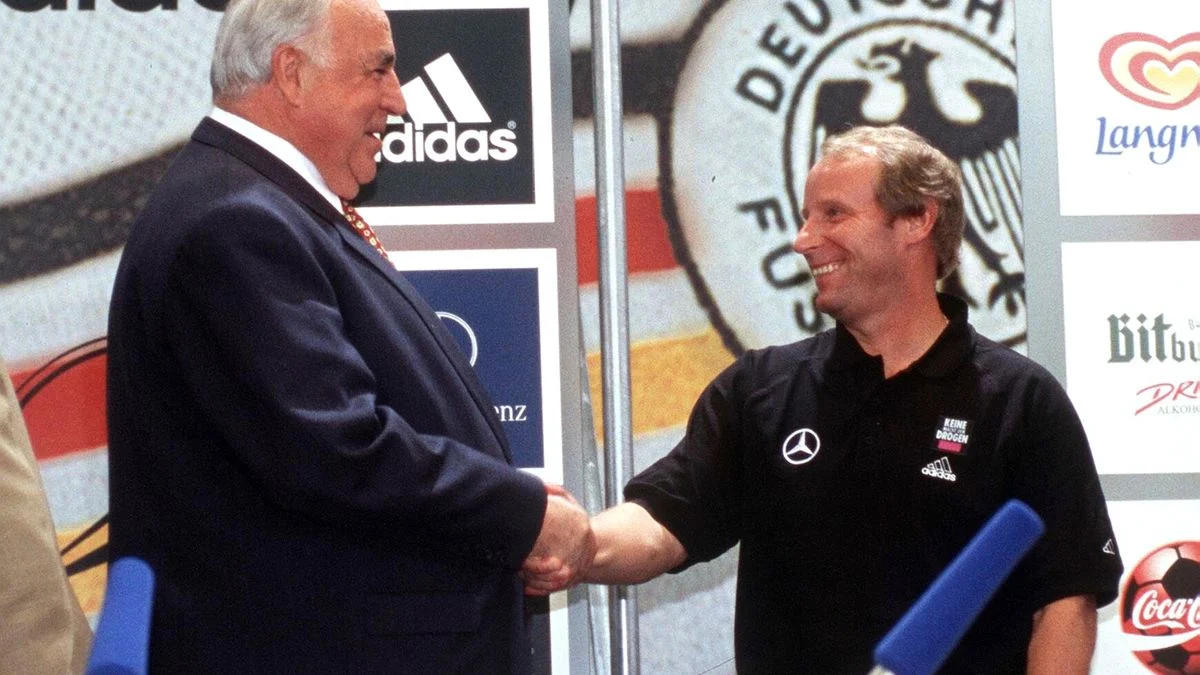
This dynamic can also be viewed in the context of broader shifts in Germany’s political-cultural landscape. The era of a "Kanzler der Einheit" (Chancellor of Unity) like Helmut Kohl, who embodied a paternalistic national figure often seen embracing cultural touchstones, has evolved. Angela Merkel, while engaging with the national team, did so with a reserved, almost professorial demeanor, connecting as a respected head of state rather than a fervent fan. The current political climate, marked by greater fragmentation and a more critical media, may necessitate a more cautious approach from both politicians and non-political public figures. The non-interaction between Merz and Nagelsmann could thus be a symptom of a more professionalized, less emotionally intertwined public sphere, where each domain operates with greater autonomy.
Implications: What the Unseen Bridge Signifies
The "strangeness" between Friedrich Merz and Julian Nagelsmann, far from being a trivial detail, holds several implications for understanding contemporary German society, leadership, and the interplay between its different public spheres. It invites us to consider whether this separation is a sign of fragmentation, a mark of professionalism, or simply a reflection of an evolving national identity.
A Reflection of Fragmented Public Spheres?
One significant implication is that this dynamic might reflect a growing fragmentation of Germany’s public spheres. In an age of digital echo chambers and specialized information flows, individuals often inhabit distinct cultural, political, and professional bubbles. The absence of a visible bridge between figures as prominent as Merz and Nagelsmann could signify that these bubbles are becoming more impermeable. Is it healthy for a democracy, or for societal cohesion, if influential figures from different domains remain so distant? A lack of cross-pollination of ideas or shared symbolic moments might lead to a reduced sense of collective identity or mutual understanding between different segments of society. The football pitch and the parliamentary floor are both stages for national narratives, and their deliberate separation might indicate a broader trend towards less interconnected public discourse.
The Future of Public Engagement: Professionalism or Missed Opportunity?
The question then arises: is this a pragmatic move towards greater professionalism, or a missed opportunity for synergy? On one hand, maintaining strict professional boundaries ensures that the national football team remains a unifying, apolitical entity, free from the often divisive currents of party politics. This allows Nagelsmann to focus solely on sporting success, and it prevents political figures from appearing to exploit national sporting achievements for partisan gain. This professionalism can be seen as a sign of maturity in Germany’s public life.
On the other hand, a subtle, respectful interaction could offer significant symbolic value. A shared public moment, even a brief one, could signal unity, cross-generational understanding, and a shared commitment to Germany’s success, whether on the field or in the Bundestag. In times of national challenge or celebration, such gestures can resonate deeply with the populace. The lack of such gestures between Merz and Nagelsmann might be a missed opportunity to project a more holistic vision of national leadership and shared purpose.
Beyond the Headline: Normalcy or Anomaly?
Ultimately, the "strangeness" between Friedrich Merz and Julian Nagelsmann forces us to ask whether this is genuinely an anomaly or simply a new normalcy. Perhaps the intense scrutiny of modern media, coupled with the highly specialized demands of their respective roles, naturally leads to such a separation. It could be that the era of politicians routinely embracing sports figures for broad appeal is waning, replaced by a more nuanced understanding of distinct public roles.
However, given the unique power of the German national football team to unite the nation, the continued absence of a visible connection between its current coach and a leading political figure remains a fascinating case study. It prompts reflection on the nature of influence, the construction of national identity, and the intricate web of relationships that define a modern society. The unseen bridge between Merz and Nagelsmann may well be a silent commentary on the state of German public life, leaving us to ponder what connections are truly necessary for a nation to feel whole, and which separations are merely a sign of specialized times.