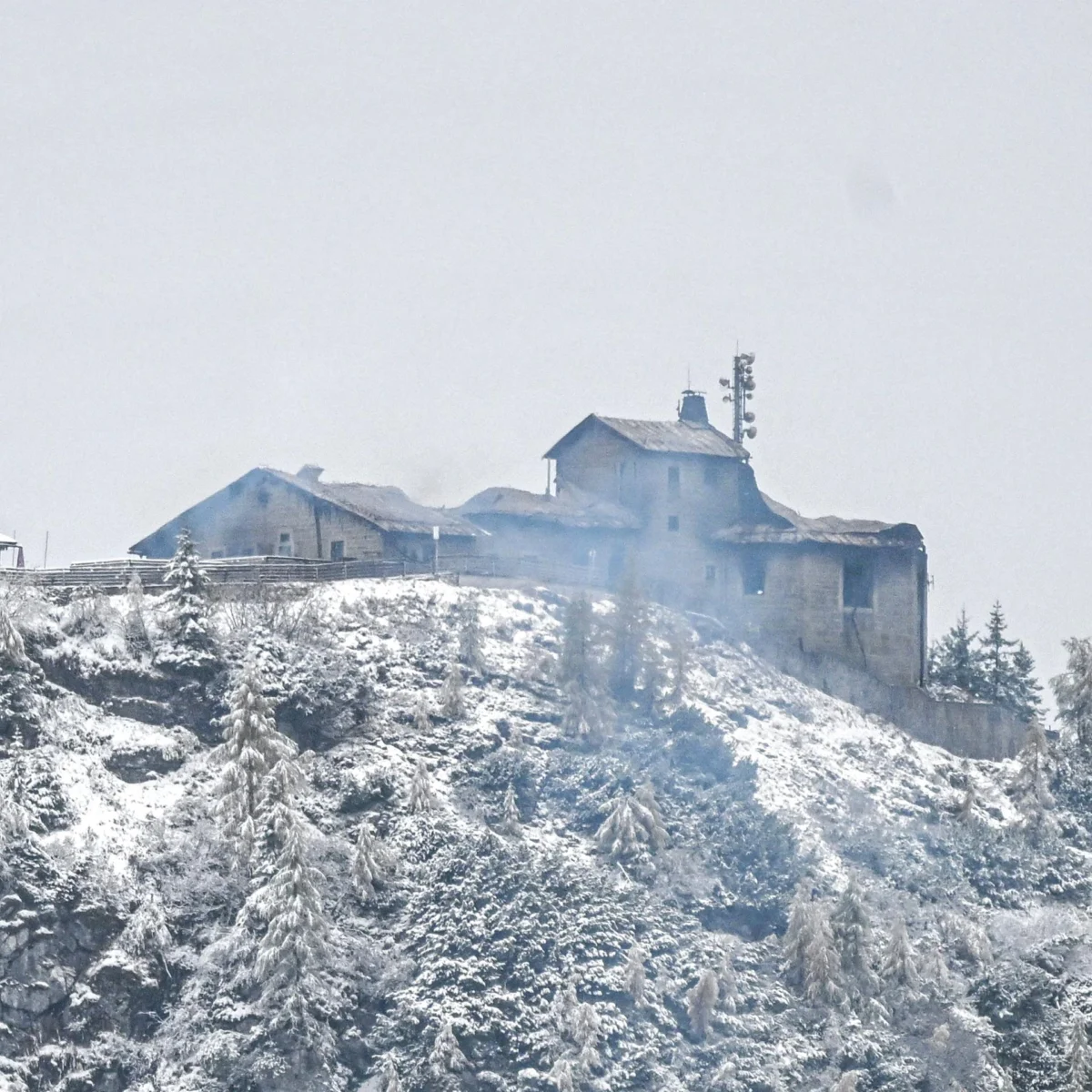
BERCHTESGADEN, Bavaria – In a development that has sent ripples through Germany’s cultural and historical preservation circles, an expert commission is set to spearhead the ambitious and historically sensitive reconstruction of the Kehlsteinhaus, famously known as the Eagle’s Nest, near Berchtesgaden. The iconic mountain retreat, a notorious relic of the Nazi regime, was almost entirely consumed by fire in a suspected arson attack in the early hours of Saturday morning.
Bavaria’s Minister for Arts and Science, Markus Blume, underscored the profound significance of the decision, stating that the building must be preserved "as a testament to history and a place of enlightenment for future generations." This commitment reflects Germany’s enduring struggle to confront and responsibly manage the tangible remnants of its darkest chapter. The incident, which saw a 33-year-old man arrested in connection with the blaze, has reignited complex debates surrounding the purpose and presentation of such historically charged sites.
The announcement, made on October 27, 2026, marks a pivotal moment for a structure that, despite its sinister origins, has evolved into both a popular tourist attraction and a crucial, albeit controversial, touchstone for historical education. The road to rebuilding will not merely involve architectural and engineering challenges but will navigate the delicate ethical landscape of reconstructing a monument inextricably linked to the Third Reich.
Main Facts: A Landmark Ablaze and the Path Forward
The Kehlsteinhaus, perched majestically at an elevation of 1,834 meters on a subpeak of the Hoher Göll, was severely damaged in a fire that investigators believe was deliberately set. The blaze, which erupted in the early hours of last Saturday, ravaged the structure, leaving behind a smoking shell of what was once a grand, albeit infamous, architectural marvel. Preliminary assessments indicate near-total destruction, a devastating blow to a site that has for decades served a dual purpose as a panoramic mountain restaurant and a stark reminder of Nazi power.
In response to this profound loss, the Bavarian state government has moved swiftly to establish an expert commission. This high-level body will be tasked with the meticulous preparation and oversight of the Kehlsteinhaus’s reconstruction. The decision to rebuild, rather than demolish, underscores a deliberate commitment to confronting rather than erasing a difficult past.
Minister Blume, a prominent figure within the Christian Social Union (CSU), emphasized the unique historical burden carried by the Kehlsteinhaus. "The house was built as a representative building of the Nazi regime and is inextricably linked to National Socialist rule," Blume stated, adding a crucial caveat: "A reconstruction must do justice to this historical responsibility." This statement lays the groundwork for a rebuilding effort that will prioritize educational integrity and critical remembrance over any potential for glorification.
The proposed expert commission will comprise specialists from diverse fields, including monument preservation, construction engineering, and remembrance culture. Their collective expertise will be vital in navigating the technical complexities of rebuilding a remote mountain structure while ensuring its future role as a site of critical historical engagement. Currently, efforts are focused on assessing the full extent of the damage and securing any remaining historical building substance. This foundational work will then inform the rapid development of a comprehensive reconstruction concept.
The fire and the subsequent decision to rebuild have thrust the Kehlsteinhaus back into the global spotlight, prompting reflection on how societies grapple with architectural legacies of tyranny. The reconstruction project is set to become a significant undertaking, not just for its engineering challenges but for its profound symbolic implications in Germany’s ongoing process of Vergangenheitsbewältigung – coming to terms with the past.
Chronology of a Crisis and Commitment
The events leading to the decision to reconstruct the Kehlsteinhaus unfolded rapidly, beginning with the devastating inferno and culminating in a firm commitment from the Bavarian state government.
Early Saturday Morning, October 25, 2026:
The tranquility of the Berchtesgaden Alps was shattered as a massive fire erupted at the Kehlsteinhaus. Emergency services, including multiple fire brigades from the surrounding districts, were alerted shortly after midnight. Responding to a fire at such a high altitude and remote location presented immediate and significant logistical challenges. Firefighters battled fiercely against the raging inferno, exacerbated by strong mountain winds and the building’s exposed position. Despite their valiant efforts, the structure, primarily built with combustible materials, was almost entirely consumed within hours. The iconic eagle’s nest, a symbol of both natural beauty and historical horror, was reduced to a smoldering ruin.
Saturday, October 25, 2026:
As dawn broke, revealing the extent of the destruction, investigators from the Traunstein police department and public prosecutor’s office immediately launched an inquiry into the cause of the fire. Initial assessments quickly pointed towards arson. Forensic teams began sifting through the charred remains, and witness statements were collected. Later that day, police announced a significant breakthrough: a 33-year-old man had been arrested in connection with the fire. While details remained sparse, the Traunstein Public Prosecutor’s Office indicated that there were "indications of a psychological illness" in the suspect, adding a complex layer to the tragic event.
Sunday, October 26, 2026:
Amidst the shock and sorrow, the first official statements regarding the future of the Kehlsteinhaus began to emerge. Bavaria’s Interior Minister, Joachim Herrmann (CSU), was among the first to publicly declare the state’s intent. He unequivocally stated that the "historically significant building must be rebuilt." This early commitment from a senior government official signaled the gravity with which the Bavarian state viewed the incident and its determination to preserve the site.
Monday, October 27, 2026:
The decision for reconstruction was formally solidified and elaborated upon by Markus Blume, Bavaria’s Minister for Arts and Science. Speaking to the Deutsche Presse-Agentur (dpa), Blume outlined the strategic approach: the establishment of an expert commission. He articulated the dual imperative of preserving the building as a historical witness while ensuring its role as a site of enlightenment. This official announcement provided the framework for the path forward, emphasizing a methodical and historically conscious reconstruction process.
Ongoing (Weeks Following):
The immediate focus shifted to the practicalities of the situation. Experts from various state agencies, including the Bavarian State Office for Monument Preservation, began their preliminary work. This involved a detailed damage assessment, carefully documenting the destruction and identifying any parts of the historical structure that could potentially be salvaged or used as a basis for reconstruction. Simultaneously, efforts commenced to secure the site, preventing further damage from weather or unauthorized access, and preparing for the intricate planning phase that lies ahead. The expert commission, though its full roster was still being finalized, began its initial consultations, setting the stage for a prolonged and deeply symbolic reconstruction effort.
Supporting Data: A History Forged in Darkness, Transformed by Light
The Kehlsteinhaus is far more than just a building; it is a profound historical artifact, its very existence a testament to one of history’s darkest chapters. Understanding its past is crucial to appreciating the immense significance of its reconstruction.
Origins and Nazi Era Significance
The Kehlsteinhaus, often erroneously called "Hitler’s Teahouse" or "Eagle’s Nest" (a name bestowed by the Allies), was not a personal retreat for Adolf Hitler but rather a diplomatic reception house. Its construction, initiated in 1937 and completed in 1938, was a monumental engineering feat, undertaken as a 50th birthday gift to Hitler from the Nazi Party. Martin Bormann, Hitler’s private secretary, oversaw the project, which involved blasting a 6.5-kilometer winding access road through solid rock and boring a 124-meter tunnel into the mountain, leading to a lavish brass-lined elevator that ascends another 124 meters directly into the house.
The structure itself was designed to impress foreign dignitaries with its breathtaking panoramic views and the sheer audacity of its construction. However, Hitler himself reportedly visited the Kehlsteinhaus fewer than 10 times, primarily due to his fear of heights and a general aversion to the exposed location. His primary residence in the area was the Berghof, located further down the Obersalzberg.
The Kehlsteinhaus was an integral part of the broader Obersalzberg complex, which the Nazis transformed into a vast second seat of government. This complex included Hitler’s Berghof residence, SS barracks, a security zone, and extensive underground bunkers. The entire area symbolized the Nazi regime’s ambition, its embrace of spectacular architecture as a tool of propaganda, and its desire to create an isolated, impenetrable power base. The Kehlsteinhaus, with its dramatic isolation and monumental scale, perfectly encapsulated this megalomaniacal vision.
Post-War Transformation and Management of Memory
Miraculously, the Kehlsteinhaus survived World War II largely intact. Unlike the Berghof, which was heavily bombed and later demolished by the Bavarian government to prevent it from becoming a neo-Nazi shrine, the Kehlsteinhaus was spared. American forces, specifically elements of the 101st Airborne Division, captured the area in May 1945. Recognizing its unique structure and strategic location, the Allied command decided against its destruction.
In 1952, the Kehlsteinhaus was handed over to the Free State of Bavaria. A pivotal decision was made to lease it to a local tourism association, which transformed it into a mountain restaurant (Berggasthof). This conversion served a dual purpose: it made the site accessible to the public, preventing its decay, and, crucially, it neutralized its original, sinister function. By transforming it into a place of leisure and scenic enjoyment, the state aimed to strip it of its propaganda value and prevent its glorification.
This approach, however, has always been fraught with tension. For decades, visitors could enjoy a meal with stunning views, often without a full understanding of the building’s dark history. This led to ongoing debates about how best to present such a site.
The Role of the Obersalzberg Documentation Centre
A significant step in contextualizing the Kehlsteinhaus and the entire Obersalzberg area came with the opening of the Obersalzberg Documentation Centre in 1999. Located near the former site of the Berghof, this modern museum provides a comprehensive and critical examination of the history of the Obersalzberg during the Nazi era. It meticulously details the transformation of the area into Hitler’s private sphere, the crimes committed by the regime, and the broader context of National Socialism.
The Documentation Centre plays a vital role in ensuring that the beauty of the landscape and the impressive engineering of the Kehlsteinhaus do not overshadow its horrific past. Visitors to the Kehlsteinhaus are strongly encouraged to first visit the Documentation Centre, which provides the necessary historical framework to understand the "Eagle’s Nest" not as a mere tourist attraction but as a tangible piece of a criminal regime. The Centre offers guided tours and educational programs, actively engaging with the difficult legacy of the site.
The fire at the Kehlsteinhaus now presents a unique opportunity to further integrate its narrative with the critical educational mission of the Obersalzberg Documentation Centre. The reconstruction effort is thus not just about rebuilding walls but about reinforcing the walls of remembrance and critical inquiry.
Engineering and Economic Considerations
Rebuilding the Kehlsteinhaus presents considerable engineering challenges. Its exposed location at 1,834 meters means construction will be subject to extreme weather conditions, including heavy snow, high winds, and freezing temperatures for much of the year. The logistics of transporting materials and equipment up the winding Kehlsteinstraße and through the mountain tunnel to the elevator shaft are complex and costly.
Economically, the Kehlsteinhaus is a significant draw for tourism in the Berchtesgadener Land region, attracting hundreds of thousands of visitors annually. Its closure, potentially for several years, will have a noticeable impact on local tourism revenue, including the bus operators and the restaurant staff. The cost of reconstruction itself is expected to be substantial, likely running into many millions of Euros, and will require significant public funding from the Free State of Bavaria. This financial commitment further underscores the state’s deep dedication to preserving this specific piece of history.
Official Responses: A Unified Front for Remembrance
The response from Bavarian officialdom has been swift, unified, and clear: the Kehlsteinhaus will be rebuilt, but its reconstruction must serve a higher purpose of historical education and critical remembrance. This consensus reflects Germany’s long-standing policy of Vergangenheitsbewältigung, the active process of confronting and coming to terms with its Nazi past.
Bavarian State Government’s Stance
Markus Blume, Minister for Arts and Science (CSU): Minister Blume has been particularly vocal in articulating the cultural and educational imperative behind the reconstruction. His statement, emphasizing the preservation of the Kehlsteinhaus "as a testimony to history and a place of enlightenment for future generations," sets the tone for the entire project. Blume recognizes the inherent tension in rebuilding a structure with such a dark past but insists that this tension must be actively managed to prevent any form of historical revisionism or glorification. He highlighted that the building’s original function as a "representative building of the Nazi regime" demands a reconstruction that "does justice to this historical responsibility." This implies that the rebuilt Kehlsteinhaus will likely feature enhanced educational components, perhaps integrated exhibitions or interpretive displays that explicitly address its origins and the atrocities committed by the regime it served.
Joachim Herrmann, Interior Minister (CSU): Minister Herrmann’s early declaration that the "historically significant building must be rebuilt" provided immediate reassurance and signaled the state’s resolve. As Interior Minister, his statement also carries weight regarding public safety and security, especially concerning the investigation into the suspected arson and the measures taken to prevent future incidents at sensitive historical sites. His emphasis on "historically significant" acknowledges the building’s place in the collective memory, regardless of its unsavory origins.
The unified message from these two key ministers from the ruling CSU party demonstrates a broad political consensus within Bavaria that such sites, however controversial, must be maintained for their didactic value. The state’s ownership of the Kehlsteinhaus places a direct responsibility on its government to manage its legacy.
The Expert Commission’s Mandate
The formation of an expert commission is central to the state’s approach. Its composition – bringing together specialists from monument preservation (Denkmalpflege), construction engineering (Bauwesen), and remembrance culture (Erinnerungskultur) – is deliberate and crucial.
- Monument Preservation: These experts will ensure that the reconstruction adheres to the highest standards of historical accuracy, using appropriate materials and techniques to restore the building as faithfully as possible to its original appearance, while also documenting and preserving any surviving original fabric. The challenge here is balancing authenticity with the practicalities of modern construction and safety standards.
- Construction Engineering: Given the remote and challenging location, these specialists will be vital for planning and executing the complex rebuilding process, ensuring structural integrity, logistical feasibility, and long-term durability against harsh alpine conditions.
- Remembrance Culture: Perhaps the most critical component, experts in remembrance culture will guide how the rebuilt Kehlsteinhaus will function as an educational site. Their input will be crucial in designing interpretive elements, exhibitions, and educational programs that critically contextualize the building’s history. They will advise on how to prevent the site from becoming a magnet for neo-Nazis or a platform for historical revisionism, a constant concern for all Nazi-era sites in Germany. This includes developing strategies to present the history in a way that promotes critical thinking and understanding of totalitarianism.
The commission’s work will not just be about rebuilding a structure; it will be about rebuilding a narrative, ensuring that the Kehlsteinhaus serves as a potent, tangible reminder of the dangers of unchecked power and the importance of democratic values.
Implications: Rebuilding History, Confronting the Future
The decision to reconstruct the Kehlsteinhaus after the devastating arson carries profound implications, extending far beyond the physical rebuilding of a structure. It touches upon Germany’s national identity, its commitment to historical remembrance, and its ongoing role as a custodian of difficult pasts.
Symbolic Significance of Reconstruction
The reconstruction of the Kehlsteinhaus sends a powerful symbolic message, both domestically and internationally. It signifies Germany’s unwavering commitment to confronting its history, no matter how uncomfortable or dark. By choosing to rebuild rather than demolish, Bavaria reinforces the principle that tangible sites of historical trauma must be preserved as educational tools. Erasing such structures risks erasing memory, creating voids that could be filled with myth or denial. The rebuilt Kehlsteinhaus will stand as a physical manifestation of Erinnerungskultur, a constant, visible reminder of a period that must never be forgotten or repeated. This commitment is particularly relevant in an era where historical revisionism and extremist ideologies are again on the rise.
Enhanced Educational Opportunities
The fire, though tragic, presents a unique opportunity to reimagine and strengthen the educational role of the Kehlsteinhaus. The expert commission’s focus on "remembrance culture" suggests that the rebuilt structure will likely integrate more explicit and comprehensive educational components. This could include:
- Permanent Exhibitions: Dedicated exhibition spaces within the Kehlsteinhaus itself, offering a critical analysis of its construction, purpose, and the broader context of the Obersalzberg complex under Nazi rule. These could complement and expand upon the excellent work of the Obersalzberg Documentation Centre.
- Interactive Displays: Utilizing modern technology to engage visitors more deeply with the historical narrative, perhaps through virtual reconstructions of the Berghof or personal testimonies from those affected by the regime.
- Guided Tours and Programs: Developing more focused educational tours that delve into the ethical complexities of the site, encouraging visitors to critically engage with questions of power, propaganda, and responsibility.
- Integration with the Documentation Centre: Strengthening the conceptual link between the Kehlsteinhaus and the Obersalzberg Documentation Centre, ensuring that visitors understand the full historical context before experiencing the physical site.
The goal is to transform the Kehlsteinhaus from a mere scenic viewpoint with a dark past into an undeniable "place of enlightenment," actively fostering critical historical awareness.
Economic and Practical Challenges
While the symbolic value is high, the practical and economic implications are substantial. The reconstruction will be immensely costly, requiring significant public investment. Funds will be needed not only for the structural rebuilding but also for the extensive planning, historical research, and the development of new educational content. The economic impact on local tourism in the Berchtesgadener Land region will also be felt during the multi-year closure, affecting local businesses that rely on the stream of visitors to the Eagle’s Nest.
Furthermore, the engineering challenges of rebuilding at such an exposed altitude are considerable. The new structure will need to meet modern safety standards while ideally replicating the historical aesthetic, a task that demands precision and innovative solutions. The logistical complexities of material transport and construction worker access will also add to the timeline and budget.
Navigating the Ethical Tightrope
The most delicate implication lies in the ongoing ethical challenge of managing a site so intimately linked to Adolf Hitler and the Nazi regime. The reconstruction must meticulously avoid any potential for glorification or unintentional veneration. This requires constant vigilance to prevent the site from becoming a pilgrimage destination for neo-Nazis or a platform for extremist ideologies. Security measures, educational messaging, and public outreach will be crucial in this regard.
The debate around "authenticity" versus "reconstruction" will also be central. While preserving historical substance is key, a complete rebuild means a new structure will stand where the original once did. The challenge is to imbue this new structure with the authentic spirit of critical remembrance, ensuring it serves its purpose as a warning rather than a monument.
In conclusion, the reconstruction of the Kehlsteinhaus is not merely a rebuilding project; it is a profound act of historical custodianship. It reflects Germany’s steadfast commitment to learning from its past and using its most challenging historical sites as powerful instruments of education and remembrance for generations to come. The phoenix rising from the ashes of the Kehlsteinhaus will carry a heavy weight of history, but also a renewed promise for enlightenment.