OpenAI has officially launched GPT-6.1 Terra, a model engineered to redefine the balance between computational intelligence and economic accessibility. Designed as a direct successor to the GPT-5.6 series, the new model promises to significantly enhance computer-based navigation, visual reasoning, and programming efficiency. Most notably, OpenAI is aggressively slashing API costs by 50% compared to its predecessors, signaling a strategic shift toward democratizing large-scale industrial AI automation.
The Core Evolution: Performance Meets Fiscal Efficiency
The introduction of GPT-6.1 Terra is not merely an incremental update in processing power; it represents a fundamental architectural refinement. OpenAI has optimized the model specifically for tasks that require high-speed execution at a fraction of current operational costs.
For businesses, this translates to the ability to automate complex workflows that were previously cost-prohibitive. Typical use cases include the autonomous generation of commercial proposals, the interpretation of intricate technical blueprints, the automated processing of bureaucratic forms, and the high-speed analysis of video content. By halving the regular API pricing compared to GPT-5.6 Terra and the GPT-6.1 Sol variant, OpenAI is effectively inviting enterprise-level integration for tasks like automated invoice processing and real-time accounting synchronization.
Chronology of Development: From Astra to Terra
The evolution of OpenAI’s model lineup has been rapid and iterative. To understand the significance of the Terra release, one must look at the progression of the recent product cycle:
- The Astra Foundation: Established the high-water mark for reasoning and safety, serving as the benchmark for top-tier performance.
- The 5.6 Era: Focused on stability and establishing a baseline for professional-grade reasoning.
- The 6.1 Sol Era: Introduced optimizations for niche tasks, providing a middle ground between power and specialization.
- The Terra Launch: The current milestone, which merges the raw power of the Astra architecture with the efficiency of the Sol series, resulting in a model that outperforms its predecessors while drastically lowering the cost-per-token.
This roadmap highlights a clear trajectory: OpenAI is moving away from purely "maximizing intelligence" toward "maximizing utility."
Supporting Data: Benchmarking the Efficiency Leap
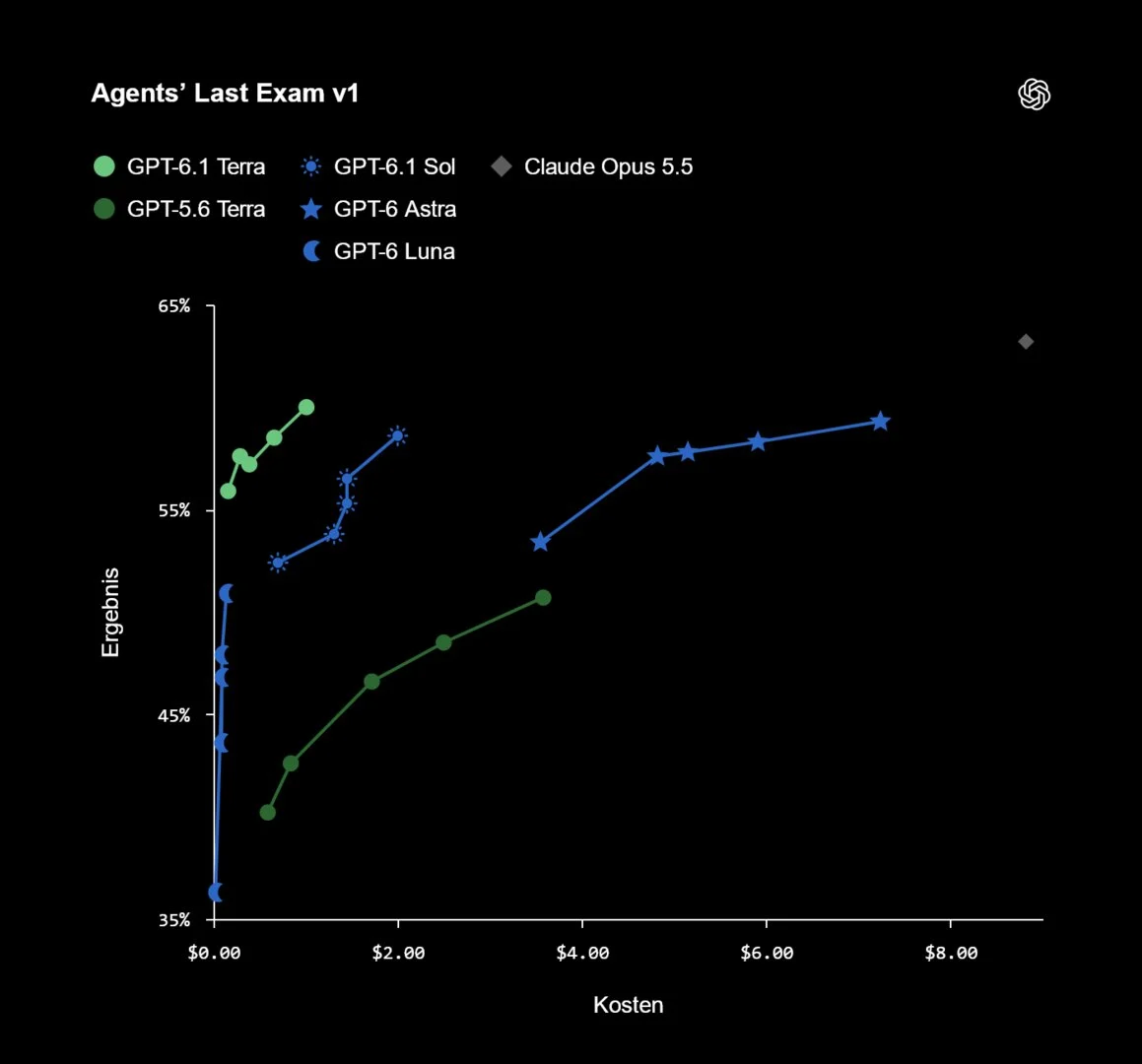
OpenAI’s documentation provides extensive evidence of Terra’s capabilities across diverse benchmarks. The company utilized the "Agents’ Last Exam"—a rigorous test for computer-based task execution—to showcase the model’s prowess.
Computational Efficiency
In a practical demonstration involving the conversion of complex architectural drawings into 3D models, GPT-6.1 Terra outperformed GPT-5.6 Terra by 15 percentage points in reasoning capability while consuming only one-third of the resources. When compared to the high-performance GPT-6 Astra, Terra achieves parity in results while costing only one-tenth per token.
Reasoning and Throughput
When pushed to maximum reasoning capacity, Terra offers more than triple the token efficiency of Claude Opus 5.5, with a cost-per-token ratio of just one-fourth. This results in an estimated cost-per-task reduction of approximately 89%—or roughly one-ninth the price of previous-generation solutions. Furthermore, tasks are completed more than three times faster than on GPT-6 Astra and GPT-6.1 Sol, drastically reducing latency for time-sensitive applications.
Visual Reasoning and Factuality
Terra excels in visual reasoning, consistently performing at or above the level of the 5.6 series on the MMMU-Pro benchmark. More impressive, however, is the reduction in hallucination. In internal "adversarial" prompt testing, the error rate for Terra dropped from 53.6% (in the previous model) to 16.7% at lower reasoning settings. At maximum capacity, the error rate bottoms out at just 4.3%, matching the reliability of the high-tier Astra models.
Technical Performance in Programming
The development sector stands to benefit significantly from the shift to Terra. In the "Terminal-Bench 4.0," which measures proficiency in software development environments, Terra demonstrated a massive leap, improving from a 21.5% success rate to 50.3% at maximum reasoning settings.
While OpenAI concedes that for "highly specialized, deeply architectural" coding tasks, the GPT-6 Astra or Sol models may still hold a slight edge, Terra proves to be a powerhouse in scientific computing. In the "Terminal-Bench-Science 0.1," Terra outpaced GPT-6.1 Sol while maintaining significantly lower costs, and lagged less than five points behind Claude Opus 5.5—all while costing less than one-fifth of the price to operate.

Official Responses and Safety Protocols
Despite the push for lower costs and higher speed, OpenAI has maintained a strict stance on safety. Following the company’s internal "Preparedness Framework," GPT-6.1 Terra has reached a "Critical" threshold, triggering the same stringent safety guardrails applied to the flagship Astra model.
OpenAI representatives have emphasized that the model is designed to be more "honest" about its limitations. Terra is programmed to communicate its operational boundaries more clearly and exhibits superior resistance to "prompt injection" attacks compared to previous iterations. This focus on "reliable behavior" ensures that even as the technology becomes more affordable and accessible, it does not sacrifice the security standards required for enterprise deployment.
Broader Implications: The Democratization of AI Agents
The release of GPT-6.1 Terra signals an industry-wide transition toward "Agentic Workflows." By reducing the cost of high-level reasoning, OpenAI is enabling the rise of autonomous agents that can act on behalf of a user across multiple desktop applications.
1. Market Disruption
The 50% price reduction for API calls will likely trigger a competitive response from rivals such as Anthropic and Google. As the cost of intelligence approaches a marginal price, the barrier to entry for startups building AI-first SaaS products will vanish, likely leading to an explosion of new applications in legal document review, medical transcription, and automated administrative support.
2. Operational Efficiency
For existing enterprises, the shift to Terra is a clear "buy" signal. Companies currently utilizing GPT-5.6 or Sol can expect to cut their AI-related operational expenses by nearly 50% while simultaneously enjoying faster response times. This is particularly relevant for high-volume sectors like finance, where processing millions of transactions and documents is the standard.
3. The Future of the Workplace
With the ability to perform multi-step tasks—such as interpreting a drawing, calculating the material requirements, and drafting a formal contract—Terra acts as a force multiplier for human labor. The focus on "Computer Use" (the ability to interact with UI elements) suggests that OpenAI is inching closer to a "Universal Digital Assistant" that doesn’t just write text, but executes entire job functions.
Availability and Pricing
GPT-6.1 Terra is available effective immediately. Developers can access the model via the API under the identifier gpt-6.1-terra. Additionally, the model has been integrated into the "Plus," "Pro," "Enterprise," and "Edu" tiers of ChatGPT Work and the Codex environment.
Pricing Structure:
- Input Tokens: $1.00 per million tokens.
- Cached Input: $0.05 per million tokens (a massive incentive for repetitive, large-context tasks).
- Output Tokens: $5.00 per million tokens.
This pricing structure is clearly designed to incentivize long-term, context-heavy sessions, making the model ideal for developers building long-running agents that maintain state over hours or days of operation.
In conclusion, GPT-6.1 Terra marks the beginning of a new era where high-level artificial intelligence is no longer a luxury reserved for specialized R&D departments. By focusing on the "trinity" of efficiency—speed, cost, and accuracy—OpenAI has lowered the threshold for widespread AI adoption, ensuring that the next generation of automation is not only smarter but significantly more affordable for the global economy.