By Jakob Hanke Vela, Thomas Jahn, and Stephan Scheuer
October 27, 2026
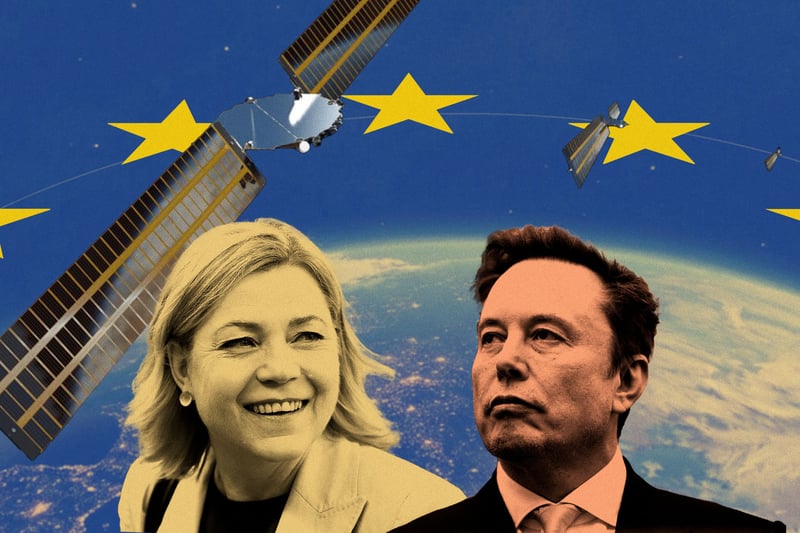
A major regulatory confrontation is unfolding between the European Union and the United States, centered on the invisible but vital infrastructure of the modern age: radio frequency spectrum. As the EU prepares to reallocate crucial bandwidth starting in May, the move directly threatens a cornerstone of Elon Musk’s global connectivity strategy for SpaceX’s Starlink service. What began as a technical debate over spectrum efficiency has escalated into a geopolitical standoff, with Washington issuing stern warnings to Brussels while EU Commissioner Henna Virkkunen maintains a firm stance on European digital sovereignty.
Main Facts: The Clash Over the Skies
The core of the dispute lies in the 1.4 GHz to 2.4 GHz range, a "golden" portion of the electromagnetic spectrum prized for its ability to penetrate buildings and cover vast distances—essential characteristics for the next generation of Direct-to-Cell satellite communications.

SpaceX has been aggressively lobbying to secure these frequencies for its Starlink satellites to enable seamless mobile connectivity from space. However, the European Commission, supported by a coalition of member states, is moving to reserve this spectrum for terrestrial 5G and future 6G mobile network operators. The argument from the European side is that local mobile networks are the backbone of the European economy and must be protected from interference caused by non-European satellite constellations.
SpaceX contends that the EU’s approach is protectionist and technologically regressive, arguing that its satellite-to-phone technology is the only way to eliminate "dead zones" in rural and mountainous regions of Europe. The US government, acting on behalf of its domestic aerospace giant, has signaled that any attempt by the EU to block SpaceX’s access could lead to retaliatory trade measures or a freeze on transatlantic digital cooperation agreements.
A Chronology of the Regulatory Standoff
The seeds of this conflict were sown nearly two years ago, but the timeline has accelerated rapidly in recent months:
- Early 2025: The European Commission initiates a review of spectrum allocation for the 2026–2030 cycle, aiming to harmonize frequencies for advanced 5G/6G deployment.
- Late 2025: SpaceX files a formal request with the European Telecommunications Standards Institute (ETSI) and the European Commission, requesting "non-exclusive, shared access" to specific bands in the 2 GHz range.
- February 2026: Member states express concern over potential interference with existing terrestrial infrastructure. The Commission begins drafting a "European Preference" directive.
- July 2026: Tensions rise as the US Department of Commerce sends a formal note to Brussels expressing "deep concern" over the potential exclusion of US-based satellite operators from European markets.
- October 2026: Commissioner Virkkunen issues a public statement in the Handelsblatt, defending the EU’s right to prioritize local infrastructure, setting the stage for the planned May 2027 rollout of new spectrum licenses.
Supporting Data: Why the Spectrum Matters
The economic value of this spectrum is difficult to overstate. According to internal Commission documents, the reallocation is expected to generate approximately €12 billion in auction revenue for EU member states over the next decade. More importantly, the efficiency gains from optimizing these frequencies are estimated to contribute an additional 0.4% to the EU’s annual GDP by enabling high-speed industrial IoT and remote manufacturing.
SpaceX’s data, presented to the European Parliament, paints a different picture. The company claims that its constellation can provide 99% coverage for even the most isolated parts of the EU, potentially serving 15 million citizens who currently suffer from inadequate mobile reception. SpaceX argues that the cost of building enough terrestrial towers to provide equivalent coverage would exceed €50 billion—a burden it claims the EU’s plan would force taxpayers to bear.
Critics of the EU’s position, including several telecom analysts, point out that the European mobile market is fragmented. Unlike the US, where massive scale allows for rapid infrastructure deployment, the EU’s reliance on dozens of different national operators has historically slowed down the rollout of advanced technology. They argue that blocking SpaceX is a defensive move designed to protect legacy telecom giants that are struggling to compete with the disruptive efficiency of satellite-based providers.
Official Responses and Political Rhetoric
The rhetoric surrounding this issue has reached a fever pitch. Commissioner Henna Virkkunen, leading the European digital policy portfolio, has been clear: "Europe will not be a testing ground for foreign monopolies that disregard our regulatory framework. Our primary duty is to ensure the reliability and security of our own communication networks."
In response, SpaceX representatives have accused the EU of "regulatory weaponization." A spokesperson for the company stated: "We are providing a service that directly benefits European citizens, particularly those in underserved rural areas. To label this as a threat to sovereignty is a mischaracterization designed to shield inefficient local incumbents from healthy competition."
Washington has taken a more aggressive tone. Sources close to the US trade delegation suggest that the White House is viewing the spectrum issue as a test of the EU-US Trade and Technology Council’s effectiveness. If the EU moves forward with the May plan without allowing for a compromise, it could sour negotiations on other critical fronts, including artificial intelligence regulation and data privacy standards.

The Implications: A New Era of Space Geopolitics
The outcome of this standoff will have profound implications for the future of the digital economy.
1. The Fragmentation of Global Standards
If the EU and the US diverge on spectrum allocation, it could lead to a fragmented global market. Devices manufactured for the US market might not function correctly on European networks, increasing costs for consumers and manufacturers. This would effectively undo decades of work to harmonize global telecommunications standards.
2. The Rise of "Digital Sovereignty"
This conflict is a litmus test for the EU’s "Strategic Autonomy" agenda. By prioritizing local control over its radio spectrum, Brussels is signaling that it is willing to sacrifice short-term efficiency for long-term control over its digital infrastructure. This is a shift from the previous era of openness and suggests that the EU will continue to use its regulatory power to push back against American tech hegemony.

3. The Future of Satellite Connectivity
For the average citizen, the immediate impact may be a delay in the availability of "anywhere" mobile coverage. If SpaceX is forced to alter its technology to comply with European requirements, the deployment of its Direct-to-Cell service could be delayed by years. Conversely, if the EU yields, it will set a precedent that satellite operators can bypass national regulators, potentially weakening the position of local telecom companies.
4. Impact on Innovation
There is also a broader question regarding innovation. By forcing SpaceX to work within a highly restrictive, localized framework, the EU risks alienating the most innovative players in the space sector. If companies perceive the European market as "hostile" to new business models, they may divert their research and development investments to the US, Asia, or the Middle East, leaving Europe behind in the next phase of the space race.
Conclusion: A Path Forward?
As the May deadline approaches, the pressure is mounting on both sides to find a middle ground. Some industry experts suggest a "hybrid model" where satellite operators are granted access to specific, non-interfering sub-bands, provided they enter into revenue-sharing agreements with local terrestrial providers.

However, as of late October 2026, both sides remain entrenched. For Commissioner Virkkunen, this is a matter of principle; for SpaceX, it is a matter of market access and global scalability. The coming months will likely see intense back-channel negotiations, as the EU must decide whether to stand firm on its regulatory principles or risk being left out of the next generation of global satellite-based connectivity.
The battle over the airwaves is more than just a fight over technical specs—it is a struggle over the future of the global digital order. As we look toward the May implementation, the world will be watching to see whether the EU can successfully assert its sovereignty without losing its competitive edge in a rapidly evolving, space-linked world.