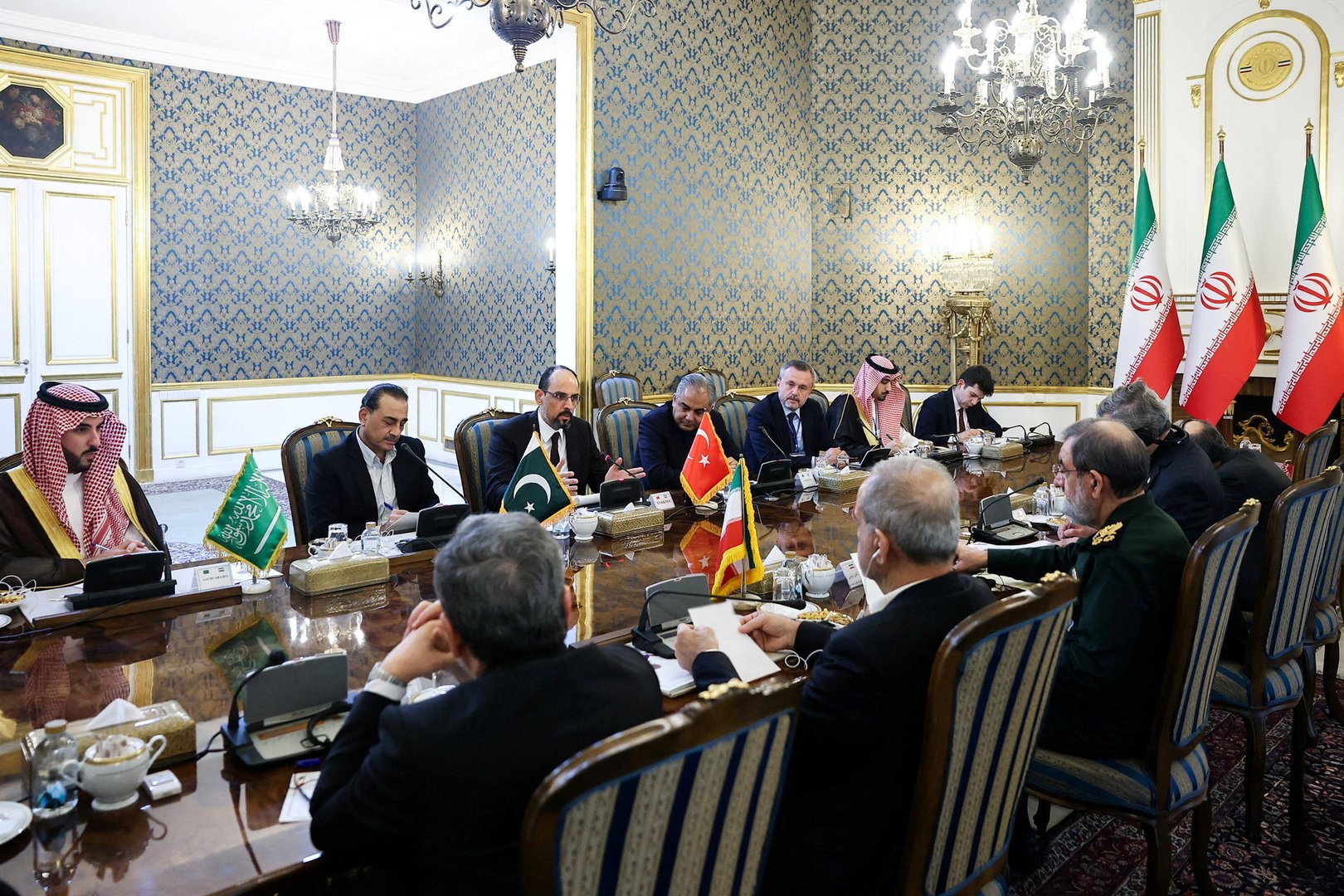
In a high-stakes effort to prevent a regional conflagration, top representatives from Iran, Saudi Arabia, Turkey, and Pakistan gathered in Tehran on Monday. The emergency summit, centered on the "Mecca Pact" alliance, sought to establish a framework for regional stability as military hostilities intensify across the Gulf and beyond.
The meeting follows weeks of escalating volatility, marked by cross-border strikes, missile attacks on critical energy infrastructure, and a resurgence of sectarian violence. As global oil markets react with sensitivity to these developments, the diplomatic urgency to contain the conflict has reached a boiling point.
Main Facts: The Tehran Summit
The summit in Tehran represents a rare, high-level diplomatic intervention involving powers that have long occupied opposing sides of the region’s geopolitical divides. The delegation included Saudi Arabia’s Minister of Defense, Prince Khalid bin Salman; Pakistan’s Army Chief, General Asim Munir; and the head of Turkey’s National Intelligence Organization, Ibrahim Kalin.
Host nation Iran was represented by Mohsen Resai, the Secretary of the Supreme National Security Council. According to state-affiliated sources, the primary objective of the meeting was to de-escalate tensions between the Islamic Republic and its neighbors, particularly concerning the Houthi-led insurgencies in Yemen and the persistent threat to maritime security in the Strait of Hormuz.
While an official joint statement has yet to be finalized, insiders suggest the dialogue focused on two tracks: a cessation of hostilities between the Saudi-led coalition and the Iran-backed Houthi rebels, and a broader regional security pact intended to discourage further military adventurism by external actors.
Chronology of Escalation
The current climate of fear is the culmination of months of friction. The following timeline outlines the key events leading to the present crisis:

- Late February: The conflict between Iran and opposing forces (involving the U.S. and Israel) intensified, leading to a spike in maritime security incidents.
- September: Houthi forces seized strategic territories along the Red Sea coast, threatening the Bab al-Mandab Strait, a critical artery for global oil transport.
- Last Week: General Asim Munir of Pakistan conducted preliminary talks in Tehran to reopen lines of communication between Washington and the Iranian regime.
- Sunday: Reports emerged of intense disagreement within the Israeli government regarding potential pre-election military strikes on Iranian assets.
- Monday: The "Mecca Pact" representatives convened in Tehran. Simultaneous reports confirmed that the Saudi-led coalition had intercepted a barrage of ballistic missiles and drones launched at the Eastern Province of Saudi Arabia.
- Tuesday: Global oil markets saw Brent crude dip slightly below $115 per barrel, reflecting a cautious optimism regarding the ongoing diplomatic efforts.
Military Dynamics: A Region Under Fire
The diplomatic maneuvering in Tehran occurs against a backdrop of relentless military activity. The security situation has deteriorated significantly in recent weeks, with several distinct theaters of conflict overlapping:
The Yemen Front and Maritime Security
The Houthi-led forces have significantly ramped up their capabilities. By occupying strategic coastal points, they have effectively weaponized the Bab al-Mandab Strait. The recent deployment of Iranian-supplied ballistic missiles and long-range drones against Saudi targets has forced the Kingdom to intensify its air campaign. According to regional reports, the coalition has engaged in thousands of air sorties over the past month, further complicating humanitarian efforts in the region.
The Jordan-Syria Theater
In a separate but related development, the Jordanian Air Force conducted strikes in southern Syria, targeting what they described as Islamic State (IS) militants. While Amman emphasized that these operations were conducted in coordination with Damascus and aimed to avoid civilian areas, Syrian authorities have disputed the casualty figures, citing deaths among non-combatants.
The Lebanese Factor
Security sources indicate that the Hezbollah militia in Lebanon has utilized the last three months to aggressively rearm. Supported by tens of millions of dollars in fresh funding from Tehran, the group is reportedly focusing on drone production and the restoration of command-and-control structures that were degraded in previous rounds of fighting.
Official Responses and Political Rhetoric
The diplomatic process is fraught with internal and external challenges. Public statements from major players reflect the precarious nature of the current negotiations.
Iran’s Position: Foreign Ministry spokesperson Ismail Baghai stated that the "window for diplomacy" remains open, though he cautioned that the Iranian government would not accept the "total capitulation" demanded by the current U.S. administration. Minister Abbas Araghtschi echoed this sentiment, asserting that while war is a possibility, Tehran is focused on the post-conflict landscape and will maintain its core policies regardless of external pressure.
The Israeli Stance: Defense Minister Israel Katz issued a clear rebuttal to rumors of an imminent Israeli strike on Iran before the upcoming national elections. "I clarify unequivocally that Israel had no intention at any time to initiate an attack on Iran before the elections," Katz said, though he maintained that Israel would respond with "great force" if attacked.
Turkish Mediation: President Recep Tayyip Erdogan issued a stern warning against further strikes on Iran, stating that any new military action would destabilize the entire region and inflict collateral damage on innocent nations.
Supporting Data: Economic and Security Metrics
The economic toll of the conflict is becoming increasingly difficult for the global community to ignore.

- Shipping Security: According to data from the Washington Institute for Near East Policy, there have been 113 recorded attacks on commercial vessels in the Strait of Hormuz since the end of February. October alone saw a record 28 incidents.
- Tanker Damage: Reuters, analyzing International Maritime Organization (IMO) data, reports that over 30 supertankers have sustained damage during this period—roughly 3.5% of the global fleet.
- Market Volatility: The oil price fluctuation, while currently showing a slight downward trend due to the Tehran talks, remains highly susceptible to "event risk." Any confirmation of a large-scale strike on energy infrastructure is projected to drive crude prices significantly higher.
Implications for the Future
The convening of the Mecca Pact states in Tehran suggests that regional powers are finally attempting to take ownership of their own security architecture, potentially moving away from a total reliance on external mediators like the United States.
1. Shift in Security Paradigms
If the Tehran summit results in a formal agreement, it could signify a pivot from the "security by proxy" model that has defined the Middle East for decades. A direct dialogue between Riyadh and Tehran, facilitated by Ankara and Islamabad, could dampen the effectiveness of non-state actors who rely on the regional power vacuum to operate.
2. The Domestic Pressure Cooker
In Israel, the political climate remains tense. The accusations by the opposition that Prime Minister Benjamin Netanyahu may be using the Iranian threat for electoral gain underscore the volatility of domestic politics in the region. The use of inflammatory imagery—such as the recent social media posts depicting a nuclear mushroom cloud over Tel Aviv—highlights how existential rhetoric is being used to mobilize voters.

3. Humanitarian and Economic Stability
The primary concern for the international community remains the human cost. With displaced populations in the thousands—notably in Hebron and the outskirts of Aden—the region is facing a deepening humanitarian crisis. The economic stability of the global energy market is equally fragile; the "record-high" frequency of attacks on shipping vessels in the Gulf is a structural issue that cannot be solved by diplomacy alone without a permanent cessation of hostilities.
Conclusion: A Fragile Path Forward
The meeting in Tehran is a critical, albeit fragile, attempt to stem the tide of a broader war. The inclusion of Saudi Arabia, Iran, Turkey, and Pakistan in a single room is an achievement in itself, but the gulf between their strategic interests remains wide.
For the international community, the focus must remain on supporting these regional initiatives while maintaining pressure on all parties to adhere to international law. Whether this summit serves as a temporary reprieve or a genuine turning point toward de-escalation depends on the willingness of the participants to move beyond rhetoric and toward actionable concessions. As of now, the world watches the Gulf with bated breath, waiting to see if the guns will fall silent or if the drums of war will continue to beat louder.