The race for the lunar surface, a competition once defined by the Cold War rivalry between the United States and the Soviet Union, has entered a sophisticated new phase. With China officially formalizing its roadmap for a crewed moon landing before 2030, the global space community is witnessing an unprecedented acceleration in lunar exploration. The plans, recently unveiled by Wang Xiang, Chief Designer of China’s Manned Lunar Exploration Program, at the 7th Manned Space Symposium in Beijing, represent the most detailed public disclosure to date regarding Beijing’s ambitions to place taikonauts on the Moon.
As China maneuvers to establish a permanent presence, the United States, through its NASA-led Artemis program, finds itself in a high-stakes race where scientific discovery is inextricably linked to geopolitical influence.
The Technical Blueprint: A Dual-Launch Architecture
The complexity of China’s lunar aspirations is matched by a meticulously planned technical strategy. Unlike the singular, massive Saturn V rockets of the Apollo era, China’s approach leans on a modular, multi-stage architecture designed for scalability and safety.
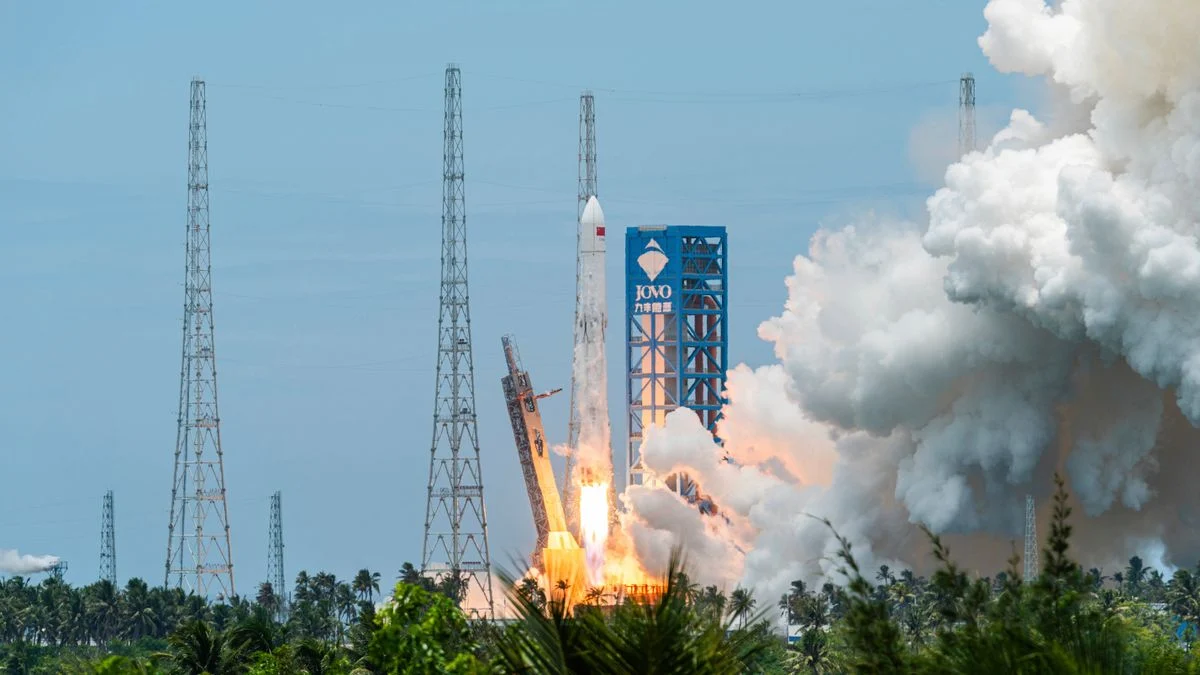
According to reports from Ars Technica and Space News, China’s strategy centers on a dual-launch mission profile. The mission will utilize two "Long March 10" carrier rockets. The first launch will transport the lunar lander, christened Lanyue ("Embracing the Moon"), into lunar orbit. The second launch will carry the Mengzhou ("Dream Vessel") spacecraft, crewed by three taikonauts.
Once in lunar orbit, the two vehicles will execute a precision rendezvous and docking maneuver. Following this, two of the three crew members will transition into the Lanyue lander to descend to the lunar surface. After conducting their surface operations, the crew will ascend to rejoin the Mengzhou spacecraft, ensuring a safe return to Earth.
Wang Xiang emphasized that this "separated development" strategy—where the crew vehicle and the landing craft are engineered to be modular—is intended to streamline production and standardize components. This methodology reflects a broader Chinese industrial philosophy: developing robust, adaptable infrastructure that can be replicated and scaled for future, more complex missions, including potential lunar bases.
Chronology of a Lunar Ambition
China’s path to the moon is not a sudden sprint but the culmination of a decades-long, systematic advancement in space technology.
- 2003: China launches Shenzhou 5, making Yang Liwei the first Chinese citizen in space, marking the country as the third nation capable of independent human spaceflight.
- 2010s: The Chang’e program achieves a series of milestones, including the first soft landing on the far side of the moon (2019) and successful sample return missions.
- April 2026: NASA’s Artemis II mission completes a historic ten-day flyby around the Moon, setting the stage for the next phase of human exploration.
- Late 2026: China formalizes its "pre-2030" timeline at the 7th Manned Space Symposium, outlining the technical requirements for the Long March 10 launches.
- 2027–2029: A series of uncrewed test flights are scheduled to validate the docking procedures, the propulsion systems of the Long March 10, and the integrity of the Lanyue and Mengzhou craft.
- 2030 (Target): The planned window for the first crewed Chinese landing on the lunar surface.
This chronology underscores a shift in Chinese aerospace policy: moving from "firsts" to "permanence." The emphasis on testing and iterative development suggests that Beijing is prioritizing a reliable, repeatable architecture over the prestige of a singular, high-risk mission.
Supporting Data: Assessing China’s Progress and Hurdles
While the Chinese government characterizes its development as "smooth," international observers remain cautious. The sheer scale of the Long March 10 project requires unprecedented levels of coordination within China’s aerospace industrial base.
The development is not without setbacks. In August 2026, the failure of a Long March 7A carrier rocket—which exploded shortly after liftoff—served as a sobering reminder of the inherent risks in high-velocity space exploration. Critics and analysts argue that such failures are part of the learning curve, yet they also highlight the technical strain involved in simultaneously developing a new generation of heavy-lift rockets and life-support systems.
Furthermore, the lack of transparency remains a primary concern for international space agencies. While NASA is subject to intense public and congressional scrutiny, China’s space program is deeply integrated with the People’s Liberation Army (PLA). This dual-use nature of their technology fuels Western concerns that lunar exploration is merely the first step toward military dominance in cislunar space.
The Artemis Program: The American Response
For the United States, the stakes are existential in the context of global leadership. The Artemis program is the cornerstone of American lunar policy, with a goal to land the first woman and person of color on the Moon.
NASA’s schedule is currently tethered to the Artemis III mission, slated for 2027, with a crewed landing intended for 2028. However, space exploration is notorious for "schedule slippage." Technical challenges with the Starship HLS (Human Landing System) and the complexity of the Orion capsule mean that the margin for error is razor-thin.
The competition is no longer just about flags and footprints; it is about establishing the infrastructure of the future. The Artemis Accords, a series of non-binding principles designed to guide civil space exploration, currently boast dozens of signatories. The U.S. is positioning these accords as the "rules of the road," hoping to cement a Western-led framework for resource extraction and lunar base management.
Geopolitical Implications: Who Owns the Moon?
The friction between these two competing programs is best articulated by officials within the U.S. space sector. Amit Kshatriya, Deputy Associate Administrator for Moon to Mars Architecture at NASA, has been vocal about the implications of a Chinese lunar "first."
"Imagine China lands on the Moon and tells the world nothing about what it is doing," Kshatriya noted in an interview. "No data, no cooperation, no common standards. We have spent decades establishing space as a domain that belongs to all of humanity. If we arrive too late, we risk losing the ability to set the rules for the next century of exploration."
The concern is that a Chinese-led lunar environment would not adhere to the international norms of transparency, environmental stewardship, or open scientific data sharing. If Beijing establishes a base with proprietary technology and communication protocols, they could effectively dictate the terms of access to lunar resources, such as water ice found at the lunar south pole—a critical component for future deep-space missions and rocket fuel production.
Conclusion: A New Era of Competition
The race to the Moon in the 2020s is fundamentally different from the 1960s. It is less about proving national superiority and more about securing the high ground for the next era of human civilization.
China’s roadmap, with its dual-launch architecture and modular systems, demonstrates a high level of strategic maturity. Meanwhile, the U.S. and its partners must navigate the difficulties of inter-agency coordination and technological development to keep pace.
As we look toward 2030, the Moon is once again the focal point of human aspiration. Whether this competition leads to a new "Cold War" in the heavens or a forced cooperation driven by the necessity of survival in a harsh environment remains to be seen. What is certain is that the next few years will define the governance and utilization of the lunar surface for generations to come. The clock is ticking, and for both Washington and Beijing, the Moon is not just a destination—it is the ultimate strategic prize.