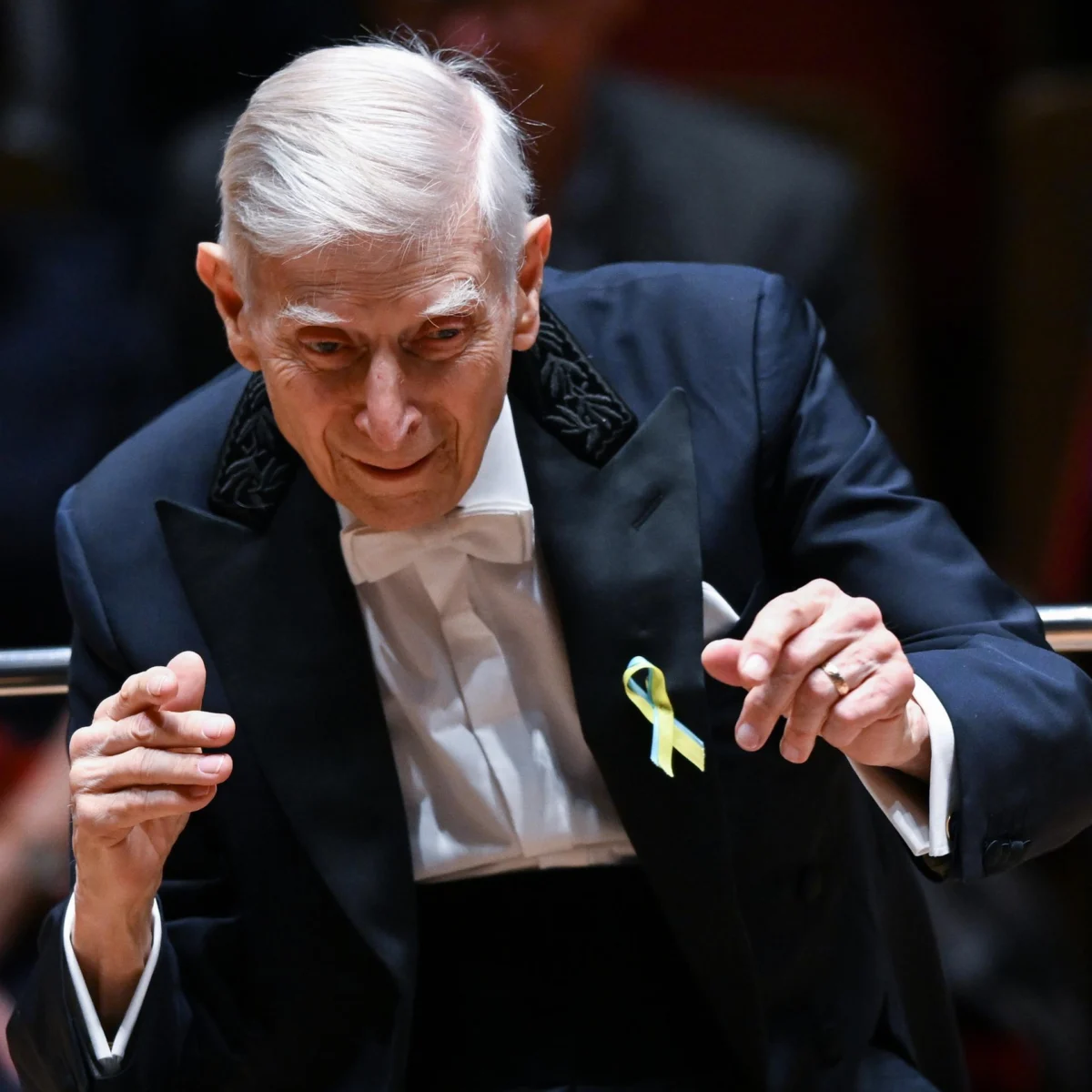
Leipzig, Germany – November 5, 2026 – The classical music world mourns the passing of Herbert Blomstedt, the revered Swedish conductor, who died today at the remarkable age of 99. The announcement came from the Gewandhaus zu Leipzig, where Blomstedt served as Kapellmeister and later as Honorary Conductor, signaling the end of an era defined by unparalleled musical integrity, profound interpretive depth, and an unwavering commitment to the art form.
In a statement released this morning, the Gewandhaus zu Leipzig expressed profound sorrow, declaring, "With him, the Gewandhaus loses one of the most important conductors of his time and an extraordinary musician whose spiritual and artistic legacy will resonate for generations." The institution, which Blomstedt led with distinction from 1998 to 2005, highlighted his transformative impact on its orchestra and his enduring connection to the city of Leipzig. Blomstedt’s death marks the departure of a figure whose influence extended far beyond the concert halls he graced, touching the lives of countless musicians and listeners worldwide.
Born in Springfield, Massachusetts, to Swedish parents, Blomstedt’s life spanned nearly a century, witnessing and shaping the evolution of classical music through the latter half of the 20th and early 21st centuries. His career was characterized by an uncommon blend of intellectual rigor, spiritual conviction, and a deeply human approach to music-making. Renowned for his meticulous preparation, his aversion to superficiality, and his profound respect for the composer’s intentions, Blomstedt was a maestro who sought to illuminate the truth within the score. His passing leaves an irreplaceable void in the global cultural landscape.
A Life in Music: A Chronology of Dedication
Herbert Blomstedt’s journey through music was a testament to persistent dedication, intellectual curiosity, and a profound spiritual connection to his art. His career arc, spanning over seven decades, saw him at the helm of some of the world’s most prestigious orchestras, shaping their sound and enriching their repertoire.
Early Years and Formative Influences
Born on July 11, 1927, Blomstedt’s early life was marked by a rich cultural environment. His parents, who emigrated to the United States from Sweden, returned to their homeland when he was a child. It was in Sweden that Blomstedt’s musical talents blossomed. He began studying violin and piano at an early age, but it was the allure of the podium that eventually captured his imagination. His formal education was extensive, reflecting a deep commitment to comprehensive musical understanding. He studied at the Royal College of Music in Stockholm and the University of Uppsala, where he focused on conducting, composition, and musicology.
Furthering his education, Blomstedt traveled to the United States to study at the Juilliard School in New York, then to the Hochschule für Musik in Vienna, and later to the Berkshire Music Center at Tanglewood, where he was mentored by the legendary Igor Markevitch. These diverse educational experiences, encompassing both European and American traditions, provided him with a broad perspective that would characterize his interpretive approach throughout his career. He also pursued theological studies, reflecting his deeply held Seventh-day Adventist faith, which he believed profoundly influenced his musical philosophy and his approach to life. This spiritual dimension was often cited by those who knew and worked with him as a key to his unique interpretive voice.
Rising Through the Ranks: International Acclaim
Blomstedt’s professional conducting debut came in 1954 with the Stockholm Philharmonic Orchestra, marking the beginning of a relentless ascent. His early appointments quickly established him as a conductor of considerable promise and integrity. He served as chief conductor of the Norrköping Symphony Orchestra from 1954 to 1962, where he honed his craft and built a reputation for demanding high standards and achieving exceptional results.
His international career gained significant momentum in the 1960s. From 1962 to 1968, he was the chief conductor of the Oslo Philharmonic, followed by a tenure with the Danish Radio Symphony Orchestra from 1967 to 1977. These Nordic appointments were crucial in establishing his reputation for insightful interpretations of Scandinavian repertoire, particularly the symphonies of Carl Nielsen and Jean Sibelius, composers whose works he would champion throughout his life. His recordings with these orchestras garnered critical acclaim, bringing his name to the attention of a wider international audience. During this period, he also held positions with the Swedish Radio Symphony Orchestra (1977-1982) and the Dresden Staatskapelle, marking his significant return to German musical life.
Leipzig and Dresden: A German Legacy
Blomstedt’s relationship with German orchestras was particularly profound and long-lasting, embodying a deep mutual respect and shared artistic vision. He first served as Chief Conductor of the Sächsische Staatskapelle Dresden from 1975 to 1985. This decade-long tenure was transformative for both Blomstedt and the orchestra. Under his leadership, the Staatskapelle, one of the world’s oldest and most distinguished ensembles, refined its sound and expanded its international presence, producing a series of acclaimed recordings, particularly of Richard Strauss and Johannes Brahms. His work in Dresden laid the groundwork for his eventual return to another iconic German institution.
The culmination of his German career, however, arguably came with his appointment as Gewandhauskapellmeister in Leipzig from 1998 to 2005. Stepping into a role historically held by figures such as Mendelssohn and Furtwängler, Blomstedt brought a renewed sense of purpose and intellectual rigor to the Gewandhaus Orchestra. His tenure was characterized by meticulously prepared performances, a focus on the core German repertoire – especially Beethoven, Brahms, Bruckner, and Schubert – and a commitment to nurturing the orchestra’s unique sound. Even after stepping down from the Kapellmeister position, his bond with the Gewandhaus remained exceptionally strong; he was named Honorary Conductor, a title he held until his death, frequently returning to lead the orchestra in critically lauded concerts.
Global Maestro: San Francisco and Beyond
Beyond his deep roots in Europe, Blomstedt cultivated a significant presence in North America. From 1985 to 1995, he served as Music Director of the San Francisco Symphony, a decade often hailed as one of the orchestra’s golden eras. In San Francisco, Blomstedt expanded the orchestra’s repertoire, enhanced its technical precision, and elevated its international profile through extensive touring and a highly successful series of recordings, particularly of Nielsen, Sibelius, and Richard Strauss, for the Decca label. His calm demeanor, intellectual approach, and unwavering artistic standards endeared him to both musicians and audiences.
Following his tenure in San Francisco, Blomstedt continued to maintain an active schedule as a guest conductor with the world’s leading orchestras. He held positions as Chief Conductor of the NDR Sinfonieorchester (now NDR Elbphilharmonie Orchestra) from 1996 to 1998, and later as Conductor Laureate. His engagements took him to the Berlin Philharmonic, the Vienna Philharmonic, the Royal Concertgebouw Orchestra, the Boston Symphony Orchestra, and many others, a testament to his enduring appeal and profound musical insight.
Enduring Presence: An Unwavering Commitment
What truly set Blomstedt apart in his later years was his astonishing longevity and sustained level of activity. He continued to conduct well into his nineties, defying conventional expectations for retirement. His presence on the podium, often without a score, remained as commanding and intellectually vibrant as ever. Audiences and critics marveled at his energy, his crystal-clear interpretations, and his profound connection to the music, which seemed to deepen with age. His final concerts, even in his late nineties, were met with standing ovations and critical superlatives, underscoring his unique place as a living legend. This sustained excellence was a reflection of his disciplined lifestyle, his sharp intellect, and his boundless passion for music.
The Artistry of Herbert Blomstedt: Supporting Data
Herbert Blomstedt’s artistry was distinguished by several key characteristics that set him apart in the competitive world of classical conducting. His approach was less about personal showmanship and more about serving the music with utmost integrity.
A Unique Interpretive Voice
Blomstedt was often described as a conductor who sought to uncover the truth within the score rather than impose his own personality upon it. His interpretations were celebrated for their clarity, structural integrity, and deep psychological insight. He was known for his forensic attention to detail, meticulously studying scores to understand every nuance of the composer’s intentions. This often led to performances that, while seemingly straightforward, revealed layers of meaning and emotional depth previously unheard.
Musicians consistently praised his ability to communicate his musical vision with precision and a quiet authority. He rarely resorted to flamboyant gestures, instead using subtle, economical movements that conveyed maximum information. This discipline fostered an environment of intense focus and collaboration within the orchestra, leading to performances that felt cohesive, authentic, and profoundly moving. His clarity was not just about technique; it was about bringing the music itself into sharp focus, allowing its inherent beauty and power to shine through.
Repertoire and Legacy
While Blomstedt was a versatile conductor capable of tackling a vast range of repertoire, he was particularly revered for his interpretations of the Austro-Germanic tradition, especially the symphonies of Beethoven, Brahms, Bruckner, and Schubert. His Bruckner cycles, in particular, were considered landmark achievements, praised for their architectural grandeur, spiritual depth, and meticulous adherence to the composer’s often complex structures. He approached these monumental works with a profound understanding of their spiritual and philosophical underpinnings, translating them into performances of immense power and clarity.
Beyond the German masters, he was an ardent champion of his Nordic heritage, giving definitive performances of works by Carl Nielsen and Jean Sibelius. His recordings of their symphonies are considered benchmarks. He also had a significant affinity for the music of Richard Strauss, whose tone poems and operas he conducted with great flair and insight. Blomstedt’s discography is extensive and critically acclaimed, serving as a testament to his interpretive prowess across a broad spectrum of composers and eras.
The Maestro’s Philosophy
Blomstedt’s philosophy of music-making was deeply rooted in his personal convictions. His Seventh-day Adventist faith imbued his work with a sense of purpose and reverence. He often spoke of music as a spiritual journey, a means of connecting with something greater than oneself. This belief informed his calm, disciplined demeanor on the podium and his patient, encouraging interactions with musicians. He believed that the conductor’s role was to be a facilitator, to help the musicians collectively realize the composer’s vision, rather than to be an autocratic dictator.
He was a tireless advocate for rehearsal discipline, not as a means of control, but as a path to collective understanding and technical mastery. His rehearsals were known for their efficiency, intellectual rigor, and an atmosphere of mutual respect. He inspired loyalty and dedication from the orchestras he led, fostering a sense of shared purpose that transcended individual egos. His quiet authority commanded respect, and his profound knowledge of the score instilled confidence.
Longevity and Discipline
Perhaps one of the most remarkable aspects of Herbert Blomstedt’s career was his extraordinary longevity. Remaining active and highly sought-after well into his late nineties, he became a symbol of enduring artistic vitality. This was often attributed to his disciplined lifestyle, which included vegetarianism and a regular exercise regimen. More importantly, it was fueled by an insatiable intellectual curiosity and an unflagging passion for music.
He famously conducted without a score in his later years, relying on his prodigious memory and deep understanding of the works. This feat was not merely a display of memory but a manifestation of his complete immersion in the music, allowing him to connect more directly with the orchestra and the audience. His continued presence on the world stage served as an inspiration, demonstrating that artistic brilliance could not only be maintained but could deepen and enrich with age.
Tributes Pour In: Official Responses
The news of Herbert Blomstedt’s passing has elicited a wave of tributes from across the globe, reflecting the immense respect and admiration he commanded throughout his long and distinguished career. Orchestras, cultural institutions, and political figures have voiced their sorrow and gratitude for his profound contributions.
From Leipzig to the World
The Gewandhaus zu Leipzig, the institution closest to Blomstedt in his final decades, led the tributes. Andreas Schulz, Director of the Gewandhaus, stated, "Herbert Blomstedt was more than an honorary conductor; he was the spiritual patriarch of our orchestra. His wisdom, his humility, and his absolute devotion to music have left an indelible mark on every musician and every performance. His presence elevated us all." The orchestra announced that it would dedicate its upcoming concerts to his memory, with plans for a special memorial concert.
Similar sentiments were echoed by the Sächsische Staatskapelle Dresden, where Blomstedt held a pivotal chief conductorship. A spokesperson for the Staatskapelle remarked, "We remember Maestro Blomstedt with immense gratitude for his decade of leadership, which profoundly shaped our sound and our international standing. His legacy of precision, clarity, and spiritual depth continues to inspire us." The NDR Elbphilharmonie Orchestra also issued a statement, remembering their former chief conductor and conductor laureate as a "guiding light whose profound musicality set the highest standards for us all."
Political and Cultural Reverence
Beyond the immediate musical circles, political and cultural leaders acknowledged Blomstedt’s significant contributions. The German Federal President, in a statement, praised Blomstedt’s role as a cultural ambassador and his deep connection to Germany’s musical heritage. "The passing of Herbert Blomstedt marks the loss of a titan whose life was dedicated to the universal language of music," the statement read. "His receipt of the Großes Verdienstkreuz mit Stern der Bundesrepublik Deutschland in 2022 was a testament to his extraordinary service not only to music but to international understanding and cultural exchange." This prestigious award, the Grand Cross of Merit with Star, is one of Germany’s highest civilian honors, underscoring the profound impact Blomstedt had on the nation’s cultural life.
The Swedish Minister of Culture also released a statement, honoring their compatriot as "one of Sweden’s most significant cultural figures of the last century. His quiet strength, his intellectual rigor, and his unwavering commitment to artistic excellence brought honor to our nation on the world stage."
Voices from the Orchestra Pit
Musicians who had the privilege of working with Blomstedt universally spoke of his profound impact. Anne-Sophie Mutter, the celebrated violinist, commented, "Maestro Blomstedt was a rare soul, a true servant of the music. He taught us to listen deeper, to think more profoundly, and to approach every note with respect. His passing is a great loss, but his lessons will live on in all of us."
Conductor Christian Thielemann, known for his own deep roots in the German tradition, shared, "Herbert Blomstedt was a beacon of integrity. His interpretations were always fresh, always true to the score, and always deeply moving. He set an example for every conductor on how to live a life dedicated to the art." Many younger conductors also took to social media and professional forums to express their sorrow and acknowledge Blomstedt’s profound influence on their own artistic development, citing his performances and recordings as essential studies.
An Enduring Legacy: Implications
Herbert Blomstedt’s death marks not just the end of a long and illustrious career, but also prompts reflection on his enduring legacy and the implications for the future of classical music. His impact extends far beyond the individual performances and recordings, touching upon the very ethos of musical interpretation and the role of the conductor.
A Guiding Light for Future Generations
Blomstedt’s methodical, deeply intellectual, yet profoundly human approach to music will continue to serve as a guiding light for future generations of musicians. In an era often characterized by spectacle and commercialism, Blomstedt remained steadfastly committed to the intrinsic value of music itself. His insistence on clarity, structural integrity, and faithful adherence to the composer’s intentions offers a powerful antidote to superficiality. Young conductors will study his recordings and his conducting philosophy, learning the importance of preparation, humility, and the relentless pursuit of musical truth. His legacy encourages a return to core values, emphasizing that true artistry stems from deep understanding and respectful collaboration, rather than ego.
His remarkable longevity and sustained excellence also provide a powerful example of dedication. He showed that artistic growth is a lifelong journey, capable of deepening and enriching with every passing year. His ability to perform at the highest level well into his nineties will undoubtedly inspire artists across all disciplines to pursue their passions with unwavering commitment, defying conventional notions of age and retirement.
The Sound of Silence
The absence of Herbert Blomstedt from the podium will be acutely felt in concert halls around the world. For decades, his name on a program was a guarantee of a performance of profound depth and integrity. His interpretations of Bruckner, Beethoven, Brahms, and Nielsen were benchmarks, setting a standard of excellence that will be challenging to match. While his vast discography preserves his unique interpretive voice for posterity, the living experience of his conducting – his quiet authority, his intense focus, and his spiritual connection to the music – is now lost to live audiences.
His departure leaves a void in the roster of elder statesmen conductors, a group that has dwindled significantly in recent years. These figures, with their decades of experience and accumulated wisdom, offer a unique perspective on the repertoire, bridging generations of musical understanding. Blomstedt was one of the last remaining titans of this generation, and his absence highlights a generational shift in classical music leadership.
A Chapter Closes, A Legend Endures
Herbert Blomstedt’s life was a testament to the power of music to transcend boundaries, to connect cultures, and to touch the human spirit. His profound spirituality, combined with his intellectual rigor, allowed him to unlock the deepest meanings within the scores he conducted. He did not merely perform music; he lived it, breathed it, and shared its profound truths with unparalleled sincerity.
As the classical music world reflects on the legacy of Herbert Blomstedt, it is clear that his influence will reverberate for many years to come. His unwavering commitment to artistic integrity, his profound musicianship, and his gentle yet authoritative presence on the podium have left an indelible mark on orchestras, musicians, and audiences alike. While a significant chapter in classical music history has closed with his passing, the legend of Herbert Blomstedt – the quiet maestro who sought only to serve the music – will undoubtedly endure, inspiring generations to come. His music will continue to speak, a timeless echo of a life beautifully and profoundly lived in service of art.