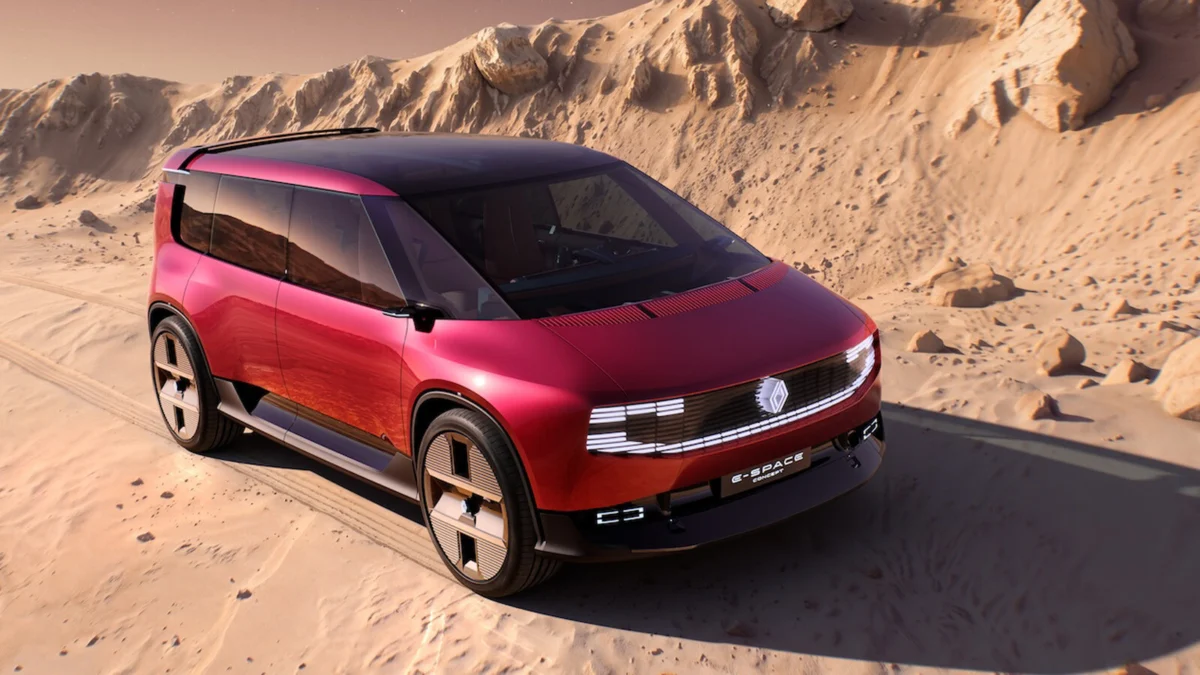
In the history of the European automotive landscape, few brands have disrupted the status quo with the audacity of Renault. From the whimsical, compact genius of the original Twingo to the pioneering silhouette of the Espace, the French manufacturer has long positioned itself as a disruptor of convention. Now, as the industry grapples with the transition to electrification and a saturated market of ubiquitous SUVs, Renault has returned to the Paris Motor Show with a bold proposition: the E-Space Concept.
This is not merely a design study intended to capture headlines and vanish into a museum vault. It represents a potential manifesto for the resurrection of the "Van"—a vehicle segment long considered dead in the shadow of the crossover.
The Core Concept: Redefining Utility
At its heart, the E-Space Concept pays homage to the DNA of the original 1984 Espace. The foundational premise remains unchanged: to provide maximum interior volume within a relatively compact footprint. Measuring 4.7 meters in length, the concept utilizes the inherent advantages of an electric vehicle (EV) platform to maximize interior real estate.
By eliminating the traditional B-pillar, the designers have created an expansive, open-plan cabin that feels more like a mobile lounge than a conventional car. While the B-pillar-less design is a perennial casualty of safety regulations and cost-cutting in mass production, its presence here serves as a powerful visual statement about the future of interior architecture.
The cabin is bathed in light, thanks to generous glazing that extends low along the vehicle’s flanks. Renault has reimagined the seating arrangement, introducing identical, modular seats that can be rotated 180 degrees. This transformation allows for a social "face-to-face" configuration, turning the vehicle into a collaborative space for four passengers. When oriented in the traditional forward-facing direction, the second-row passengers gain access to clever folding tables, complemented by 12.3-inch screens integrated into the backrests of the front seats. Perhaps most innovatively, the second-row seats can be folded down to serve as utility tables for those in the third row, reflecting a highly flexible approach to passenger ergonomics.
A Chronology of Innovation: From Espace to E-Space
To understand the significance of the E-Space, one must look back at the trajectory of the Espace nameplate:

- 1984: The original Renault Espace debuts. It was a revolutionary vehicle, largely without a direct European competitor, creating the modern MPV (Multi-Purpose Vehicle) segment.
- The Golden Era: For decades, the Espace defined the "family car" for the European middle class, prioritizing modularity, comfort, and visibility.
- The SUV Shift: As consumer preferences shifted toward SUVs, the Espace struggled, eventually evolving into a crossover-hybrid that, while functional, lost the unique "van" identity that once made it an icon.
- 2024 (Paris Motor Show): The unveiling of the E-Space Concept. By stripping away the combustion engine and the rigid architecture of the past, Renault is attempting to return to the original philosophy of the Espace—functionality first—but with a modern, zero-emission twist.
Technical Specifications and Interior Design
The shift to a dedicated battery-electric vehicle (BEV) architecture has liberated the design team from the constraints of engine placement and drivetrain tunnels. The massive battery pack is neatly integrated into the floor, providing a low center of gravity and a completely flat interior surface.
The front cabin is dominated by a sweeping 1.13-meter-wide digital display. This massive panel serves as the primary interface for navigation, climate control, and entertainment, representing a significant evolution in HMI (Human-Machine Interface) design. The dashboard and door trims flow into one another, creating a seamless "wraparound" aesthetic.
However, the concept also showcases features that push the boundaries of current production feasibility. The steering wheel, for instance, lacks a conventional airbag housing and integrates control elements directly into the rim. While aesthetically minimalist, such a design faces significant regulatory hurdles. Additionally, the interior floors are finished in high-quality wool fabric—a sustainable and sophisticated touch, though one that raises questions regarding the long-term durability required for a family-focused vehicle.
Performance: Beyond the Hybrid
One of the most compelling arguments for the E-Space is its powertrain. The current production Espace relies on a hybrid setup that, while fuel-efficient, has faced criticism in independent testing for its lack of dynamic flair and occasional lack of harmony in power delivery.
The E-Space Concept swaps this for a pure, battery-electric motor. Beyond the obvious environmental benefits, the electric powertrain is inherently more compact and refined. It offers instant torque and a linear acceleration profile that is far better suited to the "lounge on wheels" experience the E-Space aims to provide. By centralizing the weight and removing the complex mechanical linkages of a hybrid system, the E-Space promises a level of ride comfort and responsiveness that the current internal combustion model simply cannot match.
Official Stance and Market Implications
Renault remains tight-lipped regarding the path to production. When asked whether the E-Space will reach showrooms, official representatives adopt a cautious tone, noting that there is currently no formal production program. However, industry insiders suggest that the reception at the Paris Motor Show will serve as a crucial barometer for management.

The timing is telling. The market is currently reaching a saturation point regarding SUVs. Consumers are increasingly reporting "SUV fatigue," citing the lack of genuine interior space, poor visibility, and excessive weight of many current crossover models.
If Renault proceeds with the E-Space, it could effectively create a new "Electric Van" segment—a category that bridges the gap between the utilitarian passenger van and the premium luxury lounge. Such a vehicle would appeal to urban families, car-sharing services, and high-end shuttle operators who are currently underserved by the standard SUV form factor.
The Strategic Outlook
The E-Space Concept is a gamble on the idea that "form follows function" is a timeless principle. By looking backward to the innovation of the 1984 Espace and forward to the possibilities of an all-electric future, Renault is attempting to reclaim the moral and practical high ground in the family transport segment.
If the concept is brought to life, it will require a careful balance. The company must retain the "magic" of the modular, airy interior while addressing the harsh realities of mass-market manufacturing—such as the integration of safety systems, the durability of interior materials, and the cost-efficiency of the platform.
Ultimately, the E-Space Concept is more than a display piece; it is a signal. It tells the automotive world that Renault believes the era of the boxy, practical, and highly versatile vehicle is not over—it is merely waiting for an electric motor to give it a new lease on life. Whether it succeeds will depend on whether the public is ready to move past the SUV trend and embrace a return to the smart, airy, and efficient design language that once made Renault a pioneer of the road.