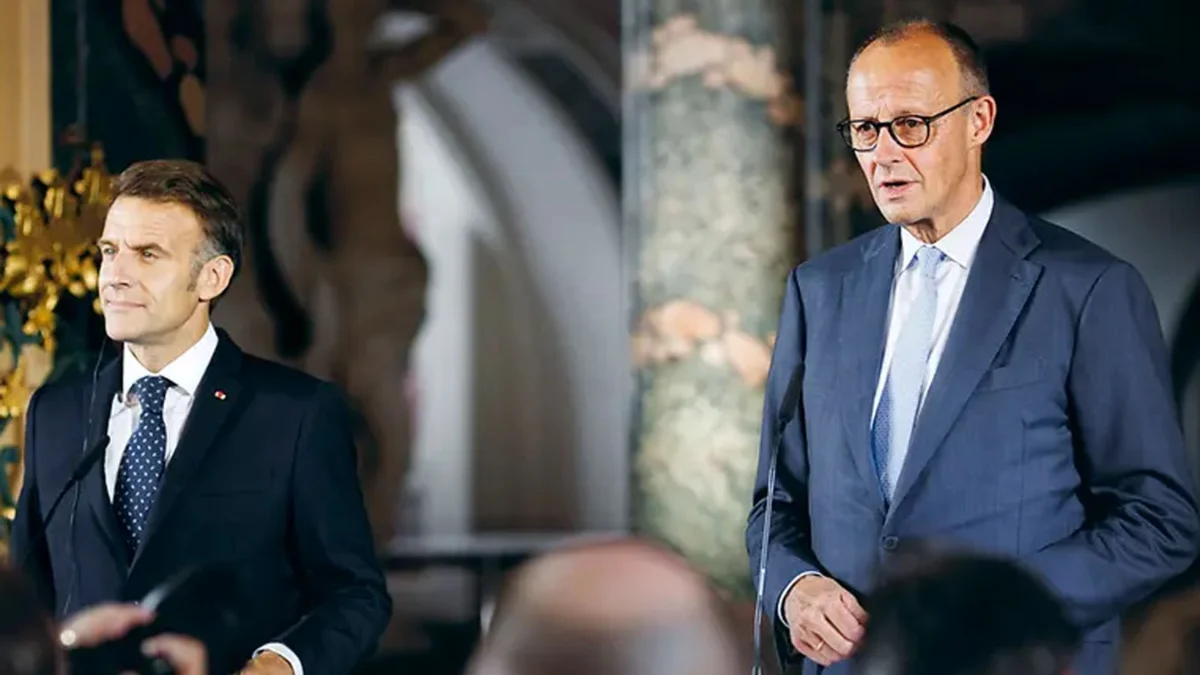
In a move that promises to reshape the landscape of the European automotive industry, German Chancellor Friedrich Merz and French President Emmanuel Macron have reportedly reached a landmark consensus to significantly soften the European Union’s planned 2035 phase-out of combustion-engine vehicles. According to recent reports, the two leaders are pushing to lower the CO2 reduction target for new passenger cars by an additional ten percentage points beyond what the European Commission had initially proposed.
This political pivot, which would effectively see a reduction target of at least 80 percent compared to 2021 levels, represents a major departure from the "net-zero" trajectory previously set by Brussels. While the details of the agreement remain under negotiation, the move is being interpreted as a strategic "quid pro quo": Paris agrees to Berlin’s demands for more lenient fleet emission limits, while Berlin concedes to France’s insistence on stricter "Made in EU" requirements for electric vehicles.
Main Facts: A New Trajectory for 2035
The core of the controversy lies in the interpretation of the EU’s climate mandates. The current Regulation (EU) 2019/631 mandates a 100 percent reduction in CO2 emissions for new cars by 2035. Effectively, this is a de facto ban on the sale of new internal combustion engine (ICE) vehicles that emit CO2.
On December 16, 2025, the European Commission introduced its "Automotive Package," which proposed a nuanced path forward: a 90 percent reduction target, with the remaining ten percent addressed via credits for sustainable renewable fuels (e-fuels) and low-carbon, EU-produced steel. The Merz-Macron initiative, however, seeks to go further by slashing another ten percentage points without requiring additional offsetting measures.
Furthermore, the proposal suggests a shift in the compliance timeline. Rather than the Commission’s preferred averaging period of 2030–2032, the German-French proposal advocates for a five-year window (2028–2032). This extension is intended to provide manufacturers with greater flexibility to balance emissions over a longer duration, thereby avoiding the heavy financial penalties associated with missing annual targets.
Chronology of the Policy Shift
The path to this potential reversal has been marked by mounting pressure from industrial stakeholders and political shifts within member states.
- November 2025: The German coalition government formally signals its intent to seek greater flexibility regarding the 2035 deadline, reflecting growing anxiety within the automotive sector about the pace of electrification.
- December 2025: The European Commission releases its "Automotive Package," attempting to bridge the gap between climate goals and industry realities by introducing credit systems for e-fuels and green steel.
- Early 2026: Regional leaders, including Bavaria’s Minister-President and representatives from Hungary, join the chorus calling for a formal "course correction," citing economic stability and consumer choice.
- Mid-2026: High-level bilateral discussions between Berlin and Paris intensify. Both nations, recognizing their shared influence in the Council, begin to trade policy concessions to secure a unified front against stricter, "all-electric" mandates.
- Late 2026: Media reports from Handelsblatt confirm the secret consensus between Merz and Macron, setting the stage for a contentious debate in the European Parliament.
Supporting Data: Understanding the 80 Percent Threshold
Critics and proponents alike are grappling with what an "80 percent reduction" actually means for the average European driver. It is vital to clarify that this figure does not translate to a mandate that 20 percent of new cars must be combustion-powered. Instead, it limits the average emissions of a manufacturer’s fleet.
The actual number of combustion engines, plug-in hybrids, or range-extender vehicles on the road will depend on a complex calculus of emission values, the specific model mix, and the utilization of sustainability credits. While the Commission estimated that its 90 percent proposal would allow for roughly 27 to 29 percent of new registrations to retain some form of combustion technology, there is currently no reliable data for the 80 percent scenario. Experts warn that without a "life-cycle" accounting method—which is currently not part of the plan—the focus will remain strictly on "tailpipe" emissions, potentially masking the environmental impact of battery production and fuel sourcing.
The "Made in EU" Trade-Off
The price of Germany’s newfound flexibility is its agreement to the "Industrial Accelerator Act" (IAA). France, long a proponent of "strategic autonomy," has successfully tied the emission-standard relaxation to stringent local-content requirements.
Under the proposed IAA, state-funded procurement of electric vehicles will be restricted to those manufactured within the EU. The requirements are exhaustive:
- Assembly: The vehicle must be assembled within the European Union.
- Components: At least 70 percent of the component value (excluding the battery) must originate from the EU.
- Battery Standards: Strict criteria for cell production, cathode materials, and battery management systems must be met, with requirements tightening significantly after a three-year grace period.
Berlin had previously lobbied to include trade partners like Turkey, Morocco, and Vietnam, fearing that protectionist measures would disrupt established supply chains and drive up costs. However, in the interest of securing the combustion engine compromise, Germany appears to have dropped these objections, leaving manufacturers to face the logistical challenge of sourcing limited European battery components.
Implications for the Industry and the EU
The implications of this agreement are far-reaching, affecting both the climate agenda and the economic fabric of the continent.
The Political Struggle
The proposal must still survive the "ordinary legislative procedure," requiring a qualified majority in the Council (15 member states representing 65 percent of the EU population) and a vote in the European Parliament. The parliamentary landscape is deeply divided. While the Greens have signaled a potential willingness to compromise, they remain wary of any alliance between the European People’s Party (EPP) and right-wing factions. Conversely, liberal MEPs are demanding rapid decisions to save jobs and maintain investment certainty.
Industrial Uncertainty
For automotive giants that have invested billions into battery gigafactories and pure-electric platforms, the shifting goalposts create a significant "planning risk." Manufacturers have spent years pivoting their entire product roadmaps toward 2035; if the rules change again, they risk being caught between stranded assets and the need to maintain legacy ICE production lines.
Environmental Skepticism
Environmental NGOs and some member states have raised red flags, arguing that the inclusion of credits for steel and fuels serves only to dilute the climate mandate. They contend that these loopholes provide a "back door" for the continued dominance of the combustion engine, effectively slowing down the essential transition to renewable energy in the transport sector.
Conclusion
The agreement between Chancellor Merz and President Macron is a microcosm of the broader struggle facing the European Union: the attempt to reconcile ambitious climate goals with the harsh realities of industrial competitiveness and economic stability. By attempting to lower the 2035 target, the two leaders are signaling that the "all-electric" future is not as inevitable as once thought.
However, by linking this change to protectionist "Made in EU" requirements, they are also ushering in a new era of European industrial policy—one that prioritizes domestic manufacturing capacity over the efficiency of global supply chains. As the debate moves to the European Parliament in late 2026, the continent faces a fundamental choice: stick to the rigid, albeit difficult, path of full decarbonization, or pivot toward a more flexible, nationalist, and potentially slower transition to a greener economy.