In the world of archaeology, the most profound insights into human history are often found in the places our ancestors sought to discard and forget. While golden treasures and royal tombs capture the public imagination, researchers have long known that the true "gold mines" of social history are, quite literally, found in the cesspits and latrines of antiquity. Recently, a team of archaeologists in the German city of Paderborn made a discovery that bridges the gap between the mundane realities of medieval sanitation and the sophisticated intellectual life of the 13th century: a rare, remarkably preserved medieval notebook found in the depths of an ancient household latrine.
A Discovery in the Depths: The Context of the Find
The excavation, conducted by the LWL-Archaeology team, serves as a poignant reminder that history is not merely preserved in cathedrals or state archives, but in the anaerobic, moisture-rich environments of urban waste pits. Because these environments are often sealed off from oxygen and light, they act as natural time capsules, preventing the decay of organic materials that would otherwise vanish within a few short years.
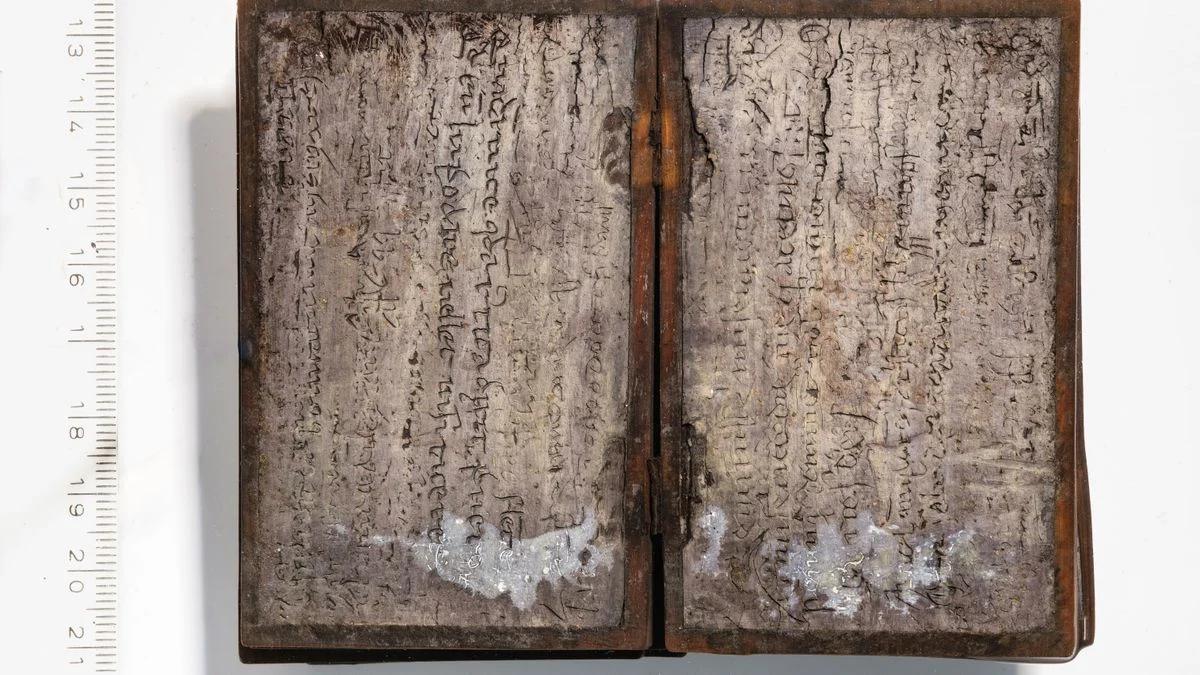
The object in question is a ten-page notebook, roughly the size of modern-day playing cards. It is an artifact of profound rarity—the first of its kind ever recovered from such a setting. The "pages" consist of wooden frames, each filled with a thin, hardened layer of wax. This design allowed the medieval owner to scratch notes, accounts, or reminders into the surface with a stylus, only to smooth them over and "reset" the tablet when the information was no longer required. It was, in essence, the medieval precursor to the modern erasable tablet or digital notepad.
Chronology of the Excavation and Recovery
The recovery of this artifact was a delicate, multi-stage process that highlights the challenges of urban archaeology:
- Discovery: During a routine urban redevelopment excavation in Paderborn, the team identified a structural feature characteristic of a medieval latrine—a stone-lined pit that had once served a high-status residence.
- Extraction: Given the fragile state of the organic materials found within, the team utilized specialized extraction techniques to stabilize the artifacts, preventing rapid degradation upon contact with the modern atmosphere.
- Conservation: The notebook, having spent centuries submerged in a combination of fecal matter and soil, required extensive chemical cleaning. Experts worked to remove the calcified residues and environmental contaminants that had coated the object since the 13th or 14th century.
- Preliminary Analysis: Once the surfaces were cleared, researchers confirmed the nature of the object. While the wax surface is scarred with what appears to be a chaotic, "scrawled" shorthand, the physical integrity of the wooden frames remains largely intact.
The Science of the Latrine: Why We Dig in Waste
To the layperson, the study of historical latrines—or "archaeological coprolite research"—may seem distasteful, yet it is arguably the most reliable source of information regarding the daily life of the common and elite citizen alike.
Dietary Insights and Public Health
By analyzing the organic remains within these pits, scientists can reconstruct the diet of the household with startling precision. Seeds, pollen, and bone fragments reveal what was consumed, while the analysis of ancient parasites (such as whipworm or roundworm eggs) provides a clear picture of the pathogens that plagued urban populations. This data allows epidemiologists and historians to track the spread of disease and the evolution of sanitary practices throughout the Middle Ages.
The Preservation of the Mundane
The Paderborn find is particularly striking because it includes not only the notebook but also fragments of silk. This juxtaposition—high-status textile waste found in the same refuse as a writing tool—suggests that the household was one of significant wealth. The presence of silk, often used as a luxury item for personal hygiene, indicates that the disposal site was connected to a residence of considerable social standing.
Expert Perspectives and the Challenge of Decipherment
The primary hurdle now facing the LWL-Archaeology team is the decipherment of the text. The script is described as "krakelig"—a German term for a shaky, hurried, or messy handwriting.

"The difficulty lies in the combination of the script style and the medium," notes one lead researcher. "Writing on wax with a stylus produces a very different aesthetic than pen on parchment. We are dealing with a shorthand that was likely never intended to be preserved for posterity."
The text is believed to be written in Latin, the lingua franca of the medieval administrative and scholarly classes. A panel of paleographers and medievalists is currently being assembled to use high-resolution imaging and multispectral scanning to isolate the indentations in the wax. The goal is to determine if the notebook served as a merchant’s ledger, a student’s practice slate, or perhaps a collection of religious devotions.
Implications for Medieval Literacy
The existence of this notebook has significant implications for our understanding of medieval literacy. For decades, the narrative of the Middle Ages was dominated by the idea that literacy was the exclusive domain of the clergy or the nobility. However, the presence of a "portable" note-taking device in a private household suggests a more widespread necessity for recording information in daily urban life.
If this was indeed a personal notebook, it demonstrates a level of cognitive habits that mirror our own: the need to organize, track, and manage information on the go. It shifts the perception of the medieval person from a static, agrarian laborer to a dynamic participant in an information-heavy, albeit localized, economy.
Future Research and the Digital Frontier
As the team at Paderborn moves into the next phase of the project, they are looking toward modern technology to bridge the gap between the 14th century and the 21st. They plan to utilize 3D laser scanning to map the depth of the stylus marks. Because the wax is brittle, physical contact must be kept to an absolute minimum, making digital reconstruction the only viable path to reading the "invisible" words.
The public interest in this discovery has been immense. It serves as a reminder that the medieval world was not a monochrome, static era, but one of complex, tactile interaction with knowledge. The notebook—a fragile, re-writable tool—represents the human drive to extend memory beyond the limitations of the brain.
Conclusion: Lessons from the Rubbish
The Paderborn notebook is more than just an archaeological curiosity; it is a testament to the continuity of human behavior. From the ancient scribes who used wax to keep track of their grain shipments to the modern office worker with a tablet, the fundamental desire to record, process, and discard information remains constant.
As the experts continue their work, the world waits to see what this "medieval iPad" has to say. Perhaps it contains the mundane shopping list of a wealthy merchant, or perhaps it holds a private prayer. Regardless of the content, the artifact itself stands as a monumental success for the field of archaeology, proving once again that in the refuse of the past lies the true narrative of our collective history. The Paderborn latrine has yielded a secret that, once deciphered, will undoubtedly add a new, human dimension to our understanding of the 13th century—proving that even in the most unlikely of places, history is waiting to be written.