As Europe grapples with an unprecedented frequency of forest fires—a crisis exacerbated by a changing climate—researchers are challenging the traditional impulse to "clean up" burnt landscapes. New evidence suggests that the most effective path to forest restoration may be to step back and let nature take the lead.
The Mounting Crisis: A Continent in Flames
The summer of 2026 has served as a grim reminder of the volatility of Europe’s forests. From the scorched hillsides of Southern France to the fire-ravaged landscapes surrounding Madrid and the outskirts of Paris, the continent is witnessing a fire season of historic proportions. In Germany, the situation is equally dire. Following a 2025 that the European Forest Fire Information System (EFFIS) identified as the worst year for forest fires in five decades, 2026 has continued this alarming trajectory.
The destruction is not merely local; it represents a systemic failure of forest management in the face of rapidly changing climatic conditions. Droughts have turned vast swathes of European woodland into tinderboxes. When flames consume these areas—as seen in the Müritz National Park and the Harz region—the immediate reaction from authorities and the public is often a desperate desire to restore order. The traditional playbook involves clearing charred timber, turning the soil, and aggressively planting new saplings. However, a growing body of scientific research is now questioning whether this interventionist approach is doing more harm than good.
Chronology of Research: The "Pyrophob" Project
The paradigm shift in how we view post-fire landscapes began in the wake of the devastating 2018 wildfire near Treuenbrietzen, Brandenburg. The fire was so intense that its plumes were visible from space and covered Berlin in a thick haze. In response, a team of ecologists launched a project with the ironic name Pyrophob ("fire-fearing").
Their goal was simple yet radical: to compare the recovery of areas that were actively "managed" post-fire against areas that were left entirely to their own devices. After five years of longitudinal study, the results have sent shockwaves through the forestry community. The data suggests that aggressive human intervention—specifically the removal of deadwood and the mechanical turning of soil—can actually stifle the natural regeneration of complex ecosystems.
Supporting Data: Why "Doing Nothing" is Often Better
The findings of the Pyrophob project are stark. Researchers observed that areas where the soil was left undisturbed and deadwood was allowed to remain showed significantly faster signs of recovery. In contrast, artificial reforestation efforts—specifically the planting of monoculture pine saplings—often resulted in failure.
"If we had simply trusted the natural process, it would have been free and far more effective," notes Professor Pierre Ibisch, a lead researcher at the Eberswalde University for Sustainable Development (HNE). "Instead, we spent resources planting tiny trees that, in many cases, withered and died over the following years because the soil had been compacted and the microclimate disrupted by our interference."
The study highlights that a forest is not merely a collection of trees; it is a complex, subterranean, and atmospheric network. By removing charred logs, managers remove the very substrate that holds moisture, protects young seedlings from extreme heat, and provides nutrients to the burgeoning fungal networks.
The Silent Architects: Insects and Fungi
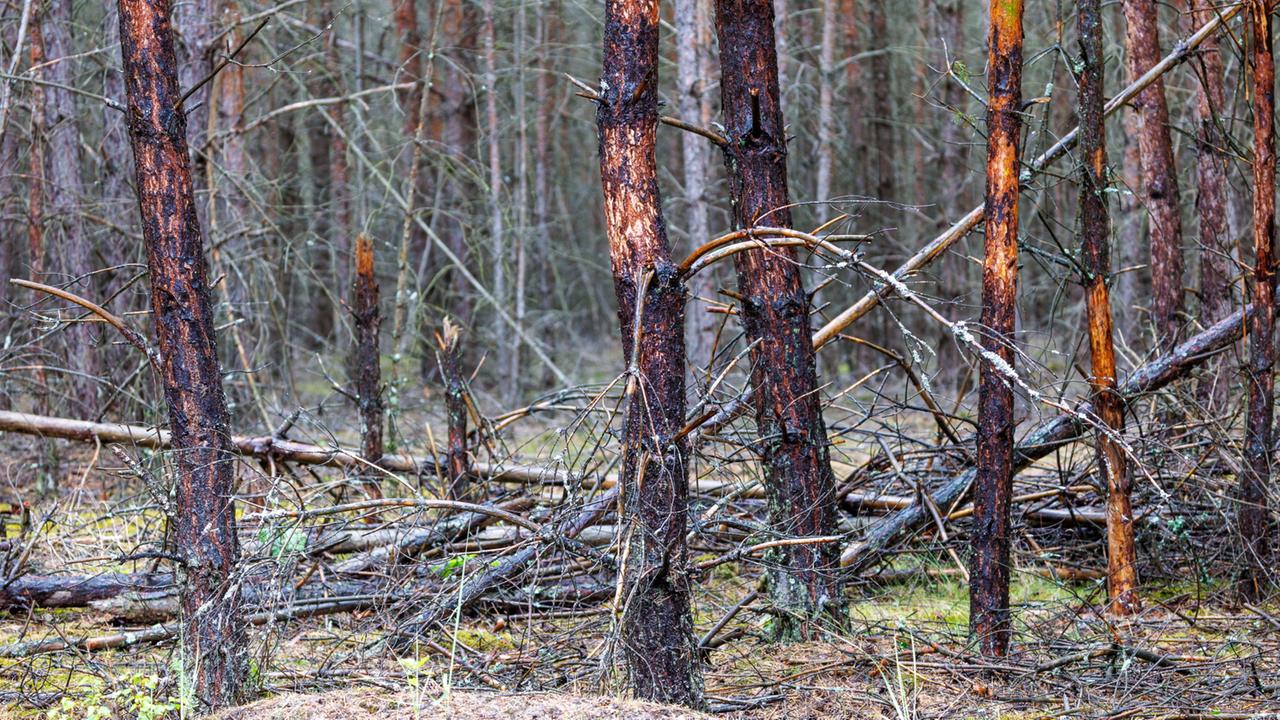
The research has revealed that the "charred wasteland" is, in reality, a hive of intense biological activity. In the Sächsische Schweiz (Saxon Switzerland) region, following the 2022 fires, biologists discovered a flourishing of biodiversity that defied expectations.
The Role of Specialized Insects
Specialists like Jörg Lorenz have been tracking the "succession of insect fauna"—the order in which species return to a burn site. Among the most fascinating is the Black Pine Sawyer Beetle (Monochamus galloprovincialis). These insects are evolutionary masters of fire; they possess sensors that can detect heat radiation from kilometers away. While humans see a disaster, these beetles see a nursery. They arrive while the ground is still smoldering to lay their eggs in the scorched wood.
The Fungal Revolution
Complementing the insects are fungi, specifically the Brandstellen-Becherling (fire-site cup fungus). Environmental biologist Alexander Karich and his team documented these fungi growing at record-breaking speeds—up to two millimeters per hour.
These fungi are the forest’s chemical engineers. They break down the carbonized, stable structures of burnt wood, turning it into nutrients that can be absorbed by the next generation of plant life. Without this mechanical and chemical breakdown provided by beetles and fungi, the landscape would remain static. With them, the cycle of life resets with remarkable speed.
Official Responses and Policy Implications
The evidence from the Pyrophob project and similar studies in Saxony is beginning to filter into policy discussions. Forest ministries across Europe are facing pressure to move away from the "timber-farm" mentality—where forests are treated as agricultural crops—toward a "process-protection" model.
The current policy debate centers on the concept of "passive restoration." Critics of this approach argue that it leaves forest owners with no economic yield and increases the risk of further fires due to the presence of dry, standing timber. However, the scientific consensus is shifting. There is an increasing recognition that a forest which grows naturally is more resistant to future fires because it develops a more diverse species composition and a more resilient soil structure.
In Saxony, the emergence of birch stands and lush fern cover within just three years of the 2022 fires has served as a powerful visual argument for this "hands-off" approach. Local officials, once keen to clear the "mess," are now observing the return of dense vegetation with a new appreciation for the forest’s inherent self-healing capabilities.
Implications: A New View of the Landscape
The narrative surrounding forest fires is undergoing a fundamental transformation. We are moving from a perspective of "catastrophe and cleanup" to one of "disturbance and renewal."
Resilience in the Age of Climate Change
Climate change ensures that fires will continue to be a reality of the European landscape. Attempting to suppress nature’s way of clearing old, stagnant growth may be a losing battle. By allowing the natural succession to occur, we allow the ecosystem to adapt to the new, warmer climate. Native species that thrive in disturbed soil, such as birch and aspen, are often more drought-resistant and better suited to the post-fire microclimate than the industrial pine plantations of the 20th century.
Ethical and Economic Considerations
The economic argument for "letting it be" is compelling. Millions of euros are spent annually on post-fire site preparation and planting, much of which is wasted on saplings that struggle to survive in degraded soil. Redirecting these funds toward fire prevention—such as creating firebreaks, managing invasive species, and restoring wetland buffers—could offer a far higher return on investment.
The Human Perspective
Ultimately, the most difficult hurdle to clear is the psychological one. Humans find it hard to look at a black, charred forest and see anything other than loss. We crave the green canopy we once knew. However, the science is clear: the green canopy of the future will not be the same as the one we lost. It will be a more resilient, diverse, and dynamic forest, born from the very ashes we once feared.
As we look toward the future of Europe’s forests, the message from the researchers is one of cautious optimism. The forest is not dead; it is simply beginning a new chapter. By acting as stewards rather than masters, we can ensure that these landscapes not only recover but thrive in a changing world. The path forward is not found in the nursery or the tractor, but in the patient observation of a forest that knows exactly how to heal itself.