Germany stands at a pivotal crossroads in the digital age. As the global race for dominance in Artificial Intelligence (AI) intensifies, a striking disconnect has emerged within Europe’s largest economy: while German researchers continue to produce world-class scientific output, the nation is failing to translate this intellectual prowess into commercial success.
This core finding, highlighted by a recent comprehensive study from the Leibniz Institute for Research on Society and Space (IRS), paints a stark picture of a "Wissenschafts-Paradoxon"—a scientific paradox where Germany functions primarily as a global knowledge exporter, while the financial rewards of that innovation are reaped elsewhere. Nowhere is this gap more visible than in Central Germany, where high-ranking research hubs like Dresden and Leipzig struggle to secure the venture capital necessary to turn breakthroughs into industry-leading companies.
The Main Facts: An Uneven Landscape of Innovation
The AI-Atlas, authored by Andreas Kuebart of the Leibniz Institute in Erkner, provides a detailed taxonomy of Germany’s AI landscape by analyzing four pillars: academic research, startup formations, venture capital flow, and computational infrastructure. The data reveals a tale of two maps.
The first map, illustrating academic output and research, shows a decentralized and vibrant landscape. AI research is not confined to a few elite hubs; it is distributed across the entire nation, with significant clusters found in both the established west and the rapidly evolving east.
The second map, however, tells a tale of extreme centralization. When it comes to the lifeblood of the startup ecosystem—venture capital—the geography of success collapses into two dominant poles: Munich and Berlin. Between 2021 and 2025, Munich alone attracted approximately 5.8 billion euros in AI investment, while Berlin secured 2.9 billion euros. Together, these two cities account for two-thirds of all AI-related venture capital in Germany.
For Central Germany, the data is sobering. While the region is an academic heavyweight, it remains a financial lightweight. In the national rankings of investment, only Dresden makes a notable appearance, while major academic hubs like Leipzig, Jena, Magdeburg, and Chemnitz remain largely invisible to venture capitalists.
Chronology of the Divide: How We Got Here
The evolution of Germany’s AI landscape has been a multi-decade process, moving from foundational research to the current era of commercial scaling.
- 2010–2015: The Academic Foundation: During this period, German universities and research institutes, particularly in the east, invested heavily in machine learning and data science. The Technical University of Dresden, among others, solidified its reputation as a powerhouse, building the intellectual infrastructure that would define the next decade.
- 2016–2020: The Emergence of the "Winner-Takes-All" Market: As AI began to move from lab to market, the capital-intensive nature of the industry became clear. Investors began flocking to pre-existing startup ecosystems, primarily Berlin and Munich, creating a self-reinforcing feedback loop where capital attracts talent, which in turn attracts more capital.
- 2021–2025: The Widening Gap: The current period is defined by a massive influx of private equity and venture capital. The gap between research output and commercial application has reached a critical threshold. While research remains distributed, the concentration of financial resources has left regional innovators at a distinct disadvantage.
Supporting Data: By the Numbers
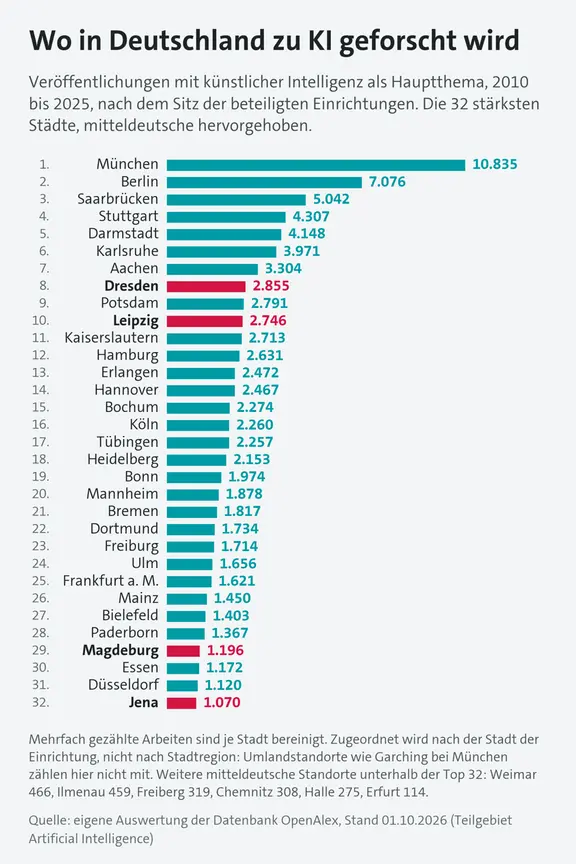
To better understand the performance of Central Germany, an independent analysis of the OpenAlex database—the same source used for the Leibniz Institute’s report—reveals a region that is punching significantly above its weight in research, even if that is not reflected in financial charts.
Research Output (2010–2025)
- Dresden: 2,855 AI-related publications.
- Leipzig: 2,746 AI-related publications.
- TU Dresden (alone): 2,164 publications, placing it among the top ten strongest institutions in Germany.
- Secondary Hubs: Magdeburg (1,196) and Jena (1,070) continue to contribute significantly, followed by Weimar, Ilmenau, Freiberg, Chemnitz, Halle, and Erfurt.
Collectively, these Central German locations are responsible for approximately 10% of all German AI publications—a figure that actually exceeds that of Berlin. The discrepancy arises when comparing this academic volume to the financial reality. While Central Germany accounts for nearly 9% of national AI research, it captures less than 1% of the available venture capital. In contrast, Munich manages to capture roughly 40% of the capital while accounting for only 12% of the research.
Official Responses and Expert Analysis
Andreas Kuebart, the lead researcher behind the Atlas, cautions against reacting to these figures with unbridled "actionism." He argues that the solution is not to simply chase the highest number of startups or the most funding, but to focus on "targeted application."
"Germany does not need to become a copy of Silicon Valley," Kuebart notes. "Our strength lies in our deep-rooted industrial base—robotics, mechanical engineering, and complex service sectors. If we can apply AI to these specific fields where we already lead, we create a sustainable competitive advantage that is harder to replicate than a generic software startup."
Furthermore, the report highlights a broader, nationwide challenge: the slow adoption of AI by the "Mittelstand"—the small and medium-sized enterprises (SMEs) that form the backbone of the German economy. Currently, only 23% of small businesses and 36% of medium-sized enterprises in Germany utilize any form of AI technology. This lack of domestic demand for AI services creates a vacuum that keeps capital away from the regional players who might otherwise serve those markets.
Implications for the Future
The findings of the AI-Atlas present a clear imperative for policymakers and regional leaders. The "Wissenschafts-Paradoxon" is not merely an economic concern; it is a structural threat to Germany’s long-term autonomy in the digital economy.
1. Bridging the Capital Gap
The lack of investment in regions like Leipzig and Jena cannot be solved by state funding alone. It requires the development of regional "angel" networks and the encouragement of private equity firms to look beyond the "Munich-Berlin" axis. Tax incentives for regional startup investments could play a pivotal role.
2. Industry-Specific Integration
The path forward for cities like Dresden is likely through the marriage of their existing academic strength with their local industrial sectors. By creating incubators that focus specifically on "Industrial AI" (applying algorithms to manufacturing, logistics, and medical technology), these regions can leverage their existing expertise rather than trying to compete in the saturated consumer-AI market.
3. Digital Literacy for the Mittelstand
As long as small and medium-sized businesses remain hesitant to adopt AI, there will be no local market for the innovators emerging from universities. State-funded digital transformation programs must shift focus from broad tech-promotion to the specific, practical needs of the local Mittelstand.
4. The Human Capital Factor
The talent is clearly present in Central Germany. The high volume of publications indicates a deep pool of skilled researchers. The challenge now is to prevent a "brain drain," where this talent migrates to the capital or the south because that is where the funding is located. Creating an environment where these individuals can launch their own ventures locally is the only way to reverse the current trajectory.
Conclusion
The latest data from the Leibniz Institute is a wake-up call. Germany possesses the intellectual ingredients to lead the global AI revolution, yet it continues to serve as a laboratory for the rest of the world. By recognizing that the "Science-Capital Gap" is a structural issue—rather than a lack of talent—the country can begin to build a more equitable and robust innovation ecosystem. For the cities of Central Germany, the goal is clear: they have already proven they can think with the best; now they must develop the financial infrastructure to ensure that the future of AI is not only researched here, but built and scaled here as well.