Introduction: A Remarkable Display of Marine Intelligence
In the vast, azure expanse of the Gulf of California, marine biologists have captured a behavior that challenges our understanding of apex predator social dynamics. Recent high-definition video footage, published in the journal Frontiers in Ethology, documents a sophisticated, coordinated action among orcas (Orcinus orca): the deliberate, high-speed ramming of deceased sunfish (Masturus lanceolatus).
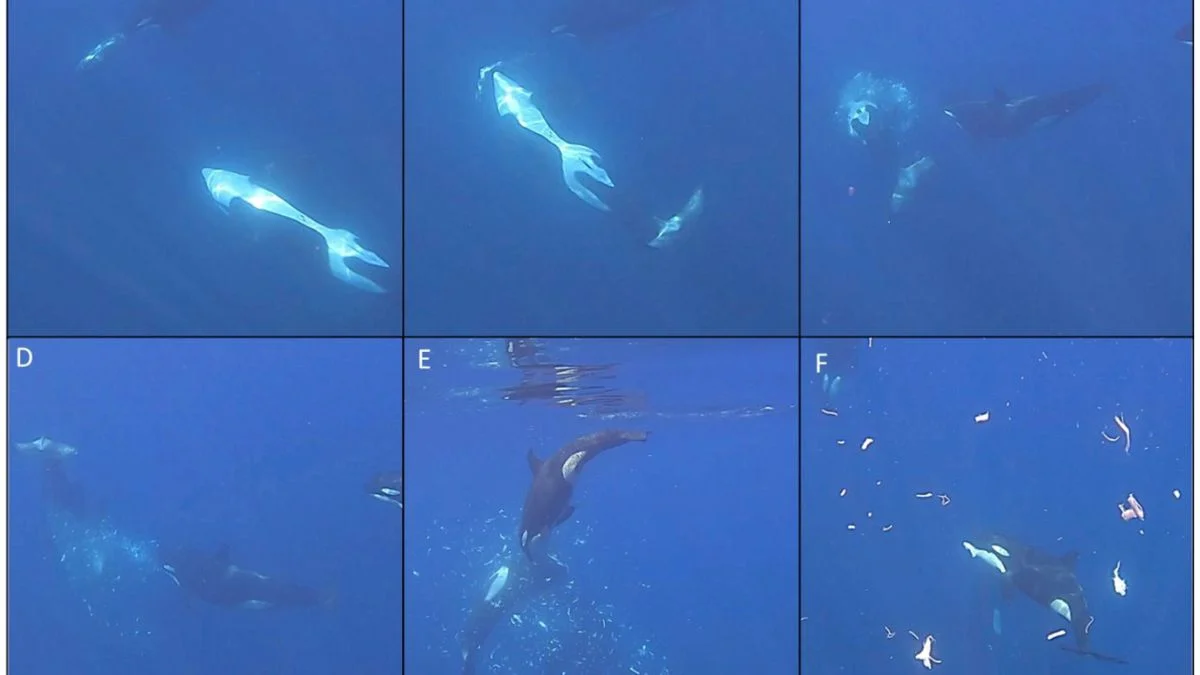
The footage, which captures orcas working in tandem to literally shatter their prey into bite-sized pieces, provides a rare window into the complex social learning and cooperative strategies employed by these intelligent cetaceans. This discovery, led by Kathryn Ayres of the marine conservation organization Beneath The Waves, suggests that orcas possess a nuanced understanding of prey processing that extends beyond simple hunting.
The Mechanics of the "Ramming" Strategy
The documented behavior is far from chaotic; it is a calculated, multi-stage operation. According to the research, the process begins when an orca retrieves a deceased sunfish—a bulky creature that can reach lengths of over three meters and weigh more than two metric tons.
In the specific incidents observed off the coast of Baja California Sur, an adult female orca was seen holding the sunfish by its large, distinctive caudal fin. While she anchored the prey, a second, male orca positioned himself at a distance, accelerating rapidly toward the fish. In a display of impeccable timing, the female released the sunfish mere moments before the male made contact. The kinetic energy generated by the collision caused the sunfish’s thick, rubbery tissue to fragment instantly into hundreds, if not thousands, of smaller pieces.
Why Ramming?
The primary consequence of this impact is the rapid physical disintegration of the carcass. Because sunfish possess a tough, resilient skin and structure, they are often difficult for younger or smaller orcas to consume. By "processing" the carcass through high-velocity impact, the adult orcas effectively pre-digest the meal for the younger members of the pod, transforming a cumbersome obstacle into manageable scraps.
Chronology of the Observations
The documentation of this behavior spanned two years, providing scientists with a longitudinal view of what appears to be a consistent social ritual within specific pods in the Gulf of California.
- 2024 (Baja California Sur): The inaugural high-definition recording took place off the southern coast of the Mexican peninsula. Researchers observed a pod interacting with a deceased Spitzschwanz-Mondfisch (Sharptail mola). The prey was already partially eviscerated, suggesting the orcas had previously removed the nutrient-dense inner organs—a known habit of orcas in this region. The ramming occurred as a secondary phase of consumption.
- 2025 (Isla Cerralvo): A second, nearly identical incident was documented near Isla Cerralvo, further cementing the behavior as a learned, recurring social practice rather than a one-time anomaly.
In both instances, the aftermath was consistent: juvenile orcas were observed moving in to feed on the resulting fragments, while the adult orcas focused on the larger, more substantial remnants of the body, largely ignoring the smaller pieces created by the impact.
Supporting Data and Biological Context
The sunfish is a unique prey item. Known for its awkward, disk-like shape and immense size, it inhabits varying depths but often surfaces, making it accessible to surface-dwelling predators like orcas.
The Frontiers in Ethology study highlights that this ramming is not a method of killing. By the time the ramming begins, the sunfish are already dead, and their most energy-rich components—the internal organs—have already been harvested. This distinction is critical: the behavior is not driven by the need for a "kill," but by the need for efficient resource distribution.
The Role of Social Learning
Orcas are renowned for their culture—the transmission of skills, dialects, and hunting techniques from generation to generation. The fact that juveniles are the primary beneficiaries of the "shattered" carcass suggests that this behavior serves a pedagogical purpose. By providing smaller pieces, the adults ensure that young orcas, who may lack the jaw strength or experience to tear through thick sunfish hide, can still receive necessary nutrition.
Furthermore, the playfulness observed by the researchers suggests that these interactions reinforce social bonds. In the wild, orcas are famous for "playing" with their food, and this activity likely serves as a communal event that strengthens the group hierarchy and cooperation.
Official Responses and Scientific Interpretations
Kathryn Ayres and her team have posited several theories regarding the evolutionary drive behind this behavior. "We suspect that this facilitates feeding for younger orcas, or simply serves as a form of play," Ayres noted in the study.
The scientific community has responded with interest, viewing this as a significant addition to the catalog of "cultural behaviors" in cetaceans. Dr. Elena Rodriguez, a marine biologist not involved in the study, commented on the significance of the findings:
"What we are seeing is not just brute force, but the application of physics for social benefit. The orcas are essentially using their own bodies as tools to modify their environment. It highlights the staggering cognitive gap between simple predator-prey dynamics and the sophisticated, managed feeding structures we see in pods."
The "Parental Care" Hypothesis
The most widely accepted interpretation among the authors is the "Parental Care" model. By acting as a sort of "living meat grinder," the adults reduce the energy expenditure required for juveniles to feed. In an environment where energy conservation is key to survival, this efficient delivery of food is a massive evolutionary advantage.
Broader Implications: The Intelligence of Apex Predators
The implications of this study are profound, suggesting that the "culture" of orcas is far more expansive than previously thought. If a group can develop and pass down a specific, complex method for processing a particular species of fish, it implies a level of communication and long-term memory that rivals the most intelligent terrestrial mammals, including chimpanzees and elephants.
Conservation Perspectives
Understanding how orcas interact with their prey is also vital for conservation. As climate change and human activity continue to alter the biodiversity of the Gulf of California, understanding the specific dietary requirements and feeding behaviors of these apex predators helps researchers map out critical habitats. If orcas are dependent on specific "teaching moments" or social rituals to raise their young, protecting those social environments becomes as important as protecting the fish stocks themselves.
Future Research Directions
The research team plans to continue monitoring the pods around Isla Cerralvo to determine if this behavior is observed in other orca populations globally. If this is a learned behavior unique to specific pods, it could lead to the identification of distinct "sub-cultures" within the species.
Furthermore, researchers are looking into whether this ramming behavior is applied to other large, tough-skinned prey. If the orcas are indeed "tool-using" predators in the most physical sense, the boundaries of what we define as "hunting" may need to be redrawn.
Conclusion: A Window Into the Deep
The sight of an orca accelerating toward a floating, dead sunfish, only to have it vanish in a cloud of debris as a juvenile drifts in to feed, is a testament to the sophistication of marine life. This is not merely a search for calories; it is a masterclass in coordination, a demonstration of social care, and a glimpse into the mysterious, intelligent lives of the ocean’s most formidable predators.
As the scientific community continues to peel back the layers of orca society, one thing remains clear: we are only beginning to scratch the surface of the complex, intergenerational knowledge that defines life beneath the waves. The Gulf of California, with its rich, vibrant ecosystem, remains the perfect laboratory for these discoveries—a place where the rules of the wild are written not just in instinct, but in the deliberate, social actions of the giants of the deep.