By Science Desk Reporter
For centuries, humans have projected their own emotional landscapes onto the animal kingdom, often anthropomorphizing the behaviors of our fellow creatures. However, a groundbreaking observation off the coast of Australia has reignited a profound scientific debate: Do whales experience grief?
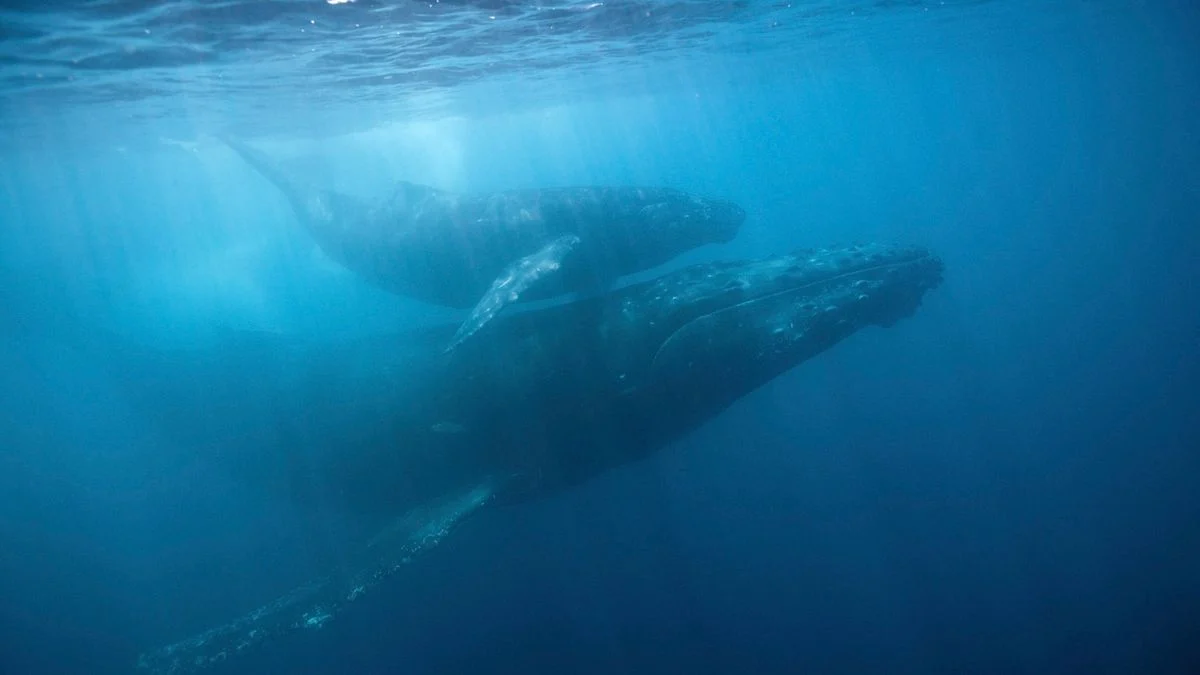
On July 17, 2025, researchers monitoring the waters near Australia’s Gold Coast witnessed a scene of quiet, devastating intimacy. A female humpback whale, typically a creature of constant motion and migration, remained anchored to the seafloor for hours, hovering over the motionless body of her calf. This behavior, now documented in the scientific journal Discover Animals, marks the first time such an occurrence has been formally recorded in baleen whales, challenging our understanding of cetacean emotional intelligence.
The Chronology of an Extraordinary Vigil
The incident began on a mid-July morning, when researchers from the Whales & Climate Research Program at Griffith University, led by Dr. Olaf Meynecke, observed a solitary female humpback whale exhibiting atypical behavior. Rather than continuing her migratory path, the whale remained in a specific area near the seabed.
Hour One: The Initial Contact
Upon closer inspection, researchers realized the female was not resting, but attending to a deceased calf. For the first sixty minutes, the mother exhibited a repetitive cycle of physical interaction. She would dive, touch the calf with her rostrum (head), and use her pectoral fins to nudge the small body. Her movements were slow, deliberate, and entirely devoid of the usual frantic energy seen in surface-level feeding or play.
Hour Two: The Stationary Silence
As the observation stretched into the second hour, the intensity of the behavior shifted. The mother began to lie perfectly still alongside the calf. For intervals lasting at least a minute at a time, the massive mammal—weighing several tons—remained motionless in the water column, seemingly suspended in a vigil. This was not a survival behavior; it offered no energetic advantage and, in the shark-rich waters of the Gold Coast, placed the mother at increased risk.
The Following Days: Lingering Spirits
The mystery deepened on July 18 and 19. Researchers returned to the same coordinates and observed two adult humpback whales circling the area for several hours. While it remains impossible to verify with 100% certainty if these were the same individuals, the persistence of their presence suggests a lingering attachment to the site of the loss, hinting that the "vigil" may have extended far longer than the initial two-hour observation period.
Supporting Data and the "Baleen Barrier"
While the scientific community has long accepted that toothed whales (odontocetes), such as orcas and bottlenose dolphins, display complex social bonds and behaviors indicative of grief, this is the first time such evidence has been captured for a baleen whale (mysticete).
Why Has This Never Been Seen Before?
The absence of previous documentation is not necessarily proof of absence in nature. Dr. Meynecke suggests a logistical explanation: the physical properties of baleen whale calves. Young baleen whales often possess a lower fat-to-muscle ratio compared to their adult counterparts. Upon death, this lack of buoyancy often causes their carcasses to sink rapidly to the seafloor.
Because most whale research occurs at the surface or via aerial drone surveys, these tragic events typically occur in the "dark zone" of the deep ocean, far removed from human eyes. The Gold Coast observation was only made possible due to specific water clarity and the calf’s positioning, which allowed researchers to witness a phenomenon that likely occurs frequently but goes entirely unrecorded.
Official Analysis: Scientific Perspectives
In the published report, Dr. Olaf Meynecke provides a measured but compelling analysis of the event. He notes that the behavior observed—the repeated physical contact, the protective positioning, and the prolonged stationary period—aligns with the "care-giving" and "nurturing" responses documented in other socially complex mammals after the death of a peer.
"These behaviors are consistent with maternal care-giving actions," Dr. Meynecke writes. "They indicate an innate, powerful maternal bond that persists even after the biological reality of death has occurred."
The "Grief" Debate
Is it grief? While science is inherently cautious about attributing human emotions to animals, the behavioral markers are undeniably significant. The act of "carrying" or "guarding" a dead calf is a phenomenon known as epimeletic behavior. In the context of this study, the term refers to the care and attention given by one animal to another that is in distress or deceased. Whether this stems from a cognitive understanding of loss or an instinctive failure to recognize the transition from life to death is the central question currently facing marine biologists.
Broader Implications: Redefining Cetacean Intelligence
The implications of this study reach far beyond a single incident in Australia. They demand a reassessment of the internal lives of the world’s largest mammals.
1. The Complexity of Social Bonds
If humpback whales are capable of such prolonged mourning-like responses, it suggests that their social structures are more fragile and emotionally integrated than previously thought. This elevates the conservation argument; if the death of a calf causes significant psychological distress to the mother, the stressors of climate change, noise pollution, and ship strikes become even more critical to mitigate.
2. Evolutionary Biology
From an evolutionary perspective, why would a whale "waste" time and energy mourning a calf that cannot be revived? Some theorists argue that this behavior reinforces the maternal bond, ensuring that during the calf’s life, the mother’s protective instincts are absolute. The "grief" observed may be a biological shadow of an instinct that is highly advantageous during the months of calf rearing.
3. The Future of Marine Research
This study serves as a call to action for the use of advanced remote sensing technology. If we are to understand the emotional lives of marine megafauna, we must expand our capabilities to monitor the seafloor and the deep-water column. The Whales & Climate Research Program plans to utilize underwater acoustic sensors and deep-diving drones to see if this "grieving" pattern is a species-wide trait or an anomaly.
Conclusion: A Window into the Deep
The image of a massive humpback whale, a titan of the ocean, suspended in silence over the body of her offspring, is a powerful reminder of the commonalities shared across the mammalian class. While we may never be able to interview the whale to ask what she felt in those hours, the physical evidence of her actions speaks a language that is universally understood.
As we continue to encroach upon the oceans with our shipping lanes, fishing nets, and carbon emissions, studies like this serve as a necessary check on our perception of these animals. They are not merely migratory biomass; they are complex, sensitive, and profoundly social creatures. The Gold Coast vigil was more than a tragic observation; it was a rare, illuminated window into the depths of the ocean, revealing a capacity for connection—and perhaps, for grief—that we are only just beginning to acknowledge.
The scientific community now waits to see if further observations will confirm that the mourning of the dead is a shared, ancient heritage among the giants of the sea. For now, the report in Discover Animals stands as a haunting, beautiful, and essential contribution to our understanding of life beneath the waves.