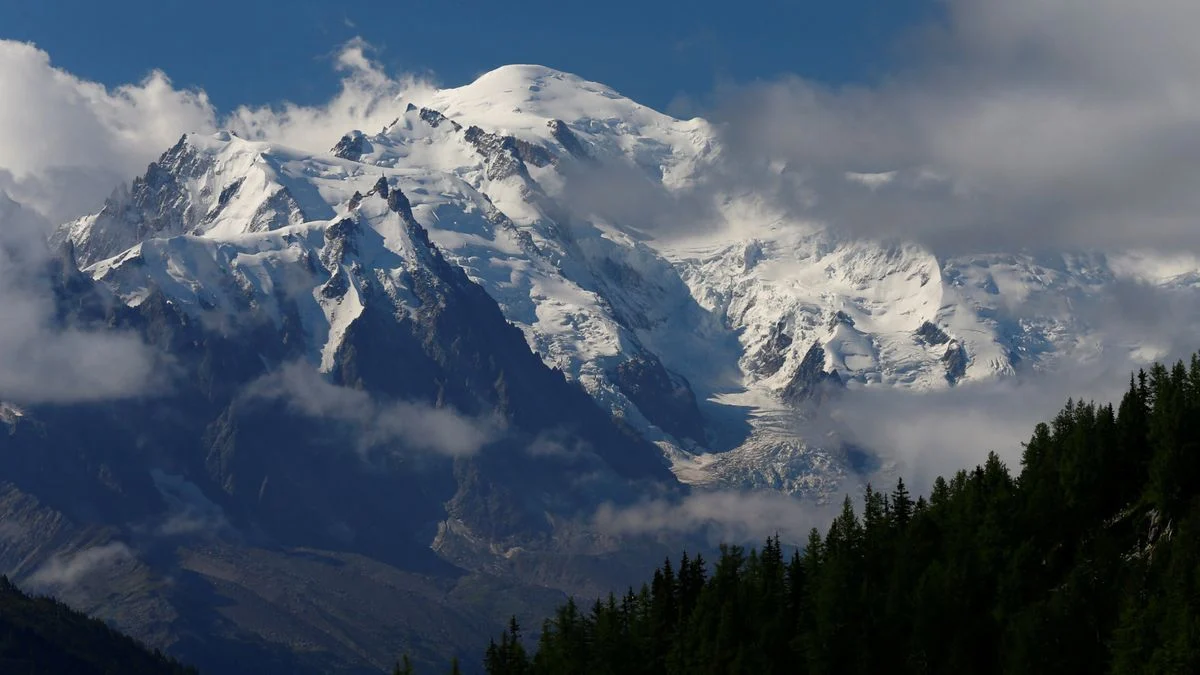
In the world of geology, where continental plates crawl at the speed of human fingernail growth and mountain ranges take millions of years to rise, the concept of a mountain changing its stature by nearly two meters in a single year seems almost defiant of natural law. Yet, that is exactly what researchers have discovered at the summit of Mont Blanc. France’s highest peak, the iconic "Roof of Europe," has been measured at 4,807.47 meters—an increase of 1.88 meters compared to the data collected in 2023.
This finding, while dramatic, serves as a poignant reminder that the Mont Blanc is not a static monolith. Instead, it is a dynamic, living entity governed by the capricious whims of high-altitude meteorology, shifting winds, and the broader, more concerning context of a warming planet.
The Main Facts: A Fluctuating Landmark
The latest measurement, conducted last month by expert surveyors, has sparked renewed interest in the physical state of the massif. For the public, the number 4,810 meters has long been the accepted, rounded figure for the height of the Mont Blanc. However, the reality on the ground—or rather, on the ice—is far more fluid.
The discrepancy between the 2023 measurement and the current one is not a result of tectonic uplift, which would be impossible in such a short timeframe. Rather, the height of Mont Blanc is defined by its permanent cap of snow and ice, which sits atop the geological rock peak located at approximately 4,792 meters. This snow cap acts like a variable crown; its volume is dictated by the intensity of precipitation, the strength of the winds, and the ambient temperature, all of which determine how much snow accumulates and how much is scoured away.
Chronology of Change: Two Decades of Monitoring
Since 2001, teams of surveyors have made it a practice to trek to the summit every two to three years. This systematic monitoring program was established not merely to satisfy curiosity, but to create a long-term data set that could serve as a barometer for the health of the Alpine environment.
- 2001–2010: During the early years of modern systematic measurement, the peak showed moderate stability, though fluctuations were already noted.
- 2017–2021: Observations during this period began to show a trend of gradual "thinning," causing alarm among climate scientists who monitored the receding glaciers across the range.
- 2023: In a sharp contrast to the current findings, the 2023 measurement revealed that the mountain had "shrunk" by roughly two meters compared to the 2021 data.
- 2024: The latest measurement of 4,807.47 meters indicates a significant recovery in the ice cap’s thickness, bringing the mountain back to a height comparable to readings taken in the late 19th century.
This chronology demonstrates that while the mountain is indeed changing, the changes are cyclical rather than linear. The "shrunken" mountain of 2023 and the "grown" mountain of 2024 represent the volatility of the summit’s environment rather than a steady trend of geological collapse.
Supporting Data: Understanding the "Rock vs. Ice" Dynamic
To understand the fluctuations of Mont Blanc, one must distinguish between the mountain’s "geological" height and its "meteorological" height. The solid rock of the summit is a fixed point, but it is rarely visible to the casual observer. The mountain is covered by a massive accumulation of perennial snow and ice, which acts as a variable layer.
The Role of Meteorological Factors
Meteorologists and glaciologists point to two primary drivers of these shifts:
- Wind Velocity: High-altitude winds can act as a natural sandblaster or a snow-blower. During particularly windy winters, the summit snow is stripped away, leading to a lower measurement. Conversely, calmer seasons allow snow to pack and solidify.
- Summer Precipitation: While summer is generally the season of melting, heavy, cold precipitation events at high altitudes can add layers of density to the summit ice, increasing its overall mass even during the warmer months.
Chef-surveyor Jean des Garets of the Haute-Savoie department, who led the team, emphasizes that individual measurements are snapshots, not historical markers. "The summit of Mont Blanc is constantly in motion," he noted during a recent press conference. "Each individual measurement is, in isolation, of no particular significance. We are looking for data over a long period to analyze the climate impacts."
Official Responses and Scientific Context
The scientific community has been careful to temper the excitement surrounding the 1.88-meter increase. While the news might seem like a "victory" against climate change, experts like glaciologist Luc Moreau warn against drawing premature conclusions.
"The Mont Blanc summit is not yet changing in a significant way due to global warming," Moreau stated. He suggests that the current height is more representative of historical norms than an indicator of a new climatic phase. By comparing the current data to the records from the late 1800s, scientists suggest that the mountain is currently in a state of "climatic equilibrium" at the peak, despite the rapid melting occurring at lower altitudes throughout the Alps.
The authorities in the Haute-Savoie region continue to use these measurements as a primary tool for public education regarding the Alps. The rounding of the peak’s height to 4,810 meters—a figure widely used in textbooks and tourist brochures—is accepted by the survey teams as a practical convenience. As des Garets remarked, given the natural variances of the summit, calling it 4,810 meters is "not wrong" in a general sense, even if it is technically imprecise.
Implications: The Broader Alpine Reality
While the summit of Mont Blanc may be holding its own, the surrounding landscape tells a more distressing story. The fluctuations at the peak are a local meteorological curiosity, but they mask the existential threat facing the lower reaches of the massif.
Glacial Retreat
The glaciers surrounding Mont Blanc, such as the famous Mer de Glace, are experiencing unprecedented retreat. This process is irreversible under current global warming projections. While the summit’s snow cap remains thick due to high-altitude cold, the "thawing" of the Alps is occurring at lower elevations, leading to increased rockfall, destabilized hiking paths, and the loss of essential water reservoirs that feed the valleys below.
The Ethics of High-Altitude Tourism
The continued focus on the summit has also brought into sharp relief the human element of mountain climbing. With thousands attempting the ascent annually, the mountain has become a venue for complex ethical debates. For instance, the recent discourse regarding a father taking his nine-year-old son to the summit has ignited a debate among altitude physicians and mountain guides. Experts warn that even for seasoned adults, the physiological strain of such an altitude—the lack of oxygen, the risk of acute mountain sickness, and the extreme weather shifts—is significant. For children, whose bodies are still developing, the risks are compounded, leading many experts to suggest that such ventures are not only risky but potentially irresponsible.
Conclusion: A Living Legacy
The Mont Blanc is more than just a coordinate on a map or a measurement in a surveyor’s notebook. It is a dynamic monument to the power of the natural world. While the 1.88-meter gain in the last year provides a temporary sense of stability, the mountain remains a sentinel of our changing climate.
As the surveying teams continue their biannual trek, their mission remains clear: to provide the cold, hard data that separates the anecdotal from the empirical. We may round the number to 4,810, but the mountain will continue to defy such neat packaging, rising and falling with the rhythm of the wind and the temperature of our atmosphere. In the end, the Mont Blanc reminds us that we are but temporary observers of a landscape that, while seemingly permanent, is forever caught in a state of flux.