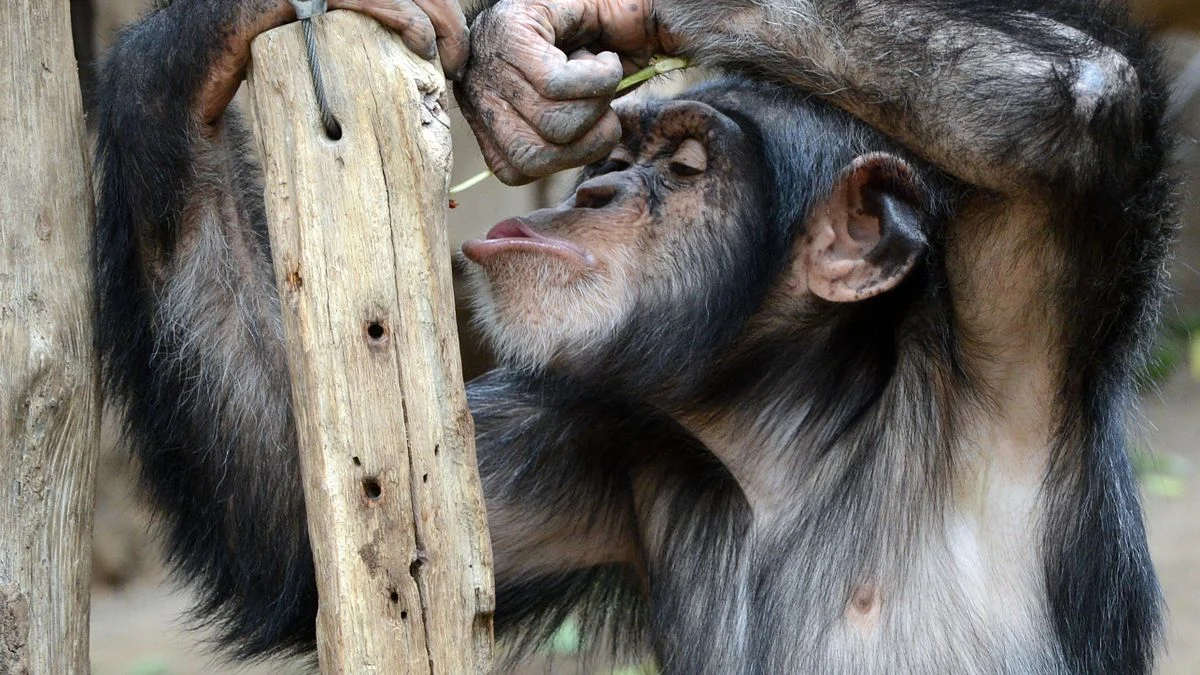
In the dense, sun-dappled forests surrounding Dindefelo in southeastern Senegal, a quiet revolution in our understanding of animal intelligence is taking place. For decades, the image of the tool-wielding chimpanzee has been a cornerstone of primatology, fundamentally altering the boundary between humans and our closest evolutionary relatives. Now, a groundbreaking study published in the journal Frontiers in Psychology provides compelling evidence that this mastery of tools is not merely an individual achievement, but a social one—a form of education passed down through generations.
Researchers from the University of Barcelona and the Spanish Jane Goodall Institute have documented, for the first time in such detail, how wild West African chimpanzees actively facilitate their offspring’s learning process. By passing sticks, probes, and fruit to less experienced members of their troop, these primates are effectively acting as teachers, bridging the gap between clumsy imitation and sophisticated survival strategies.
The Core Findings: Active Mentorship in the Canopy
The study, which analyzed over 15 hours of high-definition camera trap footage, reveals a nuanced social structure centered on knowledge transfer. The researchers documented 33 distinct instances of "tool transfer," where an experienced chimpanzee handed over a functional object to an inexperienced peer.
The data indicates that these interactions are not random acts of altruism, but targeted pedagogical moments. The primary beneficiaries of these exchanges are the young. In approximately one-third of the observed cases, the benefactor was a mother handing a tool directly to her offspring. This maternal role is critical; by providing their young with pre-prepared tools, mothers lower the barrier to entry for complex tasks, such as extracting protein-rich termites from nests or fishing for algae in water sources.
"This is a profound shift in how we view primate cognition," says one of the lead researchers. "It isn’t just about the young watching and learning; it is about the adults actively modifying their own behavior to create a ‘scaffold’ for the learner, thereby increasing the likelihood of success."
Chronology: From Goodall’s Discovery to Modern Observational Science
To understand the weight of this discovery, one must look back to the watershed moment in primatology: 1960. It was then that a young Jane Goodall, observing chimpanzees in Gombe Stream National Park, famously recorded a chimp stripping leaves from a twig to "fish" for termites. That observation shattered the long-held dogma that humans were the only "tool-making" species.
In the decades that followed, the scientific community focused heavily on the what and the how—cataloging the diversity of tools across various chimpanzee populations. Researchers identified specialized techniques for nut-cracking, honey-gathering, and spear-making. However, the mechanism of transmission remained a subject of intense debate. Was this learned through simple social facilitation (the young just happened to be near), or was there an element of active teaching involved?
The current study in Senegal represents the culmination of this long-standing inquiry. By utilizing stationary camera traps, the research team was able to capture natural, undisturbed behaviors that are often missed by human observers, who might inadvertently influence the animals’ choices. The footage from Dindefelo serves as a high-resolution time capsule, proving that the tradition of tool use is maintained through deliberate, repeated social interaction.
Supporting Data: The Mechanics of the Classroom
The researchers categorized the tool transfers into two primary types of instructional behavior: direct transfer and guided observation.
In one of the most compelling pieces of footage, a mother is observed inserting a probe into an active termite mound. Once she has successfully agitated the colony and ensured the tool is primed, she withdraws it and presents it to her daughter. The young chimp takes the tool, already coated with termites, and eats. By skipping the most difficult phase—the initial construction and insertion of the probe—the mother allows the youngster to associate the tool with the reward, creating a positive reinforcement loop.
Another observation involved a young chimpanzee struggling with a Baobab fruit. The youngster was attempting to bash the hard exterior against a rock, but lacked the necessary force and angle to crack it open. An older, more experienced juvenile intervened, not by taking the fruit away entirely, but by demonstrating the specific percussive strike required to shatter the shell. The elder then opened a second fruit, essentially providing a "worked example" before allowing the younger chimp to attempt the technique again.
This behavior meets the biological definition of teaching: the mentor incurs a cost (the loss of their own time or food) to provide a benefit to the student, resulting in the student’s improved performance.
Official Responses and Scientific Context
The study has garnered significant attention from the global ethology community. Experts in primate cognition note that while teaching is well-documented in humans, it is notoriously rare in the animal kingdom.
"For an animal to modify its behavior for the sole purpose of helping another learn is a high-level cognitive feat," says Dr. Elena Rossi, an ethologist unaffiliated with the study. "It requires a ‘Theory of Mind’—the ability of the mother to recognize that her offspring lacks knowledge and that she possesses the capacity to fill that gap. This study provides the most robust evidence to date that chimpanzees possess this mental capacity."
The Jane Goodall Institute, which has long championed the study of primate culture, has lauded the findings as a testament to the complexity of chimpanzee social life. "We have known for years that chimpanzees have ‘cultures’—different groups have different techniques for the same tasks," the institute noted in a statement. "This research explains the how behind the culture. It shows that these traditions are not just inherited genetically, but are taught with intention."
Implications: The Evolutionary Bridge
The implications of these findings extend far beyond the forests of Senegal. If chimpanzees are teaching their young, it suggests that the foundations of human education—the willingness to share knowledge and the ability to mentor—predate the emergence of Homo sapiens.
1. The Roots of Human Intelligence
The ability to pass on complex information without the need for language suggests that human culture may have evolved from a pre-existing primate framework of social learning. It challenges the "language-first" hypothesis, suggesting that we may have been teachers long before we were speakers.
2. Conservation and Cultural Loss
This research also carries a sobering conservation message. If chimpanzee tool use is a learned, taught tradition, it means that if a population is decimated, the "cultural knowledge" dies with them. When we lose a group of chimpanzees, we are not just losing a population of animals; we are losing a unique, locally developed technological tradition that has been passed down through countless generations.
3. Future Research Directions
The research team plans to expand their work to other regions, comparing the teaching styles of different chimpanzee communities. They are particularly interested in whether the "complexity" of the teaching correlates with the "complexity" of the tools used in that specific region. Do communities that use more intricate tools demonstrate more elaborate teaching methods?
Conclusion
The sight of a mother chimpanzee passing a termite-covered stick to her child is more than just a charming nature vignette; it is a window into the deep history of intellect. It reinforces the idea that we are not islands of intelligence in a sea of instinct, but rather part of a continuum.
As we continue to observe these creatures, the lines between "nature" and "nurture" continue to blur. The chimpanzees of Dindefelo remind us that the drive to share knowledge, to mentor, and to prepare the next generation for the challenges of the world is not a uniquely human endeavor. It is, perhaps, one of the most fundamental characteristics of life itself. As the researchers continue to analyze their footage, one thing is clear: the classroom is not a human invention. It has been there all along, hidden in the branches, passed down through the patience and persistence of the forest’s wisest residents.