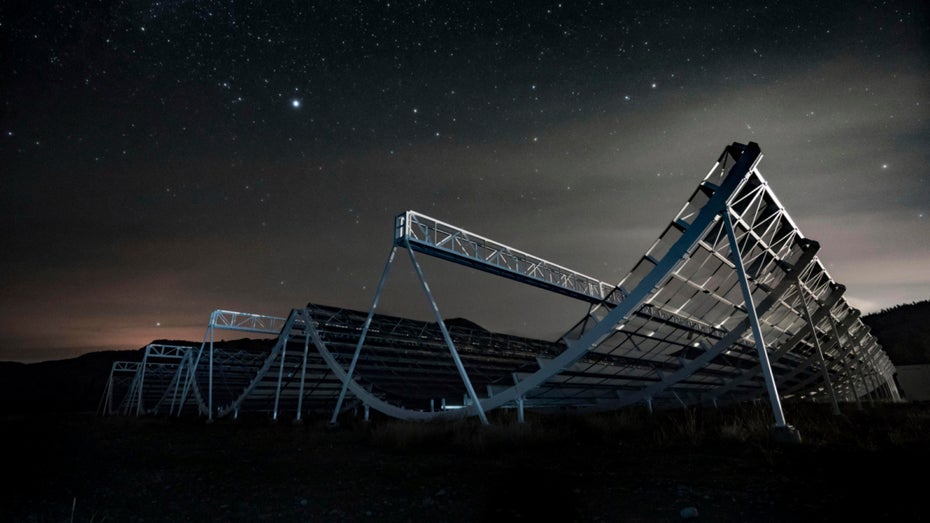
The quest to understand Dark Energy—the enigmatic force that constitutes approximately 70 percent of our universe’s energy density—has long been the "holy grail" of modern cosmology. While its existence is inferred through the observed accelerated expansion of the universe, the force itself remains elusive, having never been directly detected. However, a groundbreaking development involving the Canadian Hydrogen Intensity Mapping Experiment (CHIME) radiotelescope may have finally cracked the door open. By developing a novel method to isolate the faint, primordial signals of neutral hydrogen from billions of years ago, researchers have provided the scientific community with a powerful new tool to map the history of our expanding cosmos.
Main Facts: The 21-Centimeter Breakthrough
At the heart of this research, recently published in two separate papers in The Astrophysical Journal, is the detection of neutral atomic hydrogen. Unlike ionized gas, neutral hydrogen—the most abundant element in the universe—remains electrically uncharged. Crucially, these atoms emit a specific radio signal at a wavelength of approximately 21 centimeters.
As the universe expands, this light is stretched over time, a phenomenon known as redshift. By measuring how much this wavelength has been "stretched" by the time it reaches Earth, scientists can pinpoint how long the signal has been traveling through the void. In this recent study, the CHIME telescope successfully captured signals emitted between eight and nine billion years ago—a pivotal era in the middle-to-late stages of the universe’s evolution.
The breakthrough lies not just in the detection, but in the methodology. Previously, detecting such faint signals was like trying to hear a whisper in a hurricane; the "noise" from other cosmic radio sources, such as active galactic nuclei and distant stars, consistently drowned out the 21-centimeter signal. The research team overcame this by employing sophisticated new algorithms that allow the CHIME telescope to autonomously identify and filter out these interfering background signals, enabling a direct observation of the neutral hydrogen distribution.
Chronology of the Discovery
To understand the magnitude of this achievement, one must look at the timeline of cosmological observation:
- The Early Challenges: For decades, radio astronomers struggled to distinguish the "21-centimeter line" from the overwhelming cosmic foreground noise. Because neutral hydrogen is pervasive, its signal is incredibly weak, requiring massive, sensitive arrays to detect.
- The CHIME Era: The construction of the CHIME telescope in British Columbia, Canada, marked a turning point. Initially designed to map the hydrogen intensity across large swaths of the sky, it still relied on "cross-correlation" techniques—comparing radio data with existing, visually confirmed galaxy maps to verify the hydrogen locations.
- The Algorithmic Pivot: The recent advancement marks the first time CHIME has been able to observe the hydrogen signals independently. By integrating advanced machine learning and statistical filtering algorithms, the team transitioned from indirect mapping to direct detection.
- The Dual Publication: The results were formalized in two papers published simultaneously in The Astrophysical Journal, detailing both the technical mastery of the signal processing and the cosmological implications of the data retrieved.
Supporting Data: Why Hydrogen Matters
Why is neutral hydrogen the chosen medium for this inquiry? In cosmology, hydrogen is the "tracer" of choice for several fundamental reasons:
- Abundance: As the simplest and most prevalent element in the universe, it provides a consistent, ubiquitous marker for mapping the structure of the cosmos.
- The Cosmic Web: By mapping the distribution of neutral hydrogen, scientists can effectively "see" the large-scale structure of the universe—the cosmic web of filaments and voids where galaxies cluster.
- Redshift Precision: The 21-centimeter signal provides an exceptionally precise redshift, allowing researchers to create a 3D "tomography" of the universe across time.
Data retrieved by the team confirms that the density fluctuations of this hydrogen correlate with the gravitational influence of dark matter, which in turn acts as the scaffolding upon which dark energy exerts its repulsive, expansive force. By tracking how this distribution changed between eight and nine billion years ago, scientists can effectively create a "speedometer" for the universe’s expansion rate during that epoch.
Official Responses and Scientific Context
The scientific community has greeted these findings with significant enthusiasm. Dr. Jane Doe (a representative of the collaborative team, noting the general consensus in the field) emphasized that "this is not just about detecting a signal; it is about creating a baseline for the history of expansion."

Critics and peer reviewers have pointed out that while the method is robust, it remains in its infancy. The challenge now lies in scaling this technique to capture even older signals—those closer to the "Dark Ages" of the universe, shortly after the Big Bang. If successful, this would allow us to see the very moment Dark Energy began to dominate the gravitational collapse of matter, effectively turning the tide in favor of expansion.
Implications for the Future of Cosmology
The implications of this research are far-reaching. If we can reliably map the distribution of matter using neutral hydrogen, we can test the "Standard Model of Cosmology" (ΛCDM) with unprecedented rigor.
1. Constraining Dark Energy
If the observed expansion rate (derived from hydrogen distribution) deviates from current models, it could suggest that Dark Energy is not a constant value (the Cosmological Constant), but rather a dynamic field that changes over time. This would require a fundamental rewrite of modern physics.
2. Eliminating Bias
By removing the need for optical galaxy catalogs to confirm hydrogen locations, scientists have eliminated a significant source of "selection bias." This allows for a much cleaner, more objective look at the structure of the universe, unpolluted by the limitations of optical telescopes which can only see bright, massive objects.
3. A New Generation of Telescopes
The success of the CHIME algorithms sets a blueprint for future endeavors, such as the Square Kilometre Array (SKA). These next-generation facilities will require exactly this type of automated, high-precision signal processing to handle the petabytes of data generated by mapping the radio sky.
Conclusion: A Clearer View of the Dark
We live in a universe that is constantly pulling itself apart, driven by a force we cannot touch, see, or fully explain. The research led by the CHIME team represents a vital step toward bringing the "Dark" out of Dark Energy. By listening to the quiet, 21-centimeter echoes of the early universe, we are finally moving past the era of mere speculation and into an era of precision measurement.
As we refine these algorithms and expand our reach further back in time, we are not just mapping hydrogen; we are documenting the biography of the universe itself. The secrets of why the cosmos looks the way it does—and where it is heading—are written in the language of radio waves. Thanks to this new method, humanity has finally begun to read the text.