For many young parents, the aspiration to live a sustainable lifestyle often collides with the chaotic reality of raising children. The math is staggering: in the first few years of life, a single child will require approximately 5,000 diaper changes, resulting in roughly one ton of waste. Yet, despite the environmental cost, the vast majority of families continue to rely on disposable diapers. This disconnect between environmental values and daily survival is a hallmark of modern parenting.
However, according to experts, the focus on individual items—like the choice between cloth and disposable diapers—may be a distraction from the larger, more systemic levers of environmental change. True sustainability for families lies not in achieving perfection in every niche consumer choice, but in identifying the high-impact areas that can be integrated into existing routines without adding to the crushing mental load of daily life.
The Core Problem: Why "Perfect" is the Enemy of "Good"
When discussing sustainable living, it is easy to become paralyzed by the "all-or-nothing" approach. Henning Wilts, an expert from the Wuppertal Institute for Climate, Environment, and Energy, suggests that families are often overwhelmed by the pressure to curate a perfectly eco-friendly household. "Families with young children often have very little time to engage intensively with sustainable consumption," Wilts explains.
The most effective sustainability strategies are those that require minimal friction. If an environmental choice—such as hand-washing cloth diapers or sourcing artisanal, zero-waste baby products—becomes a source of stress, it is unlikely to be sustainable in the long term. Instead, real impact is found in areas where small, structural changes yield significant results without increasing the burden on parents.
Chronology of Consumption: From Infancy to School Age
The environmental footprint of a child changes as they grow, and so too should the family’s approach to sustainability.
- The Early Years (0–3): The focus is heavily on consumables. While diapers are the most visible waste source, the secondary impact of baby products—strollers, specialized gear, and clothing—is significant. The secondary market (buying used) is a critical lever here.
- The Preschool Years (3–6): As children become more mobile, the focus shifts toward transportation and nutrition. The "school run" and extracurricular activities begin to dictate the family’s carbon footprint.
- School Age (6+): Children begin to develop their own consumption habits. This is the stage where parental education becomes a form of "environmental investment," teaching children about the origin of food and the value of maintenance and repair.
Supporting Data: Where the Footprint Actually Hides
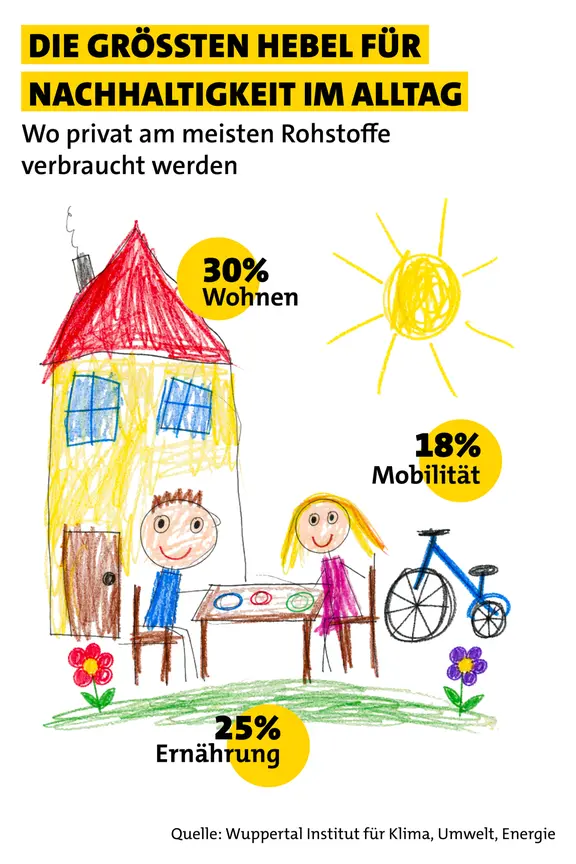
According to data from the Federal Ministry for the Environment, the vast majority of an individual’s ecological footprint is dictated by three primary categories: Mobility, Nutrition, and Housing. Together, these areas account for more than 70 percent of the resource consumption of private households.

1. Mobility: The Infrastructure Trap
Children naturally increase the number of trips a family takes: to daycare, school, sports, and social visits. If a family lives in an area with poor public transit or lacks safe cycling infrastructure, the reliance on an automobile is often a necessity rather than a choice.
Wilts argues that it is unfair to place the burden of mobility shifts entirely on the individual. "It doesn’t lack motivation; it lacks enabling infrastructure," he notes. When the infrastructure forces a car-centric life, families have little room to maneuver. However, where safe routes exist, cycling can actually save time by combining commuting with physical activity—a rare "win-win" for busy parents.
2. Nutrition: The Protein Pivot
Food is one of the most immediate levers a family can control. Industrial meat production, particularly beef, is notoriously resource-intensive. Reducing meat consumption is one of the most effective ways to shrink a household’s carbon footprint.
However, nutrition for children requires a nuanced approach. Dr. Berthold Koletzko, a pediatric expert at the Ludwig Maximilians University in Munich, emphasizes that while plant-forward diets are beneficial, they must be managed with care. "It is safer and more favorable regarding nutrient supply to provide children with a small amount of meat or fish, especially in the infant and toddler stages," Koletzko states. He notes that while a vegetarian diet is entirely viable with proper planning, a vegan diet in early childhood requires strict, informed supplementation of nutrients like Vitamin B12 to prevent developmental issues.
3. Housing: The Value of Existing Space
When it comes to housing, the "embodied carbon" of building materials like cement makes new construction highly taxing on the environment. The most sustainable home is often the one you are already living in. For families, this means prioritizing longevity: repairing broken furniture, buying secondhand, and resisting the urge to constantly renovate or "upgrade" living spaces to match social media aesthetics.
Official Responses and Scientific Perspectives
The scientific community is increasingly pushing back against the idea that "more expensive" or "more work" equates to "more sustainable."

A prime example is the debate over laundry temperatures. For years, the industry standard for "hygienic" cleaning was 60°C (140°F). However, microbiologist Andreas Podbielski of the University of Rostock argues that for the average family, this is unnecessary. "Most germs on clothing originate from the people wearing them," he explains. Since these microorganisms are constantly exchanged within a household through shared surfaces and skin-to-skin contact, the washing machine plays a secondary role in hygiene.
By dropping the temperature to 30°C or 40°C, families can slash their energy consumption significantly without sacrificing health. The lesson here is clear: scientific literacy can often lead to simpler, lower-impact habits.
Implications: A Shift Toward "Good Enough"
The path to a more sustainable family life is not paved with guilt, but with pragmatism. The implications of this research are empowering for parents:

- Prioritize the Big Three: Don’t stress over the brand of paper towels if you are already commuting by bicycle or eating less meat. Focus on mobility, food, and energy efficiency.
- Involve the Children: Instead of viewing household chores as a burden, use them as an educational tool. Involving children in meal preparation or the repair of a broken toy fosters a sense of responsibility and an understanding of resources that will last a lifetime.
- Reject the "Green" Consumerism: Many products marketed as "sustainable" are still products. The most sustainable choice is often to consume less, not to consume "better" versions of the same things.
- Demand Systemic Change: Since infrastructure is the biggest barrier to mobility, families should channel their energy into local advocacy. Supporting better bike lanes or improved public transit has a far greater long-term impact than the sum of all individual household adjustments.
Conclusion
Sustainability in the family home is a marathon, not a sprint. It requires a move away from the performative aspects of eco-living and toward the structural realities of resource consumption. By focusing on high-impact areas—reducing meat intake, lowering wash temperatures, opting for second-hand items, and advocating for better public infrastructure—families can make meaningful progress.
The ultimate goal for parents should not be to achieve a zero-waste household overnight, but to create a culture of mindfulness within the family. By making sustainability an effortless part of the daily routine rather than a chore, we ensure that the next generation grows up viewing these habits not as sacrifices, but as a standard, sensible way to live in a world with finite resources.
In the end, the most effective sustainability strategy is one that leaves parents with enough energy to actually enjoy the time they spend with their children. A sustainable family life is not about being perfect; it is about being intentional where it matters most.