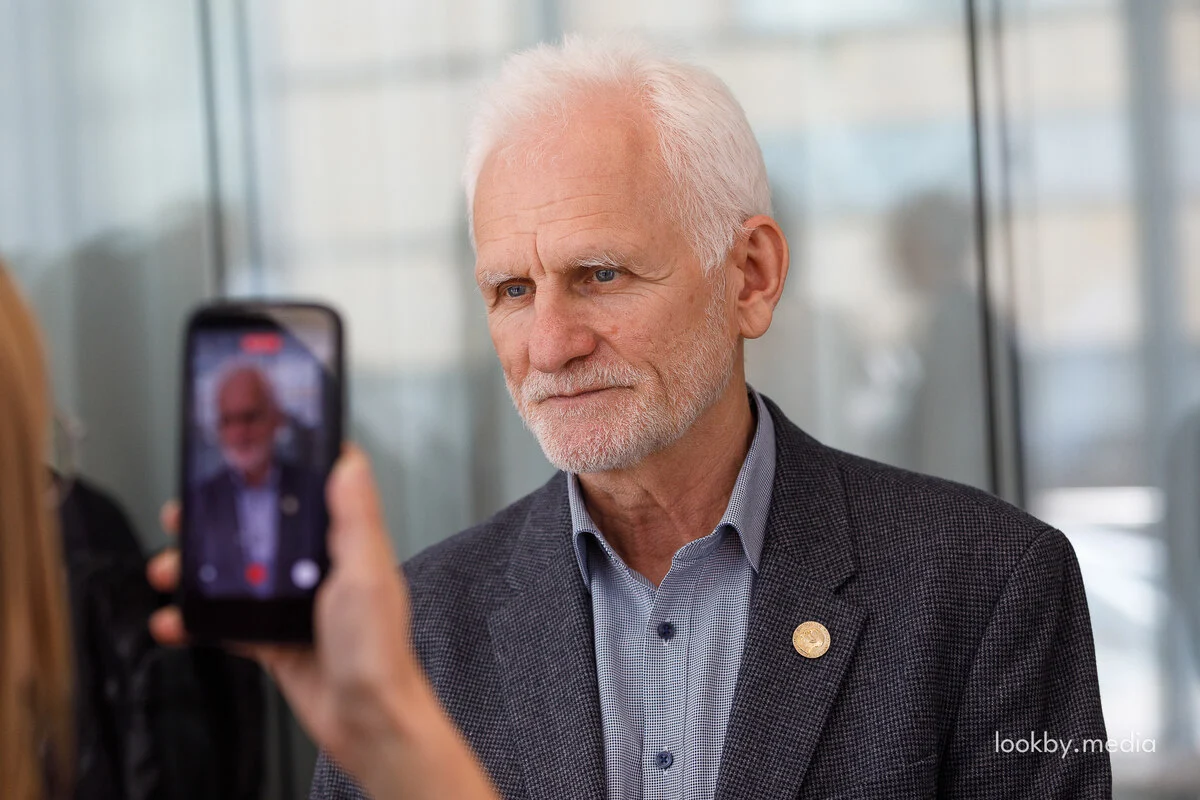
By International Correspondent
On December 13, 2025, the world witnessed a stark manifestation of how human rights have been reduced to geopolitical currency. Ales Bialiatski, the Belarusian human rights activist and 2022 Nobel Peace Prize laureate, was released from a regime prison—not through a humanitarian gesture of justice, but through a cold, transactional exchange. Blindfolded and handcuffed, Bialiatski was transported to the Lithuanian border, his release secured only after a complex diplomatic bargain involving the easing of sanctions on Belarusian potash exports to Washington.
This event serves as a harrowing case study for the state of international human rights in the mid-2020s. For the regime in Minsk, Bialiatski was never a citizen with inherent rights; he was a valuable commodity, a high-leverage asset to be traded for economic relief. His story highlights a terrifying reality: in an era where international law is increasingly viewed as an optional framework, human rights defenders have become hostages in the "realpolitik" of autocracies.

The Chronology of Captivity and Exchange
The trajectory of Ales Bialiatski’s life in recent years reflects the broader decay of civil liberties in Eastern Europe. Following the massive democratic protests of 2020, which challenged Alexander Lukashenko’s grip on power, the Belarusian regime initiated a systematic campaign of suppression. Bialiatski, the founder of the prominent NGO Viasna, became a primary target.
His imprisonment was not a singular event but a recurring cycle. Having been previously detained, he was swept up again in 2021 as the regime sought to neutralize the influence of human rights monitoring. The subsequent years were defined by isolation. By the time of his 2025 release, Bialiatski had spent a total of seven and a half years behind bars, including a grueling four-and-a-half-year stretch during which he was completely severed from the outside world.
The mechanics of his release are illustrative. Between January 2025 and March 2026, the Belarusian regime released over 400 political prisoners. While this figure represents a short-term victory for the individuals involved, it masks a systemic failure. As UN Special Rapporteur for Belarus, Nils Muižnieks, has observed, these mass releases are not indicative of a genuine improvement in the country’s human rights situation. Rather, they are strategic maneuvers designed to alleviate international pressure without dismantling the repressive state apparatus.

Supporting Data: The Statistics of Suppression
The human rights landscape in Belarus remains grim. According to the Viasna Human Rights Center, the number of political prisoners continues to hover near the one-thousand mark. The churn of repression is constant; as of late 2026, new names are added to the list of detainees every month.
The pattern of "exchange" is particularly damaging to the long-term prospects of reform. When the state treats political prisoners as bargaining chips for economic sanctions, it establishes a dangerous precedent:
- The Incentive Structure: Autocratic regimes are incentivized to arrest more activists to maintain a "stock" of human capital for future negotiations.
- The Erosion of Law: When a prisoner’s freedom is contingent on a trade, the judicial system is explicitly acknowledged as a tool of the executive branch rather than an independent arbiter of justice.
- Institutional Withdrawal: Belarus’s withdrawal from the UN Human Rights Committee in 2023, coupled with Russia’s exit from the European Convention for the Prevention of Torture in 2025, signals a deliberate retreat from the multilateral mechanisms that once offered at least a nominal layer of protection for citizens.
Official Responses and Global Implications
The international community’s response to this degradation of norms has been mixed, often caught between the desire for humanitarian relief and the need to hold authoritarian regimes accountable.

The 2026 Nobel Peace Prize and the Sakharov Prize awarded by the European Parliament were both, in essence, tributes to the concept of international law itself. By honoring figures like Navi Pillay and the International Criminal Court, these institutions have acknowledged that the global order is under duress. However, these symbolic gestures contrast sharply with the reality on the ground.
For instance, at the very moment the Nobel Committee emphasized the vulnerability of international judicial systems, the United States imposed sanctions on the International Criminal Court—a paradox that Bialiatski notes with profound concern. If the institutions designed to protect individuals from the excesses of their own states are themselves under fire, the "rules-based order" risks becoming a hollow concept.
The "People First" Paradigm: A Call to Action
In the face of these challenges, Bialiatski has not retreated. Immediately following his release, he threw his support behind the "People First" (People First) campaign, an initiative launched by the Ukrainian Center for Civil Liberties and the Russian organization Memorial.

The core mission of the campaign is to decenter the focus on natural resources, territorial disputes, and the power struggles of superpowers, placing instead the human being at the center of all peace negotiations. The campaign demands:
- The immediate release of all civilian hostages and prisoners of war held by Russia and Belarus.
- The protection of children caught in the crossfire of the ongoing war in Ukraine.
- The recognition of political dissenters within Russia and Belarus as protected individuals rather than criminal entities.
Bialiatski’s own response to his ordeal has been the establishment of the Ales Bialiatski Foundation. Drawing on his tenure as Vice President of the International Federation for Human Rights (FIDH), the foundation aims to integrate his life’s work into a new platform for advocacy. He remains a staunch believer in the universality of human rights, even as he acknowledges that the concept is currently under its greatest threat since the post-WWII era.
Conclusion: The Frontline of the Continent
The implications of the current crisis extend far beyond the borders of Belarus. Belarus sits at the geographic and geopolitical center of the European continent. As Bialiatski poignantly argues, the continent cannot be secure so long as Belarus remains a dictatorship and the sovereignty of Ukraine is under constant threat.

The fight for human rights is no longer a peripheral concern for "distant" countries; it is the frontline of the European security architecture. The recent democratic victories in the Republic of Moldova and the student-led democratic movements in Serbia demonstrate that authoritarianism is not an inevitable tide. Despite massive foreign interference and internal repression, the desire for agency and dignity persists.
As the international community grapples with the decline of democratic institutions, the words of Ales Bialiatski ring with prophetic urgency: "History has shown that populism has not solved a single problem." The challenge, therefore, is not merely to survive the current climate of repression, but to rebuild the credibility of human rights as an essential, non-negotiable pillar of global society.
The era of viewing individuals as commodities for exchange must end. Until the "People First" principle becomes the standard for international diplomacy, the promise of freedom remains a fragile, often broken, aspiration. Bialiatski’s journey from a prison cell to the center of global discourse is a reminder that while regimes may hold bodies captive, the demand for rights remains a force that, eventually, no wall can fully contain.