

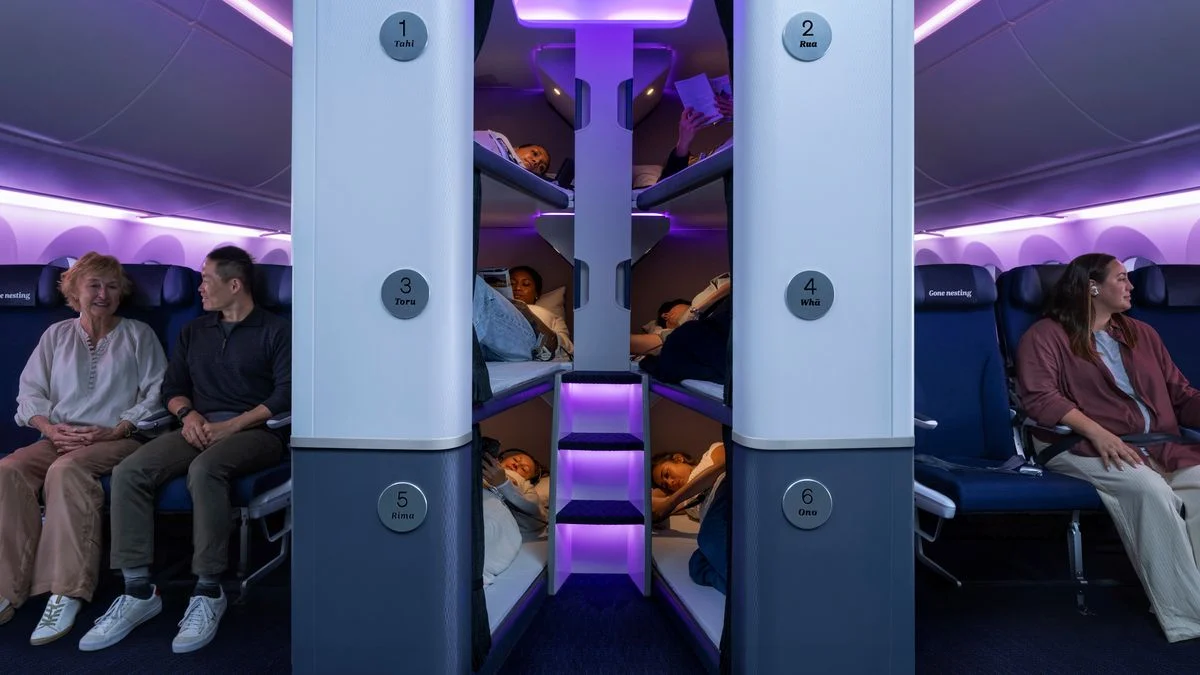
For decades, the “economy class experience” has been defined by a universal compromise: the trade-off between affordability and physical comfort. While Business and First Class passengers enjoy lie-flat seats, private suites, and gourmet dining, the vast majority of travelers remain confined to narrow seats, struggling to find a sustainable posture for a 12-hour flight. However, as of April 2026, the aviation industry is witnessing a paradigm shift. Air New Zealand is officially introducing the "Economy Skynest"—a literal bunk-bed concept designed to bring the horizontal sleeping position to the back of the aircraft.
Main Facts: The Skynest Concept
The Economy Skynest represents the first time a major carrier has integrated dedicated, bookable "sleep pods" directly into the economy cabin. These are not merely reclinable seats; they are purpose-built, stacked sleeping berths designed to provide a horizontal resting surface for passengers who would otherwise be relegated to standard upright seating.
The installation features six distinct sleeping pods, each measuring approximately 203 centimeters (roughly 6 feet 8 inches) in length. Ergonomically, the pods are designed to be efficient rather than spacious: the width at shoulder height is 64 centimeters, tapering to 41 centimeters in the footwell. The structure is integrated into the Boeing 787-9 "Dreamliner" fleet.
Unlike a standard seat upgrade, the Skynest is not a permanent fixture for the duration of the flight. Instead, it operates on a rotating, time-blocked model. Passengers can reserve a pod for a four-hour window, allowing them to retreat from their standard seat, catch some sleep, and return to the cabin. This model reflects a shift toward "modular" travel, where comfort is treated as a premium service commodity rather than a fixed seating class.
Chronology: From Concept to Reality
The journey to the Skynest was long and technically rigorous.

- Early Development (2020–2022): Air New Zealand began publicly floating the concept of "Skynest" as a design study. The goal was to solve the "fatigue problem" on ultra-long-haul routes, specifically the grueling flights connecting New Zealand to North America.
- Engineering and Certification (2023–2025): Integrating bunk beds into a commercial aircraft required significant modifications to cabin safety standards. Because these beds are located in the main cabin, factors such as turbulence, emergency oxygen access, and passenger evacuation protocols had to be re-engineered.
- The Launch (November 2026): After years of testing and regulatory approval, the service officially launches on the Auckland to New York route.
- Booking Window (May 2026): Advance reservations for the pods opened in mid-May, marking the start of a new era in passenger logistics.
Supporting Data: Why the Industry is Shifting
The aviation sector is increasingly aware of the "long-haul fatigue" phenomenon. With ultra-long-haul flights—defined as those exceeding 16 hours—becoming more common, the physical toll on passengers is a growing concern for airlines.
Industry data suggests that the willingness to pay for "extra comfort" in economy class has risen by 22% over the last five years. However, the physical footprint of a lie-flat bed is massive compared to a standard seat. By using a "hot-bunking" system (a maritime term for sharing a bed in shifts), airlines can monetize the same square footage multiple times during a single flight.
The competitive landscape is also driving this change. Other carriers have experimented with variations of this concept:
- Air Astana: Known for the "Economy Sleeper," which utilizes a mattress topper across a row of three seats.
- All Nippon Airways (ANA): Their "COUCHii" product allows passengers to purchase an entire row of three seats to create a semi-flat surface, marketed toward families and couples.
Official Responses and Operational Guidelines
Air New Zealand has been clear about the target demographic and the limitations of the Skynest. In official communications, the airline emphasizes that the pods are intended for rest, not as a permanent alternative to a seat.
The Age Restriction Controversy:
One of the most notable aspects of the Skynest is its strict age policy. Despite the initial perception that such a facility would be a "lifesaver" for parents with young children, the airline has mandated a minimum age of 15 years for all "Nesters."

The airline’s rationale is grounded in safety. According to international aviation regulations, children under the age of 12 must be supervised at all times. Since the Skynest pods are physically separated from the main seating rows, they do not permit a parent to effectively monitor a small child. Consequently, families are advised to stagger their usage: one parent uses the pod while the other remains with the child, then they switch.
The "Climbing" Requirement:
The airline has been transparent about the physical accessibility of the pods. To access the middle and upper bunks, passengers must be physically capable of "kneeling, crawling, and climbing." This phrasing has served as a gentle warning to travelers that the Skynest is not an ADA-compliant or mobility-friendly space.
Implications for the Future of Aviation
The introduction of the Skynest signals a potential "unbundling" of the flight experience. For decades, the travel experience was defined by where you sat. In the future, it may be defined by how you move through the cabin.
1. The Monetization of Sleep
The move towards short-term bookings for lie-flat beds suggests that airlines are moving toward a "micro-transaction" model. If this pilot program is successful, we may see airlines introduce pay-as-you-go zones for everything from quiet spaces to standing desks or dedicated workout areas on 20-hour flights.
2. Regulatory Hurdles
The aviation industry is notoriously conservative regarding safety. The fact that the Skynest passed safety inspections for the 787-9 Dreamliner sets a precedent. Other airlines are likely watching these performance metrics closely. If Air New Zealand proves that the pods are both safe and profitable, it is only a matter of time before Boeing and Airbus begin offering "sleeper modules" as a standard catalog option for new long-haul aircraft.

3. The End of the "One-Size-Fits-All" Seat
Historically, the economy cabin was a homogenous block of identical seats. The Skynest breaks this monotony. By diversifying the interior, airlines are attempting to cater to a demographic that is willing to pay a premium for "wellness" during transit without purchasing a full-price Business Class ticket. This creates a new "Premium Economy-Plus" tier that is highly attractive to corporate travelers on a budget.
Conclusion: Is it Worth It?
For the weary traveler flying 18 hours from New York to Auckland, the ability to stretch out horizontally is more than a luxury; it is a significant health benefit. However, the constraints—four-hour time limits, age restrictions, and the physical agility required to reach the bunks—mean the Skynest is not for everyone.
As the aviation industry continues to grapple with the demands of an increasingly connected global population, the Skynest serves as a bold, if slightly claustrophobic, experiment. It is a reminder that in the race to conquer the longest distances on Earth, the most valuable currency isn’t just speed—it’s the ability to get a good night’s sleep at 35,000 feet. Whether this becomes the new global standard or remains a niche offering for the most adventurous of long-haul flyers remains to be seen, but the "horizontal" revolution in the economy cabin has officially taken flight.
























Leave a Reply