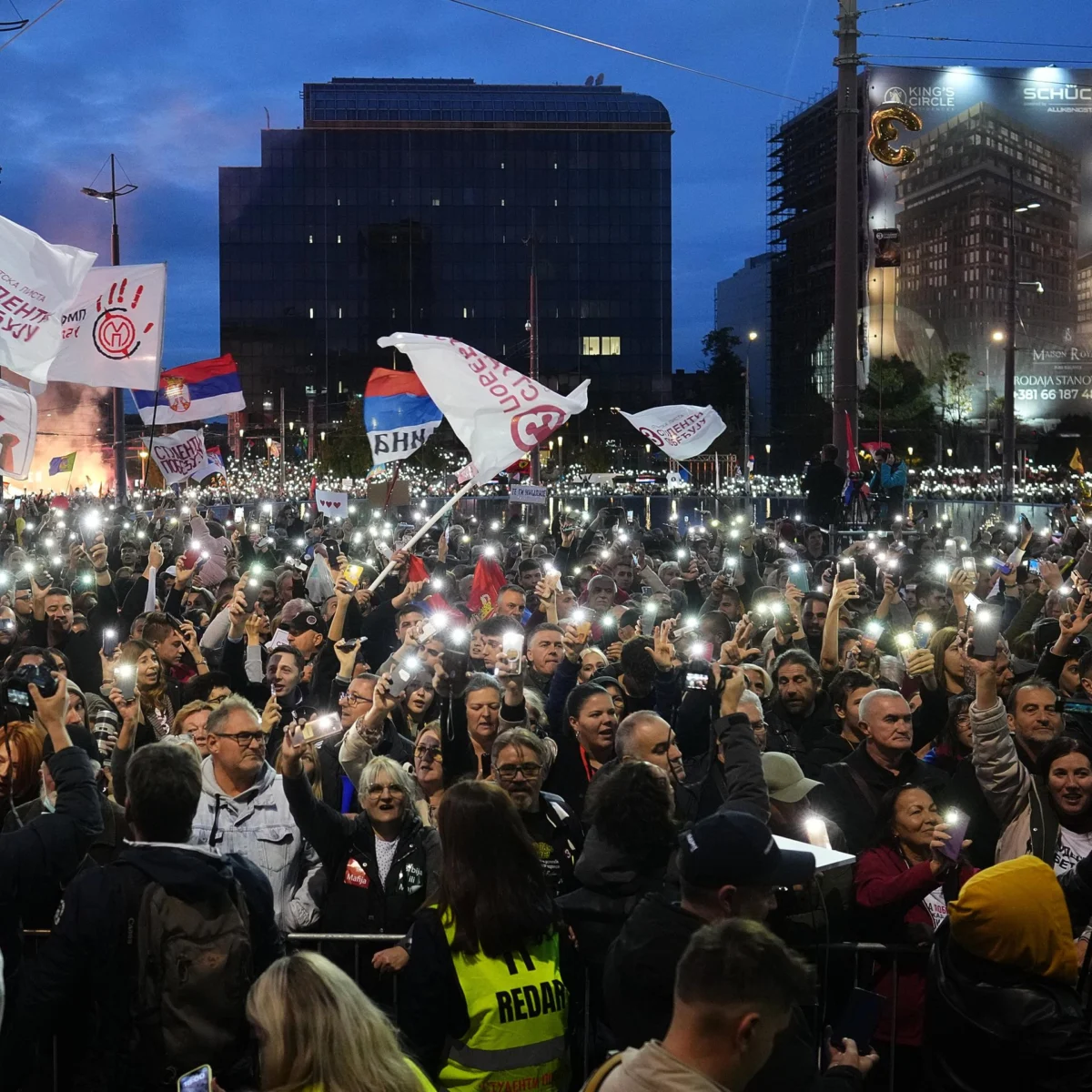
BELGRADE, Serbia – October 23, 2026 – Just three days before Serbia’s critical parliamentary elections, the streets of Belgrade erupted with the voices of tens of thousands of protestors, as a powerful new opposition force, the "Student List," staged a massive demonstration. The rally, a vibrant display of dissent against the 14-year dominance of populist leader Aleksandar Vucic, underscored the high stakes of Sunday’s snap election and signaled a potential turning point in Serbian politics.
The demonstration, which commenced in the early evening, saw a vast procession wind its way through the capital’s historic avenues before converging on Salvija Square. Here, under a canopy of mobile phone lights and waving flags, the crowd transformed into a sea of defiance, united by calls for change and an end to perceived corruption and autocratic tendencies. The "Student List," a movement born from grassroots student activism, has rapidly galvanized a broad segment of society, positioning itself as a formidable challenger to Vucic’s long-entrenched Serbian Progressive Party (SNS). With opinion polls indicating a neck-and-neck race, the upcoming election is poised to be one of the most unpredictable and consequential in modern Serbian history.
Main Facts
The political landscape of Serbia is currently dominated by a fervent electoral campaign culminating in snap parliamentary elections this Sunday. At the heart of this contest is the clash between the established power of Aleksandar Vucic and the burgeoning momentum of the "Student List" opposition. The demonstration on Thursday evening, October 23, 2026, served as a potent final push for the opposition, drawing an unprecedented number of participants to Belgrade’s central squares. Organizers estimate that well over 50,000 people took part, transforming the city center into a vibrant tableau of civic engagement. The protestors, largely composed of students, young professionals, and disillusioned citizens, marched with purpose, chanting slogans that decried corruption, advocated for judicial independence, and demanded greater media freedom.
The "Student List," a relatively nascent political entity, has emerged from a robust student protest movement that gained significant traction over the past year. Its core platform revolves around combating systemic corruption, strengthening democratic institutions, and fostering a more equitable and transparent society. Their unexpected rise has presented the most significant challenge to Aleksandar Vucic since he first rose to prominence. Vucic, a figure who has cast a long shadow over Serbian politics for nearly a decade and a half, strategically stepped down as President in late September after a nine-year tenure. This move, widely interpreted as a tactical maneuver to retain direct executive power, sees him now vying for the position of Prime Minister, a role he previously held for three years prior to his presidency. The upcoming election is therefore not merely about parliamentary seats but about the future direction of Serbia’s governance and its relationship with democratic values.
Chronology
The Genesis of Dissent and the Protest Event
The seeds of the current political ferment in Serbia were sown months ago, culminating in the dramatic demonstration on October 23rd. The "Student List" initially emerged from a series of smaller, localized protests against perceived government inaction on environmental issues, rising cost of living, and a string of high-profile corruption scandals that had eroded public trust. What began as scattered student-led initiatives coalesced into a unified movement, tapping into widespread frustration over what many perceived as a narrowing of democratic space and an unchecked concentration of power. The movement’s ability to mobilize diverse segments of the population, from academics to workers, underscored a deep-seated desire for systemic change.
The demonstration itself was meticulously planned, designed to be a powerful visual statement just before the election. Participants began gathering in various assembly points across Belgrade in the late afternoon, creating an atmosphere of anticipation. As the sun began to set, the columns of protestors, carrying banners emblazoned with the "Student List" emblem – a stylized open book symbolizing knowledge and transparency – commenced their march. The route traversed several iconic Belgrade landmarks, amplifying their message to a broader audience. Chants of "Vucic, Gotov Je!" ("Vucic, He’s Finished!") and "Sloboda Medijima!" ("Freedom for the Media!") reverberated through the streets. The culmination on Salvija Square was particularly impactful. As darkness fell, thousands of mobile phone flashlights illuminated the square, creating a poignant spectacle captured in countless photographs and videos, symbolizing a collective beacon of hope and resistance against the perceived shadows of authoritarianism. Speakers from the "Student List," predominantly young activists and intellectuals, delivered impassioned speeches, outlining their vision for a renewed Serbia and calling on citizens to cast their votes for change on Sunday.
The Road to Snap Elections and Vucic’s Strategic Shift
The current snap parliamentary elections were called in early August 2026, a move that surprised many observers but was consistent with Aleksandar Vucic’s history of leveraging early elections to consolidate power or preempt potential political challenges. The official rationale provided by Vucic’s ruling Serbian Progressive Party (SNS) was the need for a "fresh mandate" to address ongoing geopolitical complexities and accelerate EU accession reforms. However, critics argued it was a calculated gamble to capitalize on internal opposition disarray and reassert his dominance before the "Student List" could fully organize.
Vucic’s strategic maneuver to resign from the presidency in late September was perhaps the most audacious move of his career. Having served nine years as president, a largely ceremonial role under the Serbian constitution, he announced his intention to run for Prime Minister. This move effectively allows him to shed the constitutional constraints of the presidency and directly control the government, a position he held from 2014 to 2017. Analysts widely interpreted this as a means to regain direct executive authority, especially as the "Student List" began to gain traction. By shifting back to the premiership, Vucic aims to maintain a firm grip on policy-making and decision-making, ensuring his influence remains paramount, irrespective of the presidential office’s occupant. This unprecedented switch has further fueled the opposition’s narrative that Vucic prioritizes personal power over democratic norms.
The "Student List," though formally registered as a political entity only months ago, traces its origins back to widespread public discontent that intensified throughout 2025 and early 2026. Initially focused on local grievances and environmental issues, the movement quickly broadened its scope to encompass concerns about corruption, rule of law, and media freedom. Its ability to harness social media and engage directly with a younger, politically conscious demographic allowed it to bypass traditional media channels, many of which are perceived as government-controlled or heavily influenced. This grassroots mobilization, coupled with a clear anti-corruption message, allowed the "Student List" to rapidly transition from a protest movement to a legitimate electoral force, setting the stage for the dramatic confrontation witnessed this week.
Supporting Data
The "Student List" – A New Political Force on the Rise
The "Student List" represents a significant departure from Serbia’s traditional opposition landscape, which has often been fragmented and unable to present a united front against Vucic’s formidable political machine. What started as a decentralized movement primarily comprised of university students and young intellectuals has rapidly matured into a broad coalition attracting support from various segments of society, including disgruntled academics, small business owners, and disillusioned members of the working class. Their core demands extend beyond simple anti-corruption rhetoric to a comprehensive vision for a more democratic and transparent Serbia. Key planks of their platform include: establishing an independent judiciary free from political influence, ensuring genuine media pluralism, reforming public procurement processes to combat graft, investing in education and innovation, and strengthening environmental protections.
Crucially, the "Student List" has managed to articulate a positive vision for the country, moving beyond mere criticism of the incumbent government. They emphasize inclusivity, open dialogue, and a commitment to European integration based on genuine democratic reforms, rather than superficial compliance. Their leadership, composed of a mix of charismatic young activists and respected public figures who have lent their support, has successfully projected an image of integrity and fresh ideas, distinguishing them from older, often compromised, opposition figures. This has resonated particularly with first-time voters and those who feel disenfranchised by the existing political establishment.
Vucic’s Enduring Influence and the SNS Machine
Aleksandar Vucic’s 14-year dominance over Serbian politics is a testament to his astute political maneuvering, populist appeal, and the formidable organizational power of his Serbian Progressive Party (SNS). Critics accuse Vucic of gradually eroding democratic institutions, stifling dissent, and consolidating power through control over state media, public enterprises, and the judiciary. His leadership style is often described as authoritarian, characterized by frequent public appearances, direct communication with citizens, and a strong nationalistic rhetoric that appeals to a broad base, particularly in rural areas and among older generations. Allegations of clientelism, cronyism, and selective application of justice have plagued his administration, contributing to the very corruption that the "Student List" seeks to dismantle.
The SNS, under Vucic, operates as a highly disciplined and centralized party machine. Its platform, while ostensibly pro-European, often balances this with strong nationalist sentiments and a pragmatic approach to relations with non-EU powers like Russia and China. The party emphasizes economic stability, infrastructure development, and a strong national identity. Vucic’s supporters credit him with bringing stability to a region prone to turmoil, attracting foreign investment, and improving living standards for many Serbians. His popularity, despite persistent criticism, remains significant, making him a formidable opponent even for a rapidly rising movement like the "Student List."
Opinion Polls and the Electoral Landscape
The latest opinion polls paint a picture of an intensely competitive election, with the "Student List" and Vucic’s Serbian Progressive Party (SNS) locked in what pollsters describe as a "statistical tie" or "neck-and-neck race." While the SNS historically enjoys a solid base of support, the "Student List" has seen an unprecedented surge in recent weeks, drawing undecided voters and those disillusioned with traditional politics. One recent survey from the independent "Balkan Insight Polls" agency showed both parties hovering around 35-38% of the vote, with a significant percentage of voters still undecided. The margin of error makes predicting a clear winner impossible.
This close contest suggests a highly fragmented parliament is a strong possibility, potentially leading to complex coalition negotiations. If neither party secures an outright majority, smaller parties and minority lists could become kingmakers. This scenario could usher in a period of political instability or force unprecedented alliances. The possibility of a hung parliament also raises questions about the ease of forming a stable government and the potential for a prolonged political deadlock, especially given the deep ideological divisions between the leading contenders.
International Context and Geopolitical Balancing Act
Serbia’s elections are not just an internal affair; they are closely watched by international actors, particularly the European Union, the United States, Russia, and China. Serbia is a candidate country for EU membership, and progress on rule of law, media freedom, and the normalization of relations with Kosovo are crucial benchmarks. The EU has frequently expressed concerns over democratic backsliding in Serbia under Vucic, making the "Student List’s" anti-corruption and pro-democracy platform potentially appealing to Brussels.
However, Vucic has skillfully navigated a complex geopolitical landscape, maintaining close ties with Russia and China, which provide significant investment and diplomatic support, particularly regarding Kosovo’s status. This balancing act allows Serbia to play different international powers against each other, often frustrating Western efforts to push for faster reforms. A significant shift in power towards the "Student List" could potentially reorient Serbia more decisively towards the West, while a Vucic victory might maintain the current pragmatic, multi-vector foreign policy. The elections are therefore a barometer not only for Serbia’s domestic trajectory but also for its geopolitical alignment.
Official Responses
Vucic’s Camp: Dismissal and Counter-Narrative
Official responses from Aleksandar Vucic and his Serbian Progressive Party (SNS) to the "Student List’s" growing momentum and the massive protest have been a mix of dismissal, criticism, and an attempt to control the narrative. Vucic himself, in a televised address on state-controlled media, downplayed the size and significance of the demonstration, attributing it to "foreign-funded agitators" and "irresponsible elements seeking to destabilize the nation." He claimed the protestors were merely a loud minority, out of touch with the "silent majority" who appreciate his government’s efforts to bring stability and prosperity.
Senior SNS officials echoed these sentiments, often characterizing the "Student List" as inexperienced, naive, and lacking a coherent political program beyond vague calls for change. "They offer nothing but empty promises and chaos," stated Prime Minister Ana Brnabic, a close Vucic ally, during a campaign rally. "Our government has delivered tangible results, economic growth, and a clear path forward for Serbia. These protests are an attempt to undermine our democratic process and frighten voters." The SNS campaign has heavily focused on highlighting their achievements in infrastructure development, economic reforms, and maintaining national sovereignty, while portraying the opposition as a threat to Serbia’s hard-won stability.
"Student List" Leaders: A Call for Democratic Renewal
In contrast, the leaders of the "Student List" have embraced the protests as a powerful affirmation of public desire for genuine change. Speaking from the illuminated stage on Salvija Square, Dragan Milic, a prominent spokesperson for the movement, declared, "Tonight, Belgrade has spoken! Tens of thousands of voices, from students to pensioners, have risen to say ‘enough is enough.’ We are not foreign agents; we are the citizens of Serbia, demanding respect for our institutions, an end to corruption, and a future built on justice and equality." He emphasized that the movement represents a broad, diverse segment of Serbian society, tired of a political system they view as increasingly autocratic and unaccountable.
Another key figure, Professor Jelena Petrovic, a respected academic who joined the "Student List," highlighted the movement’s commitment to democratic principles. "Our goal is not merely to replace one strongman with another," she asserted. "Our goal is to build a system where institutions are strong, where the rule of law is paramount, and where every citizen’s voice is heard. This election is a referendum on democracy itself, and we believe the people will choose a path towards a truly European Serbia." The "Student List" leaders have consistently positioned themselves as proponents of transparency and accountability, drawing a stark contrast with what they describe as Vucic’s opaque and centralized governance.
Neutral Observers and Analysts: Concerns Over Electoral Fairness
Independent political analysts and international monitoring bodies have expressed cautious optimism about the public engagement but also significant concerns regarding the fairness of the electoral environment. The Organization for Security and Co-operation in Europe (OSCE) and the Council of Europe have previously flagged issues in Serbia concerning media freedom, the abuse of state resources for campaigning, and the blurred lines between party and state. "While the enthusiasm of the ‘Student List’ is undeniable, the playing field remains significantly uneven," noted Dr. Marko Jaksic, a Belgrade-based political scientist. "State-controlled media outlets heavily favor the ruling party, and there are persistent reports of pressure on public sector employees to vote for the SNS. These factors could significantly impact the final outcome, regardless of the strong opposition turnout at rallies."
Human rights organizations have also voiced alarm over the intimidation tactics allegedly used against opposition activists and independent journalists. The transparency of campaign financing and the voter registration process are also areas of ongoing scrutiny. These observations underscore the challenges faced by any opposition movement in Serbia, even one as vibrant and popular as the "Student List), in an environment where democratic norms are perceived to be under constant pressure.
Implications
Short-Term Implications: A Volatile Aftermath
The immediate aftermath of Sunday’s elections promises to be highly volatile, regardless of the outcome. If the polls prove accurate and the "Student List" manages to secure a plurality or even a narrow victory, forming a stable government will be an arduous task. The highly fragmented parliament would necessitate complex coalition negotiations, potentially leading to weeks or even months of political uncertainty. The deep ideological chasm between the "Student List" and Vucic’s SNS would make any grand coalition virtually impossible, forcing the winning party to seek alliances with smaller, often ideologically diverse, factions. This could result in a fragile government susceptible to internal disagreements and external pressures.
Conversely, if Aleksandar Vucic and the SNS manage to secure another victory, especially a narrow one, the "Student List" and its supporters are likely to challenge the legitimacy of the results, citing concerns about electoral irregularities and an unfair campaign environment. This could trigger further protests, civil unrest, and a deepening of political polarization. The possibility of post-election street demonstrations and calls for recounts or even new elections would place significant strain on Serbia’s democratic institutions and societal cohesion. The next few weeks will undoubtedly test the resilience of Serbia’s political system and its capacity to manage a potentially contentious transfer of power or a renewed mandate amidst widespread dissent.
Long-Term Implications: A Crossroads for Serbian Democracy
The long-term implications of these elections are profound, marking a critical juncture for Serbia’s democratic trajectory and its future orientation. A strong showing or a victory by the "Student List" would signify a powerful rejection of populist governance and a renewed embrace of democratic values, rule of law, and transparency. Such a shift could revitalize Serbia’s stalled EU accession process, as Brussels would likely view a government committed to genuine reforms more favorably. It could also lead to a more independent media landscape, a more robust civil society, and a greater emphasis on combating corruption at all levels of government. This would mark a significant step towards consolidating Serbia’s democratic institutions and potentially inspire similar movements in other Balkan nations facing similar challenges.
However, if Vucic manages to secure another term, especially one that allows him to maintain his tight grip on power, it could further entrench what critics describe as an autocratic system. This would likely lead to continued pressure on independent media, a weakened judiciary, and a further erosion of democratic checks and balances. Serbia’s EU accession path might become even more complicated, with the country potentially drifting further from European democratic norms while maintaining its strategic balancing act between East and West. The outcome will also have a bearing on regional stability, particularly concerning the delicate dialogue with Kosovo, where Vucic’s approach has often been characterized by a mix of pragmatism and nationalist rhetoric. Ultimately, these elections are not just about who governs Serbia, but about the very soul of its democracy and its chosen path in a complex and evolving geopolitical landscape. The rising voice of the youth, as embodied by the "Student List," suggests that the desire for a different future is palpable and will continue to shape Serbian politics for years to come.