Berlin, Germany – On the hallowed grounds of Berlin’s Museum Island, a new exhibition has opened its doors, inviting visitors on an ambitious journey through the heart of Central Asian history. Titled "Genghis Khan and the World of the Mongols," the showcase at the James-Simon-Galerie commemorates the 800th anniversary of the legendary warlord’s death, which falls in 2027. Yet, in a curious paradox, the exhibition presents its titular hero as a "decently absent" figure, compelling a deeper look not at the man himself, but at the sprawling empire he founded and its enduring geopolitical ramifications that resonate even today.
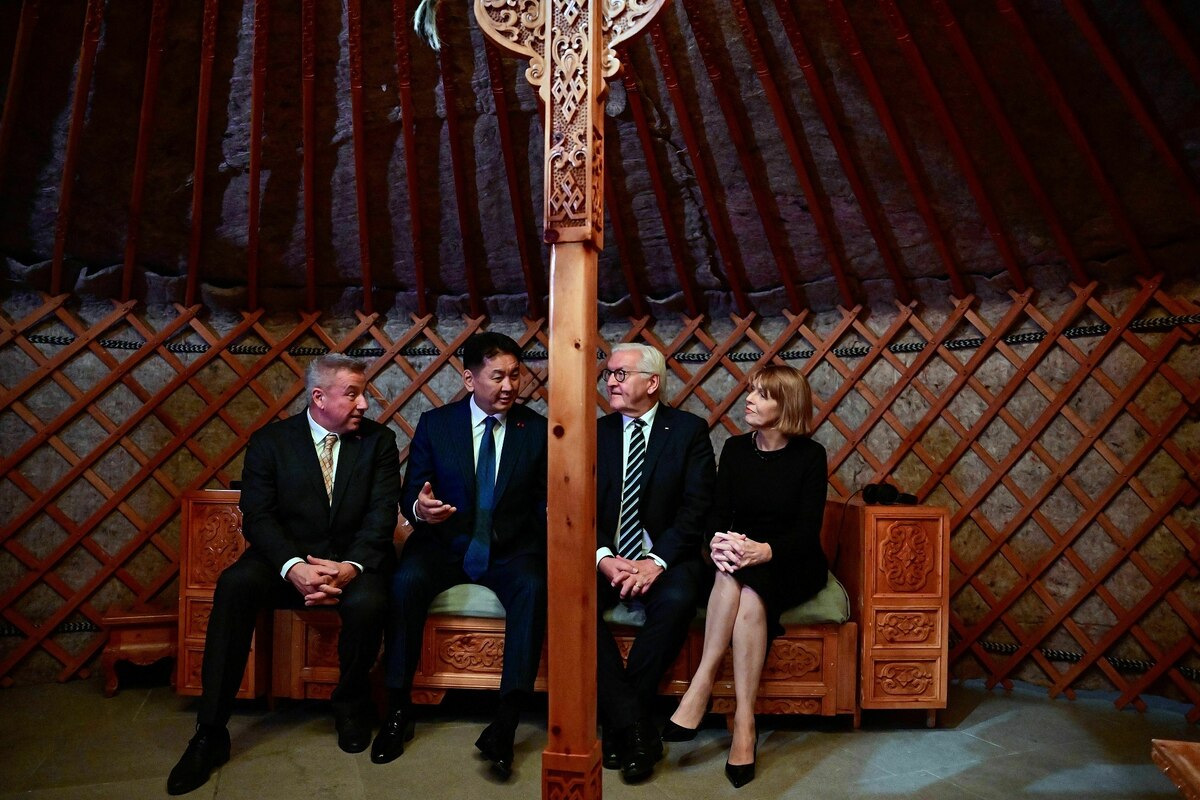
The opening ceremony, a high-profile affair, underscored the exhibition’s contemporary relevance, taking place during the state visit of Mongolian President Ukhnaagiin Khurelsukh. This diplomatic backdrop transformed a historical retrospective into a vibrant stage for cultural exchange and strategic dialogue, highlighting the intricate connections between ancient empires and modern international relations.
A Grand Opening on Berlin’s Museum Island
The James-Simon-Galerie, a modern architectural marvel serving as the entrance to Berlin’s UNESCO World Heritage site, now houses an exhibition that transcends mere historical display. It is a carefully curated exploration of a civilization often misunderstood, aiming to peel back layers of myth and caricature to reveal the sophisticated tapestry of the Mongol world.
The Enigmatic Absence of a Legend
One of the most striking aspects of "Genghis Khan and the World of the Mongols" is the almost complete lack of direct physical evidence relating to its namesake. As Matthias Wemhoff, the state archaeologist and director of the Museum of Pre- and Early History, candidly admitted in his opening address, "We have nothing." This absence is not for lack of trying, but rather a reflection of historical reality: Genghis Khan’s burial site remains undiscovered, and no authentic contemporary portrait of the legendary commander, who founded the largest contiguous land empire in world history, is known to exist.
The exhibition cleverly navigates this void. Instead of relying on definitive images, the promotional materials feature a golden monumental statue from the Genghis Khan National Museum in Ulaanbaatar – a modern creation dating to 2025. This choice subtly underscores that the exhibition is not about a definitive portrayal of the man, but rather an exploration of the idea of Genghis Khan, the impact of his reign, and the world he shaped. The year 2027 marks the 800th anniversary of his death, providing a timely hook for an exhibition that acknowledges the enduring power of his name to draw public attention to Central Asian history.
Stirrups and Steppes: A Glimpse into Nomadic Life
Upon entering the exhibition, visitors are immediately confronted with a tangible connection to the nomadic lifestyle that defined the Mongol Empire: stirrups. In recent weeks, there has been much talk of "Steigbügel" (stirrups) in a different, more politically charged context in Germany, making the exhibition’s focus on the actual objects a refreshing return to their original, elegant function. Displayed in various forms and from several centuries, including miniature golden stirrups as grave goods, these artifacts eloquently narrate the intimate bond between the nomadic steppe peoples and their horses. They speak of an existence intricately woven with equestrian mastery, a relationship that underpinned the Mongol’s military prowess and expansive reach.
The sheer number of stirrups, juxtaposed with the conceptual absence of their most famous "holder," prompts reflection. The exhibition implicitly draws a contrast, noting that the high medieval Mongolian horsemen, unlike certain modern political figures, "managed quite well to get onto their horses without help." This subtle jab hints at the exhibition’s underlying intellectual rigor, refusing to reduce complex historical figures to simplistic narratives.
The Legacy of Temüjin: From Warlord to World Builder
The story of Genghis Khan, born Temüjin, is one of extraordinary transformation and unparalleled ambition. From a humble chieftain’s son in the Onon River valley, he rose to become the "Oceanic Ruler" – a title that aptly describes his boundless influence.
Unifying the Steppe and Forging an Empire
Temüjin’s initial achievement was the unification of the disparate tribes of the Mongolian steppe. This monumental feat, achieved through a combination of strategic alliances, ruthless warfare, and charismatic leadership, laid the foundation for an empire that would soon encompass vast swathes of the globe. By 1206, he had established a realm stretching from the East China Sea to the Caspian Sea. His successors, building upon this formidable base, would expand it significantly further south and west, creating an imperial entity that dwarfed all previous land-based empires.
The sheer scale of the Mongol impact is not merely a historical footnote but has left traces even in unexpected scientific data. Historians and environmental scientists have posited that the Mongol conquests, which led to the massacre of up to a third of Asia’s population, had a measurable effect on the Earth’s atmosphere, causing a discernible drop in atmospheric CO2 levels due to reforestation of abandoned agricultural lands. This chilling statistic serves as a stark reminder of the immense human and ecological cost of their expansion.

The Dual Nature of Genghis Khan: Conqueror and Administrator
In Europe, Genghis Khan is often remembered primarily as a brutal slaughterer, a figure of terror and destruction. However, the exhibition challenges this one-dimensional portrayal, presenting a more nuanced and complex image. While his campaigns were undeniably violent, Genghis Khan was also a sophisticated administrator and lawgiver. He brought peace to contested regions, introduced religious freedom across his vast dominions, and established a principle of equality before the law, laying the groundwork for a stable and ordered society within his empire. This duality – the ruthless conqueror and the enlightened ruler – is central to understanding his enduring legacy.
The Pax Mongolica: A Bridge Between East and West
From this often-overlooked "Pax Mongolica," or Mongol Peace, Europe itself greatly benefited. The exhibition asserts that the wealth of the Italian city-states, a crucial precursor to the Renaissance, was largely predicated on the free and secure trade routes facilitated by the Mongol Empire, connecting the Far East to the Crimean Peninsula. Without the "devilish Tatars," who stood at the borders of the German Empire in 1241 before their sudden retreat, it is conceivable that the European Renaissance might never have blossomed as it did. The Mongol Empire effectively created an unprecedented network of communication and commerce, allowing for the exchange of goods, ideas, and technologies across Eurasia, profoundly impacting the trajectory of global history.
Curating the Unseen: The Exhibition’s Narrative Journey
The exhibition’s strength lies not in an abundance of "overwhelming objects," but in its ability to construct a compelling narrative that reshapes perceptions and highlights historical interconnections. Much of what is on display are everyday objects, although many are shown outside Mongolia for the first time. Rare and precious items, such as golden travel passes, are often presented as high-quality replicas, allowing the focus to remain on context and storytelling.
Dispelling Myths: Beyond the Pop Culture Caricature
The collective association with Genghis Khan in popular culture is often reduced to a crude German Schlager song, with lyrics like "On, brothers! Drink, brothers! Fight, brothers! Again and again!" The exhibition tackles this cliché head-on, addressing it immediately at the entrance. Video projections, employing a "Terra X"-style aesthetic, initially depict monstrous horse armies galloping across the screen, catering to the popular image. However, this is swiftly followed by an impressive display contrasting the heavy European armor with the light, agile Mongolian armor, and showcasing different saddles and bows. This direct comparison effectively dismantles simplistic notions of warfare and highlights the tactical advantages of the Mongol military.
Further evidence of the Mongol campaigns is presented through remnants of destroyed monasteries, powerfully illustrating the devastating impact on settled populations. Europe, the exhibition shows, was largely defenseless against these formidable attackers. The Mongol advance, however, halted abruptly some 250 kilometers before Berlin in 1241, not due to military defeat, but due to the death of the Great Khan in the Far East, necessitating the return of the armies for the election of a successor. This pivotal moment underscores how internal dynamics within the Mongol Empire shaped the destiny of distant lands.

From Battlefield to Capital: Karakorum’s Significance
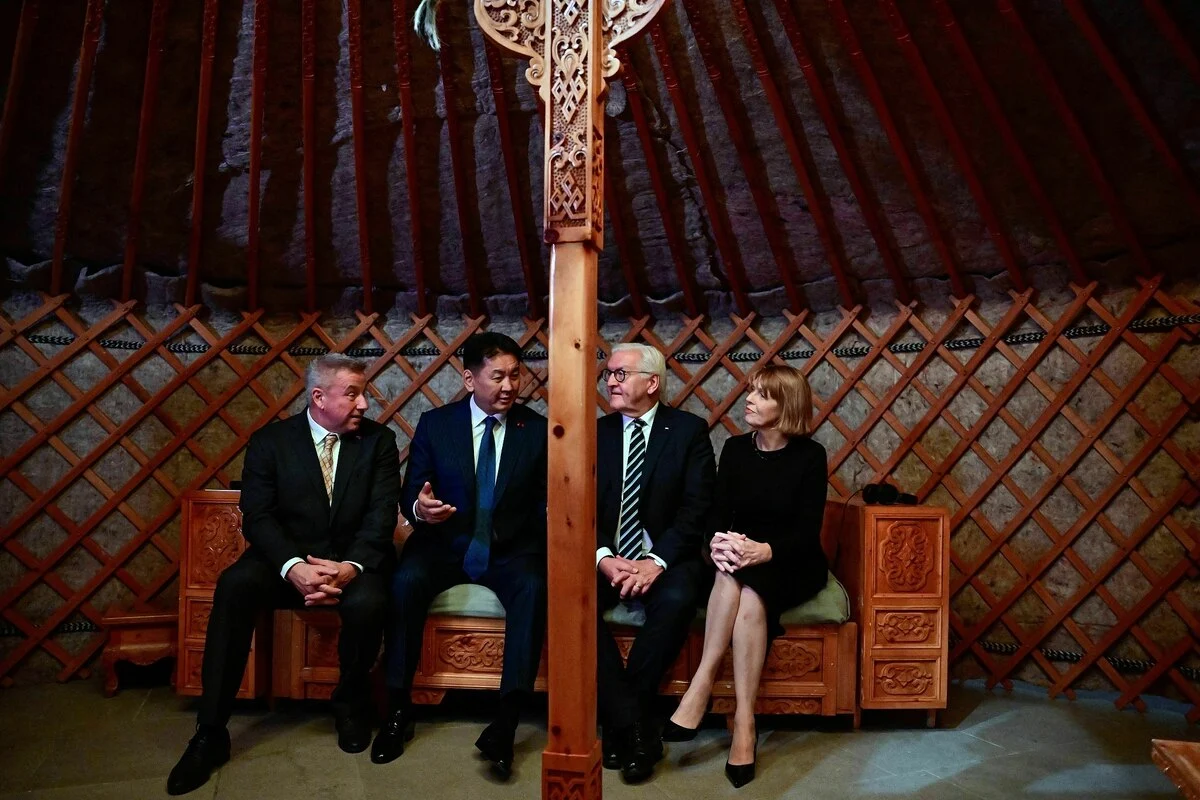
The exhibition then makes a significant leap through time and space, moving beyond the initial conquests to the settled imperial phase. Embracing an "oldschool" approach to exhibition design, the creators use evocative set constructions to depict the various empires and ethnic groups of the steppe. The journey into the main hall leads through a reconstructed burial passage, featuring magnificent grave goods from Shoroon Bumbagar (7th century), offering a tangible connection to earlier steppe cultures. Naturally, a traditional yurt also forms a central part of the display, grounding the visitor in the nomadic heritage.
The focus subsequently shifts from Genghis Khan’s immediate milieu to his capital city, Karakorum. Recognizing that an empire of such vastness could not be managed solely from the back of a horse, the nomadic ruler centralized economic and administrative functions here. Archaeological finds from Karakorum reveal a sophisticated urban center with an extensive trade network and remarkable religious diversity, reflecting the cosmopolitan nature of the Mongol Empire.
A particular highlight is a fragment of the founding stele of Karakorum, a prized loan from Ulaanbaatar. Its bilingual inscription, in Chinese and the Mongolian script developed at the Khan’s behest, testifies to the empire’s administrative ambitions and its engagement with diverse cultural traditions. These artifacts, though not individually overwhelming, collectively build a powerful picture of a complex and interconnected world.
Objects of Everyday Life and Imperial Power
The exhibition is less about showcasing dazzling individual treasures and more about illuminating the historical fabric through a multitude of objects. While many items are displayed outside Mongolia for the first time, it is the everyday artifacts that dominate, painting a vivid picture of the lives of the people within the Mongol sphere. The focus on context over sheer spectacle allows the exhibition to foster a deeper understanding of historical connections and disruptions, reordering conventional historical narratives. For instance, the Uighurs, currently perceived predominantly as victims of alleged ethnocide, are presented here as an earlier imperial power from the steppe, a precursor to the Mongol Empire. This reframing challenges contemporary perceptions and enriches the historical understanding of Central Asian peoples.
Rewriting History: New Perspectives on Central Asia
One of the most compelling aspects of the exhibition is its capacity to challenge established historical narratives, particularly those with a Eurocentric bias. By presenting Central Asian history through its own lens, the exhibition invites a reconsideration of global power dynamics and cultural influences.

The Uighurs: A Precursor to Imperial Might
The narrative reordering extends to groups like the Uighurs, whose current plight often overshadows their historical significance. The exhibition thoughtfully portrays them not merely as a people subjected to external forces, but as a significant imperial power of the steppe, laying foundational elements that would later be absorbed and expanded upon by the Mongols. This perspective is crucial for a more comprehensive understanding of the complex historical succession and interaction of power in Central Asia, moving beyond contemporary headlines to reveal deeper historical roots.
The Golden Horde’s Enduring Influence on Eastern Europe
The exhibition also delves into the profound impact of the Mongol Empire on Eastern European history. As Matthias Wemhoff noted in the press conference preceding the opening, the divergent historical development of Ukraine and Russia can be partly attributed to the uneven influence of the Mongolian Golden Horde. This observation is particularly poignant in the current geopolitical climate, offering a historical lens through which to understand the deep-seated cultural and political distinctions that continue to shape the region. The Mongol legacy, therefore, is not just a distant historical event but an active force in understanding contemporary fault lines.
Geopolitics on Display: Genghis Diplomacy in Action
The presence of Mongolian President Khurelsukh at the exhibition’s opening ceremony was far from coincidental; it highlighted the geopolitical undercurrents that imbue the historical narrative with contemporary urgency.
Mongolia’s Delicate Balancing Act
Wemhoff’s opening speech, delivered in the presence of the Mongolian President, conspicuously omitted the discussion of the Golden Horde’s differential impact on Ukraine and Russia. This diplomatic deference was perhaps a nod to the guest, given Khurelsukh’s controversial reception of his internationally wanted Russian counterpart in 2024. Mongolia finds itself in an unenviable geopolitical position: it is Central Asia’s only relatively stable democracy, bordered by two authoritarian great powers, Russia and China. This delicate balancing act makes international partnerships, particularly with democratic nations, strategically vital.
State Visits and Strategic Partnerships
It is therefore entirely understandable that President Khurelsukh, during the opening ceremony, spoke of Genghis Khan as a "peace bringer," who "ended centuries of war between East and West" and thanks to whom "Europe and Asia could live together peacefully." This framing of Genghis Khan as a unifier and facilitator of peace, though a highly selective interpretation of history, serves a clear diplomatic purpose. German President Frank-Walter Steinmeier, in his preceding speech, acknowledged this subtext with ironic wit, remarking, "This time, the Mongols have actually come to Berlin."

Essentially, Mongolia is engaging in "Genghis diplomacy" with this state-supported exhibition, a strategy akin to China’s "panda diplomacy." The National Museum of Mongolia sends miniature golden stirrups and other artifacts, and in return, antique sculptures from Berlin’s Museum Island are likely to visit Ulaanbaatar in the near future. Beyond cultural exchange, this diplomacy serves concrete strategic interests. Germany seeks to secure access to raw materials from the Mongolian steppe, while Mongolia gains a measure of security and strengthens its position within the democratic axis through the "close values-based friendship" invoked by President Khurelsukh.
Conclusion: Bridging Eras and Fostering Dialogue
The exhibition "Genghis Khan and the World of the Mongols" is more than a historical display; it is a profound exercise in historical re-evaluation and contemporary diplomacy. It skillfully navigates the complex legacy of Genghis Khan, moving beyond simplistic narratives of brutality to reveal an astute leader who unified disparate tribes, established a vast administrative system, and fostered an era of unprecedented Eurasian exchange.
By confronting the paradox of a missing protagonist, the exhibition compels visitors to focus on the enduring impact of the Mongol Empire on trade, governance, religious tolerance, and even the very climate. It challenges Eurocentric perspectives, recontextualizes historical events, and illuminates the often-overlooked contributions of Central Asian civilizations.
In the current geopolitical landscape, the exhibition takes on an added layer of significance. It provides a platform for Mongolia, a democratic outpost nestled between powerful authoritarian neighbors, to assert its cultural heritage and strengthen its international ties. The "Genghis diplomacy" at play underscores how history and culture can be potent tools in contemporary foreign policy, facilitating not only understanding but also strategic alliances and economic cooperation.
Genghis Khan, the formidable conqueror and administrative genius with a knack for organization and cohesion, would undoubtedly have approved of this sophisticated interplay of history, culture, and geopolitics. The Berlin exhibition serves as a powerful reminder that the echoes of ancient empires continue to shape our present and influence our future, inviting us to look beyond conventional narratives and embrace the rich, multifaceted tapestry of global history.