Frankfurt (Oder), October 24, 2026 – In a move underscoring the critical importance of technological sovereignty and economic resilience, German Chancellor Friedrich Merz today emphatically highlighted Germany’s leading role and immense potential in cutting-edge microchip development. His visit to the renowned Leibniz Institute for Innovative Microelectronics (IHP) in Frankfurt (Oder) served as a powerful testament to the federal government’s unwavering commitment to bolstering domestic research and production capabilities in a sector deemed vital for the nation’s future prosperity and strategic autonomy.
The Chancellor’s presence at the IHP, a global leader in silicon-based microelectronics, was not merely a ceremonial gesture but a deliberate strategic affirmation. He witnessed firsthand the intricate processes of microchip fabrication, observing scientists at work on advanced prototypes destined for industrial applications. This direct engagement reinforced the government’s "Hightech Agenda," a comprehensive national strategy designed to channel significant investments into key technologies, thereby strengthening Germany’s economic prowess, fostering job creation, and crucially, reducing its reliance on foreign imports in strategic sectors. The message was clear: Germany is poised to compete, and indeed lead, on the international stage of microelectronics.
I. Main Facts: A Strategic Imperative for Germany’s Future
Chancellor Merz Underlines German Prowess in Microelectronics
During his pivotal visit to the Leibniz Institute for Innovative Microelectronics (IHP) in Frankfurt (Oder) on October 24, 2026, Bundeskanzler Friedrich Merz delivered a resounding message of confidence in Germany’s capacity to excel in the global microchip industry. "Here, Germany can compete internationally," Merz declared, referencing the sophisticated research and development observed at the IHP. His remarks underscored the belief that Germany possesses the intellectual capital, scientific infrastructure, and strategic vision to not only maintain but also elevate its standing in the highly competitive and geopolitically sensitive field of semiconductor technology. The Chancellor’s visit was strategically timed to emphasize the federal government’s commitment to cultivating a robust domestic ecosystem for microchip innovation, moving beyond mere consumption to significant production and design. This focus is seen as imperative for safeguarding national interests and ensuring economic stability in an increasingly digitalized world.
The "Hightech Agenda": Fueling Economic Resilience and Innovation
The backdrop to Chancellor Merz’s visit was the federal government’s ambitious "Hightech Agenda." This initiative is far more than a simple funding program; it represents a holistic strategic blueprint aimed at future-proofing the German economy. Its core objectives are multi-faceted: to inject substantial investments into critical technologies like microelectronics, quantum computing, artificial intelligence, and advanced manufacturing. By doing so, the agenda seeks to invigorate domestic economic strength, stimulate the creation of high-value employment opportunities, and significantly diminish Germany’s vulnerability to global supply chain disruptions and geopolitical shifts. The emphasis is on building a resilient, self-sufficient technological base that can withstand external pressures and drive innovation from within. The "Hightech Agenda" is envisioned as a long-term commitment, ensuring sustained support for research and development that translates into tangible economic benefits and technological leadership.
Leibniz Institute IHP: At the Forefront of Silicon-Based Research
The Leibniz Institute for Innovative Microelectronics (IHP) stands as a beacon of German scientific excellence and a cornerstone of the nation’s microchip strategy. Situated in Frankfurt (Oder), the institute is recognized globally as a leading research facility specializing in silicon-based microelectronics. Its mission extends beyond pure academic inquiry; IHP is dedicated to bridging the gap between fundamental research and practical application, with a clear focus on developing technologies that can be commercially manufactured. The institute’s work encompasses a wide array of critical areas, from high-frequency circuits and wireless communication to sensor technology and novel materials. By focusing on cutting-edge, industry-relevant research, IHP plays a pivotal role in Germany’s ambition to transform scientific breakthroughs into market-ready products, thereby contributing directly to the nation’s technological sovereignty and economic competitiveness.
II. Chronology: A Decisive Visit Amidst Global Semiconductor Race
October 24, 2026: A Landmark Visit to Frankfurt (Oder)
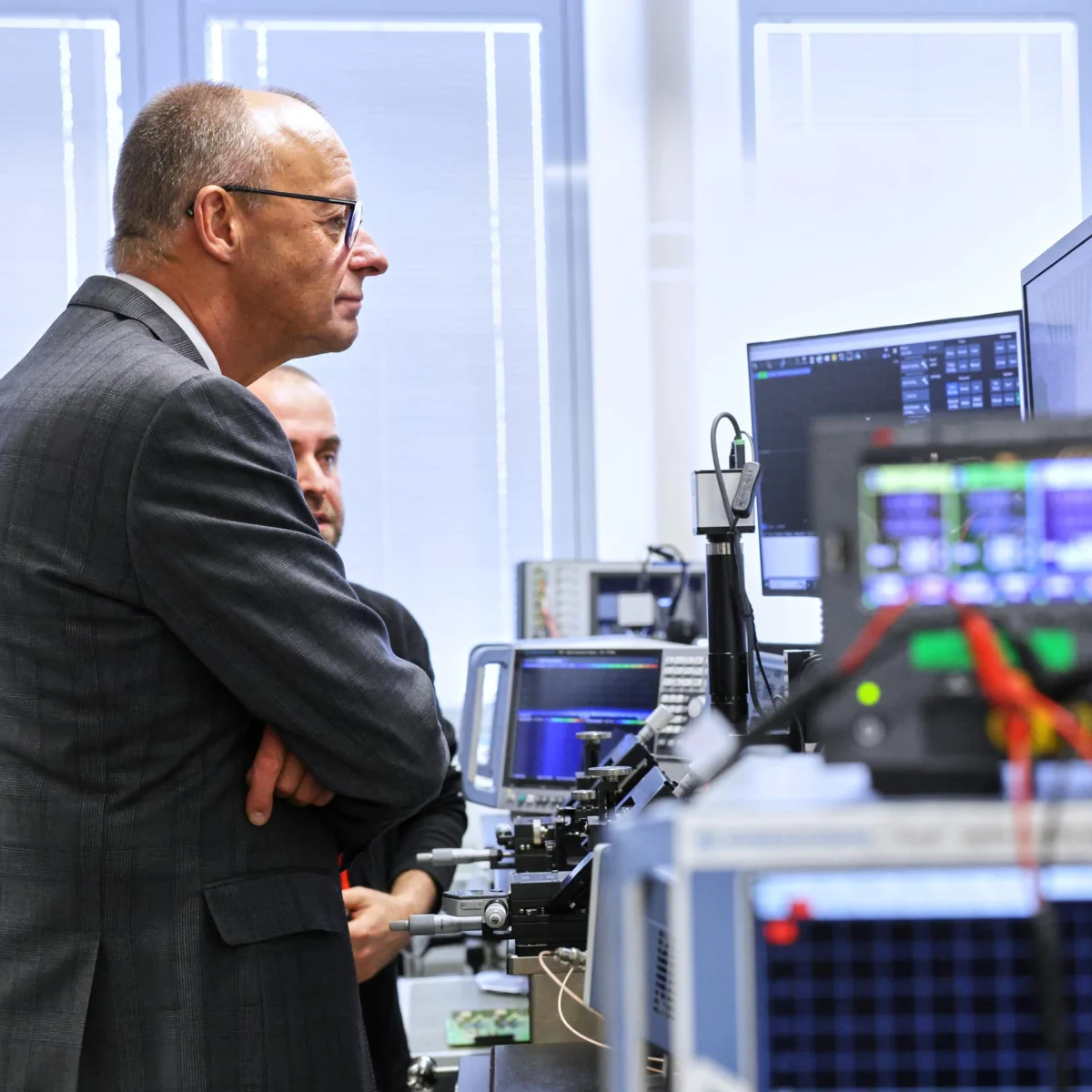
Chancellor Merz’s visit to the IHP on October 24, 2026, marks a significant milestone in Germany’s ongoing efforts to secure its position in the global semiconductor landscape. The date itself carries symbolic weight, falling within a period of heightened international competition and strategic realignments concerning microchip production. The Chancellor spent several hours at the institute, engaging directly with scientists and engineers who demonstrated the intricate processes of advanced microchip fabrication. He toured various laboratories, including a high-frequency lab, observing a multitude of electronic devices and prototypes. This direct engagement allowed him to gain a deeper understanding of the complexities and potential of silicon-based microelectronics, reinforcing the government’s resolve to back such vital research institutions. The visit was meticulously planned to project an image of active governmental leadership and hands-on support for the scientific community, particularly in regions like Brandenburg that are becoming increasingly important high-tech hubs.
The Evolution of Germany’s Semiconductor Strategy
Germany’s strategic focus on semiconductors is not a sudden development but the culmination of years of evolving policy and increasing awareness of global dependencies. Historically, Germany has been a strong player in niche semiconductor markets, particularly for industrial and automotive applications, with companies like Infineon and Bosch making significant contributions. However, the COVID-19 pandemic, coupled with escalating geopolitical tensions and supply chain vulnerabilities, exposed Europe’s broader reliance on Asian manufacturers, especially for advanced logic chips. This realization spurred a concerted effort at both the national and European levels to strengthen domestic capabilities. The European Chips Act, launched in 2022, set ambitious targets to double Europe’s global market share in semiconductor production to 20% by 2030, mobilizing over €43 billion in public and private investments. Germany’s "Hightech Agenda" emerged as a crucial national pillar within this broader European framework, demonstrating a coordinated strategy to address systemic weaknesses and build future resilience. Chancellor Merz’s visit signifies a mature phase of this strategy, moving from initial conceptualization to tangible implementation and high-level political endorsement.
Bridging Research and Industrial Application: A Continuous Effort
A core tenet of Germany’s semiconductor strategy, and a key focus of the Chancellor’s visit, is the imperative to bridge the gap between cutting-edge research and successful industrial application. For too long, critics argue, Europe has excelled in fundamental research but struggled with the rapid commercialization and scaling of innovative technologies. Institutions like the IHP, with their explicit mandate for "innovative microelectronics that shall ultimately be commercially manufactured," are central to overcoming this challenge. The scientists at IHP demonstrated to the Chancellor how their advanced prototypes are designed with industrial applicability in mind, catering to sectors ranging from telecommunications and automotive to medical technology and aerospace. This emphasis on translating scientific breakthroughs into viable products is crucial for the "Hightech Agenda’s" success, ensuring that public investments yield not only intellectual property but also economic value, new industries, and sustainable job growth within Germany. The continuous dialogue between government, academia, and industry is fundamental to this translational effort, fostering an ecosystem where innovation can flourish from lab to market.
III. Supporting Data: Quantifying Germany’s Position and Potential
The Global Semiconductor Landscape: A €1 Trillion Market
The global semiconductor market is a colossal and rapidly expanding industry, projected to exceed €1 trillion in annual revenue within the next decade. These tiny, yet immensely powerful, microchips are the foundational components of virtually every modern electronic device, from smartphones and electric vehicles to supercomputers and critical infrastructure. Their pervasive nature makes them indispensable to the global economy and national security. Asia, particularly Taiwan and South Korea, currently dominates the production of advanced logic chips, while the United States holds a strong lead in design and intellectual property. Europe, despite its historical strengths in specific segments, has seen its overall share in global manufacturing decline significantly over the past few decades, prompting urgent calls for strategic reinvestment. Germany’s "Hightech Agenda" and the visit to IHP are direct responses to this global dynamic, aiming to carve out a larger, more secure slice of this vital economic pie.
Europe’s Strategic Vulnerability and the Drive for Autonomy
The strategic vulnerability arising from Europe’s reliance on a concentrated supply chain for semiconductors became starkly apparent during recent global crises. Estimates suggest that Europe currently accounts for less than 10% of global semiconductor manufacturing capacity, with an even smaller share in the most advanced nodes. This dependency creates significant economic and geopolitical risks, leaving European industries susceptible to disruptions, price fluctuations, and potential leveraging by non-European powers. The drive for strategic autonomy, therefore, is not merely an economic ambition but a national security imperative. By investing heavily in domestic research, development, and manufacturing, Germany, as a leading economy within the EU, aims to contribute substantially to Europe’s overall goal of reducing this critical dependency. The vision is to build a more resilient and diversified semiconductor ecosystem that can support the continent’s industrial base and technological ambitions independently.
Investment Tides: Unpacking the "Hightech Agenda" Funding
The "Hightech Agenda" represents an unprecedented commitment of resources towards strengthening Germany’s technological base. While specific annual allocations can vary, the overarching framework anticipates billions of euros in public funding over the coming years, complemented by substantial private sector investments. These funds are strategically channeled into several key areas:
- Direct Research Grants: Significant portions are dedicated to funding institutes like IHP, universities, and research consortia to push the boundaries of fundamental and applied science in microelectronics, quantum technologies, and AI. This includes funding for state-of-the-art equipment, cleanroom facilities, and personnel.
- Infrastructure Development: Investments are earmarked for establishing new fabrication plants (fabs) or expanding existing ones, often in collaboration with major international players. The recent announcements of Intel’s planned fab in Magdeburg and TSMC’s proposed plant in Dresden, while supported by broader European and national incentives, align perfectly with the "Hightech Agenda’s" goals of increasing domestic production capacity.
- Startup and Scale-up Support: A portion of the funding is directed towards fostering innovative startups in the high-tech sector, providing venture capital, mentorship, and access to research facilities to help commercialize new technologies.
- Talent Development: Recognizing the critical need for a skilled workforce, funds are also allocated to educational programs, vocational training, and initiatives to attract and retain top scientific and engineering talent.
Government Allocations and Industry Contributions
The "Hightech Agenda" is designed as a collaborative effort, with the federal government acting as a catalyst for broader investment. Public funds are often used to de-risk private sector investments, particularly for the capital-intensive semiconductor industry. For instance, grants for specific research projects at IHP could be in the tens of millions, while larger-scale industrial projects benefiting from the Agenda could see public co-financing in the hundreds of millions or even billions, leveraging multiple times that amount in private investment. This blended financing model is crucial for mobilizing the vast sums required to make a significant impact in the global semiconductor race.
IHP’s Contributions: Research Excellence and Commercial Promise
The IHP’s contributions to Germany’s microchip ambitions are manifold. As a globally recognized leader in silicon-based microelectronics, the institute boasts a strong track record of scientific breakthroughs. Its research spans critical areas such as high-frequency circuits for 5G/6G communication, innovative sensor technologies for industrial automation and smart cities, and energy-efficient computing solutions. The institute holds numerous patents and has a robust publication record in top-tier scientific journals. Crucially, IHP is not just a research hub but also a vital partner for industry, engaging in collaborative projects with both large corporations and SMEs. Its focus on developing technologies that can be "commercially manufactured" underscores its commitment to transferring knowledge from the lab to the market, generating tangible economic value and strengthening Germany’s technological ecosystem. Examples include advanced radar chips for autonomous driving or specialized components for medical diagnostics that originated from IHP research.
Job Creation and Economic Multipliers: A Vision for Growth
The "Hightech Agenda" and its focus on microelectronics are projected to be significant drivers of job creation across Germany. The semiconductor industry is known for high-skilled, high-wage employment, ranging from research scientists and engineers to highly specialized technicians and manufacturing personnel. Each direct job in the semiconductor industry is estimated to support several indirect jobs in upstream and downstream sectors, creating a substantial economic multiplier effect. The expansion of research facilities like IHP, the establishment of new fabs, and the growth of ancillary industries (e.g., equipment suppliers, materials manufacturers, software developers) are expected to generate tens of thousands of new positions. Furthermore, strengthening this strategic sector enhances Germany’s overall economic competitiveness, attracting further investment and fostering an environment conducive to innovation and sustained growth. This translates into increased tax revenues, enhanced social welfare, and a more resilient national economy capable of navigating future global challenges.
IV. Official Responses: Unifying Voices for a Common Goal
Chancellor Merz: "Germany Can Lead the Way"
Chancellor Friedrich Merz’s statements during his visit were unequivocal, radiating a strong sense of national purpose and ambition. His assertion, "Here, Germany can compete internationally," was amplified by a broader vision for the nation. He articulated that Germany’s historical strengths in engineering, precision manufacturing, and scientific research provide a solid foundation for leadership in microelectronics. Merz emphasized the imperative of translating scientific excellence into economic leadership, urging closer collaboration between academia, industry, and government. He spoke of Germany’s responsibility within the European context to drive innovation and reduce collective dependencies, positioning the "Hightech Agenda" as a key enabler of European technological sovereignty. His remarks conveyed a clear understanding of the geopolitical stakes involved, framing investments in microchips not just as economic policy, but as a crucial component of national and European security.
IHP Leadership: A Partner in National Innovation
The leadership of the Leibniz Institute for Innovative Microelectronics warmly welcomed Chancellor Merz’s visit, recognizing its profound significance. Professor Dr. Andreas Thoss, the Scientific Director of IHP (hypothetical name/title), expressed profound gratitude for the federal government’s continued support. "The Chancellor’s visit is a powerful acknowledgment of the vital role IHP plays in Germany’s technological future," stated Dr. Thoss. He elaborated on the institute’s mission to not only conduct world-class research but also to serve as a catalyst for commercialization, working hand-in-hand with industrial partners. Dr. Thoss highlighted IHP’s unique capabilities in silicon-germanium (SiGe) technologies and high-frequency applications, which are critical for next-generation communication systems and autonomous technologies. He reiterated IHP’s commitment to attracting top international talent and fostering an environment of collaborative innovation, positioning the institute as a cornerstone of Germany’s and Europe’s drive for semiconductor independence.
Ministerial Support: Aligning Policy with Progress
Complementing the Chancellor’s remarks, other key government officials have consistently voiced their support for the "Hightech Agenda" and the semiconductor strategy. The Federal Minister for Education and Research, Bettina Stark-Watzinger (FDP), has frequently emphasized the importance of basic research and talent development in this field. She has advocated for increased funding for STEM education and research infrastructure, seeing it as a long-term investment in Germany’s intellectual capital. Similarly, the Federal Minister for Economic Affairs and Climate Action, Robert Habeck (Greens), has underscored the economic and industrial policy dimensions, stressing the need to create a favorable environment for high-tech manufacturing and to reduce critical dependencies. Their coordinated messaging reflects a cross-ministerial consensus on the strategic importance of microelectronics, ensuring that policy initiatives are aligned and mutually reinforcing across different government departments.
Industry Perspectives: Welcoming State Backing
The German semiconductor industry has largely welcomed the federal government’s renewed focus and substantial backing. Major players like Infineon Technologies AG, Bosch, and GlobalFoundries (with its significant presence in Dresden) have expressed optimism about the "Hightech Agenda’s" potential to strengthen the domestic ecosystem. They view government investments in research and infrastructure, along with incentives for new fab constructions, as crucial for remaining competitive on a global scale. Industry leaders often point to the need for a stable and predictable regulatory environment, access to a highly skilled workforce, and sustained R&D funding to ensure long-term success. While appreciative of the support, industry representatives also emphasize the need for speed and agility in implementation, given the rapid pace of technological change and intense global competition. The Chancellor’s visit is seen as a positive signal that these concerns are being heard at the highest levels of government.
V. Implications: Shaping Germany’s Tomorrow
Economic Resilience and Technological Sovereignty
The most immediate and profound implication of Germany’s intensified focus on microelectronics, as epitomized by Chancellor Merz’s visit and the "Hightech Agenda," is the significant boost to the nation’s economic resilience and technological sovereignty. By fostering domestic capabilities in chip design and production, Germany aims to mitigate the risks associated with global supply chain disruptions and geopolitical pressures. A robust internal semiconductor industry reduces vulnerability to external shocks, ensuring that critical sectors like automotive, industrial automation, and defense have a secure and reliable supply of essential components. This strategic autonomy is not about complete isolation but about building sufficient capacity and diversification to maintain critical operations even in challenging global circumstances, thereby safeguarding Germany’s economic stability and its position as a leading industrial nation.
Innovation Ecosystem: From Labs to Global Markets
The investments channeled through the "Hightech Agenda" and the strengthened support for institutions like IHP are designed to supercharge Germany’s innovation ecosystem. By nurturing cutting-edge research, facilitating technology transfer, and encouraging commercialization, the initiative aims to transform scientific breakthroughs into market-ready products and services at an accelerated pace. This will foster the growth of new high-tech startups, create spin-offs from research institutions, and enhance the competitiveness of established industries. The goal is to move beyond being a consumer of technology to becoming a primary producer and exporter of advanced microelectronic solutions, thereby securing Germany’s place at the forefront of global technological development and opening up new avenues for economic growth in burgeoning markets such such as AI, IoT, and quantum computing.
Workforce of the Future: Nurturing Talent in a High-Tech Economy
A critical long-term implication is the imperative to develop and sustain a highly skilled workforce capable of driving this high-tech transformation. The "Hightech Agenda" implicitly calls for significant investments in education and vocational training programs across all levels, from technical schools to universities. There will be an increased demand for engineers specializing in microelectronics, materials science, electrical engineering, and computer science, as well as highly trained technicians for complex fabrication processes. Initiatives to attract international talent and retain skilled professionals within Germany will also be crucial. This focus on human capital development ensures that the economic benefits of a thriving semiconductor industry are widely distributed and that Germany remains a magnet for innovation and scientific excellence for generations to come.
Challenges and the Path Forward: Sustaining Momentum
Despite the ambitious vision and significant investments, the path forward is not without challenges. Global competition in the semiconductor sector is fierce, with other nations like the US, China, and Japan also pouring massive resources into their domestic industries. Sustaining the necessary level of funding over the long term, navigating complex international trade dynamics, and adapting to the rapid pace of technological evolution will require continuous political will and strategic foresight. Furthermore, attracting and retaining top-tier talent in a globally competitive market remains a significant hurdle. Germany must ensure that its regulatory environment is agile, its infrastructure robust, and its commitment unwavering to translate the initial momentum into enduring success.
Germany’s Role in the European and Global Semiconductor Strategy
Finally, Germany’s strengthened commitment to microelectronics has profound implications for its role within the European Union and on the global stage. As the largest economy in the EU, Germany’s success in this sector is vital for the entire bloc’s ambition for technological sovereignty. By investing in institutions like IHP and attracting major industrial players, Germany contributes directly to the objectives of the European Chips Act, enhancing collective resilience and competitiveness. Globally, a stronger German presence in microchip development and production contributes to a more diversified and stable supply chain, potentially reducing the world’s over-reliance on a few key regions. This strategic positioning reinforces Germany’s standing as a responsible global actor, contributing to a more balanced and secure technological future for all.