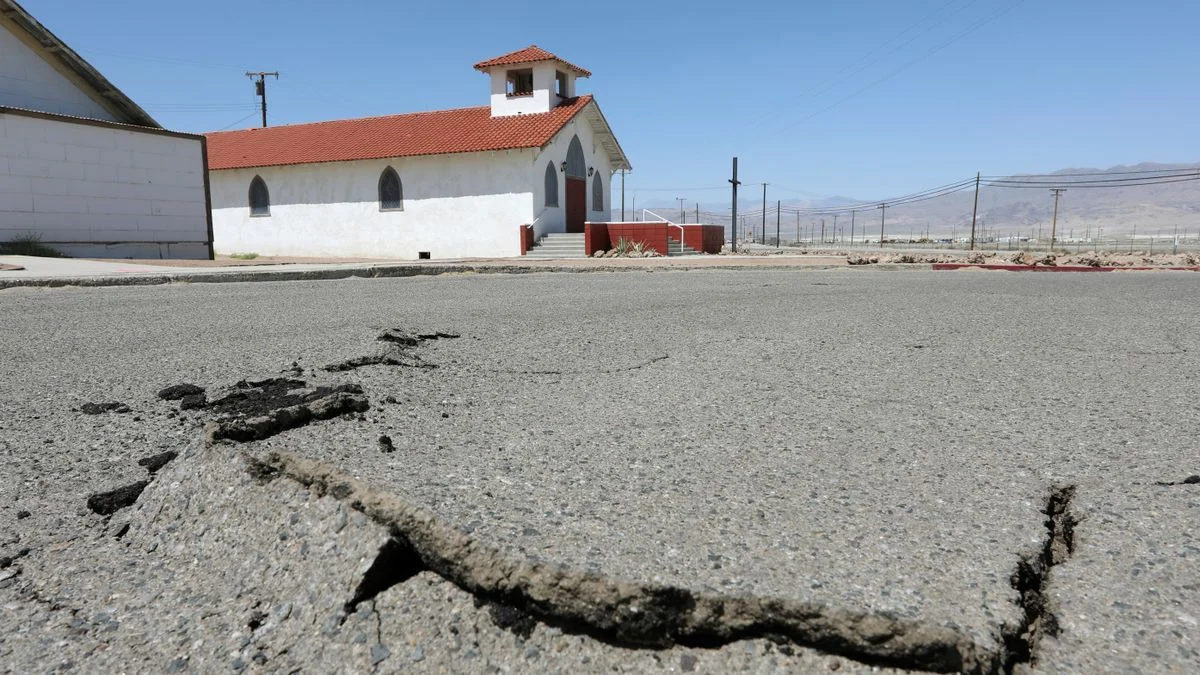
In the quiet, arid landscapes of the California interior, a silent crisis is brewing beneath the feet of millions. Recent geophysical surveys and data synthesized from the state’s extensive network of seismic sensors have revealed that tectonic stress levels along key segments of the San Andreas Fault and its secondary networks have reached an all-time high. Scientists are increasingly concerned that the "Great One"—a catastrophic seismic event long feared by seismologists—may be moving from the realm of abstract risk to a near-term reality.
The Science of the Subsurface: Understanding the Tension
The Earth’s crust in California is a complex puzzle of tectonic plates in constant motion. As the Pacific Plate slides northwestward past the North American Plate, friction inevitably causes these massive rock masses to lock. Over decades, or even centuries, this "locking" stores an immense amount of elastic potential energy.
When the friction is finally overcome, that energy is released in the form of an earthquake. The current concern, as highlighted by recent monitoring, is that the amount of accumulated energy—the "stress deficit"—has reached record levels in several critical sectors, particularly in the southern regions of the fault line.
Geophysicists utilize InSAR (Interferometric Synthetic Aperture Radar) and a dense array of GPS sensors to measure ground deformation down to the millimeter. Recent data indicates that the "slip deficit"—the amount of motion that should have occurred but hasn’t because of the fault locking—is now greater than at any point since detailed record-keeping began.
A Chronology of Escalating Seismic Indicators
To understand why experts are raising the alarm now, one must look at the timeline of geological observations over the past decade:
- 2014-2016: The Period of Unusual Creep: Seismologists observed anomalous "slow-slip" events, where parts of the fault moved without generating seismic waves. While these events can sometimes relieve pressure, in this instance, they appeared to transfer stress to more locked, dangerous segments.
- 2019: The Ridgecrest Sequence: The magnitude 6.4 and 7.1 earthquakes near Ridgecrest served as a wake-up call. While these did not occur directly on the main San Andreas Fault, they demonstrated the interconnected nature of California’s fault systems, effectively "loading" nearby faults with additional stress.
- 2021-2022: Increased Micro-seismicity: A statistically significant uptick in small-magnitude tremors (magnitudes 1.0 to 3.0) was recorded in the Salton Trough, the southern terminus of the San Andreas Fault.
- 2023-Present: The Record-Level Readings: The most recent data integration shows that the stress accumulation rate in the southern Coachella Valley segment has surpassed historical averages, suggesting that the fault is primed for a major release.
Supporting Data: By the Numbers
The severity of the current situation is underscored by several key metrics:
- The Recurrence Interval: Paleoseismological studies, which analyze soil layers to date past earthquakes, indicate that the southern San Andreas Fault typically ruptures every 150 to 200 years. It has been over 300 years since the last major rupture in that specific section, leading experts to conclude that the region is "overdue."
- Cumulative Slip Deficit: Current models estimate a deficit of nearly 20 feet (6 meters) of displacement in some southern zones. If released in a single event, the energy would be equivalent to a magnitude 7.8 or higher earthquake.
- Regional Network Integration: Modern computational models, such as the Uniform California Earthquake Rupture Forecast (UCERF3), now integrate over 300 fault segments. The latest iterations show a 99% probability of at least one magnitude 6.7 or greater earthquake striking California within the next 30 years.
Official Responses and Public Policy
The response from the scientific community and state authorities has been one of "preparedness over panic." The California Governor’s Office of Emergency Services (Cal OES) has ramped up its "Earthquake Warning California" program, which utilizes the ShakeAlert system to provide seconds of warning before the strongest shaking arrives.
"We cannot predict the exact day or hour," says Dr. Elena Vance, a lead geophysicist at the Southern California Earthquake Center. "However, the data is unequivocal. The physical state of the fault is at a record level of stress. Our focus is on structural resilience, retrofitting older buildings, and ensuring that our critical infrastructure—water, power, and communications—can withstand the inevitable."
The state legislature has recently approved increased funding for the "Seismic Retrofitting Program," which aims to incentivize homeowners to strengthen "soft-story" buildings—older multi-family homes with garages on the ground floor, which are notoriously prone to collapse during major quakes.
The Socioeconomic Implications
The implications of a major seismic event in Southern California are staggering. Unlike a hurricane or wildfire, which can often be tracked and predicted days in advance, an earthquake provides no warning until it begins.
Infrastructure and Lifelines
A magnitude 7.8 earthquake would not only cause direct structural damage but would likely sever "lifelines." The aqueducts that transport water from Northern California to the thirsty south cross the San Andreas Fault; a major rupture would almost certainly rupture these pipes, leaving millions without water for weeks or months. Similarly, the "energy corridor"—the network of high-voltage transmission lines and natural gas pipelines—faces high risks of catastrophic failure.
Economic Impact
Economists warn that the economic ripple effects could be global. The Port of Los Angeles and the Port of Long Beach are critical nodes in the global supply chain. A significant disruption to these facilities, coupled with the destruction of logistics hubs and regional businesses, could result in damages estimated in the hundreds of billions of dollars, potentially triggering a significant downturn in the national economy.
The Human Element
The greatest risk remains the loss of life and the displacement of residents. Modern building codes in California are among the strictest in the world, which will undoubtedly save thousands of lives. However, the sheer density of population in the Los Angeles basin means that even with excellent building performance, the number of casualties could be substantial if the event occurs during peak hours.
Preparing for the Inevitable: A Call to Action
The current findings regarding the San Andreas Fault should not be viewed as a signal for mass exodus, but rather as a catalyst for modernization. Experts emphasize that the "Big One" is not a matter of if, but when.
"We are currently living in a period of relative seismic calm that is historically anomalous," says Dr. Marcus Thorne, a seismologist who has spent decades studying fault mechanics. "We have the technology to monitor these stresses, the engineering capability to reinforce our cities, and the administrative structures to organize a response. The question is whether we will act with the necessary urgency before the earth forces our hand."
Recommendations for Resilience:
- Home Retrofitting: For homeowners in older residences, bolting the house to its foundation is the single most effective action to prevent catastrophic collapse.
- The "Two-Week" Rule: Emergency planners are moving away from the "three-day" supply recommendation. Given the expected damage to infrastructure, families are now urged to be prepared to be self-sufficient for at least 14 days following a major disaster.
- Community Engagement: Local Community Emergency Response Teams (CERT) provide essential training for neighbors to assist one another when professional emergency responders are overwhelmed.
As the data continues to pour in from the sensors buried deep in the California soil, the silence of the fault line serves as a stark reminder of the volatile world beneath us. While the Earth moves on its own schedule, our ability to mitigate the consequences of its movement is within our control. The record-level tensions in the underground are not just a scientific curiosity; they are a mandate for a state—and a nation—to prepare for the inevitable.