In a groundbreaking development for planetary science, astronomers utilizing the cutting-edge capabilities of the Vera C. Rubin Observatory in Chile have identified a potential new dwarf planet lurking in the frigid, distant reaches of our solar system. Designated "2026 ED138," the object promises to deepen our understanding of the Kuiper Belt and the complex history of our cosmic neighborhood.
The announcement, made on October 29, 2026, has sent ripples of excitement through the global scientific community. If confirmed, 2026 ED138 would join an elite and exclusive group of only five previously recognized dwarf planets—a list that includes the iconic, albeit demoted, Pluto, as well as Eris, Haumea, Makemake, and Ceres. This discovery is not merely a tallying of celestial bodies; it represents a triumph of modern observational technology and international scientific collaboration.
The Nature of the Discovery: What is 2026 ED138?
At its core, the definition of a dwarf planet is a matter of gravity and shape. Unlike smaller asteroids, which often resemble "potatoes" or irregular, jagged fragments of rock, a dwarf planet possesses sufficient mass to achieve hydrostatic equilibrium—meaning its own gravity has pulled it into a roughly spherical shape.
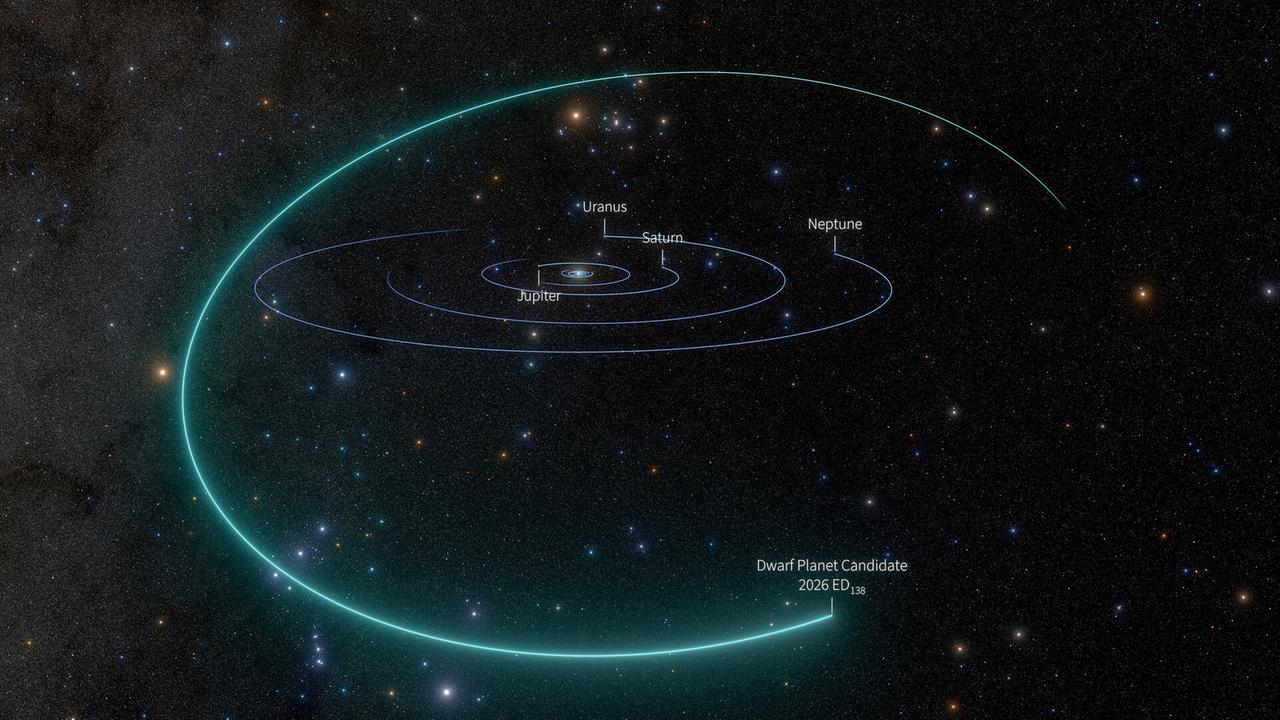
2026 ED138 is estimated to be between 600 and 1,500 kilometers in diameter. Its surface is believed to be composed largely of ice, reflecting the characteristics typical of objects residing in the outer solar system, far from the warming influence of the Sun. While its orbit is significantly more distant than that of Pluto, it shares the defining limitation that keeps these bodies from being classified as full-fledged planets: they have not "cleared" their orbital neighborhood of other debris. They remain travelers among a vast swarm of remnants from the solar system’s formation.
A Technological Marvel: The Role of the Vera C. Rubin Observatory
The identification of 2026 ED138 was not a matter of a lone astronomer peering through an eyepiece. It was the result of the gargantuan, automated survey power of the Vera C. Rubin Observatory, located high in the Chilean Andes.
Equipped with what is colloquially known as the "world’s largest digital camera"—a device the size of an automobile—the observatory is designed to conduct the Legacy Survey of Space and Time (LSST). Its mission is to capture the entire visible sky with unprecedented resolution and frequency. By comparing images taken at different times, the observatory’s software identifies "moving" light sources against the static background of distant stars.
The Challenge of the Galactic Background
One might wonder why such a significant object was not discovered sooner. The answer lies in the sheer complexity of our night sky. 2026 ED138 was hidden in plain sight, moving across a particularly dense, star-rich region of the Milky Way. To the human eye or less sophisticated telescopes, the faint, slow-moving point of light was easily swallowed by the overwhelming brilliance of thousands of background stars. It took the ultra-high resolution and the sophisticated data-processing algorithms of the Rubin Observatory to isolate this specific "wanderer" from the galactic noise.
The Role of German Expertise: A Global Collaboration
While the hardware sits in the high-altitude deserts of Chile, the "brains" of the operation rely on international contributions. The complex software required to parse the staggering volume of data produced by the observatory was developed, in part, in Heidelberg, Germany.
Researchers at the Max Planck Institute for Astronomy and the Astronomisches Rechen-Institut (ARI) at Heidelberg University were instrumental in creating the analytical pipelines that allow scientists to manage and interpret the nightly harvest of hundreds of thousands of celestial anomalies. This partnership is a testament to the modern reality of "Big Science," where the financial backing of the United States—which funds the Rubin Observatory—is married to the intellectual prowess of European research institutions. In exchange for their software contributions, the Heidelberg team has been granted privileged, high-speed access to the observatory’s data, ensuring they remain at the forefront of the analysis.
The Scientific Implications: Why Dwarf Planets Matter
The discovery of 2026 ED138 is more than a curiosity; it is a vital piece of the puzzle regarding the evolution of the solar system. Dwarf planets are "time capsules." Because they exist in the deep freeze of the outer solar system, they have undergone very little geological or thermal change since the dawn of the solar system approximately 4.5 billion years ago.
Unlocking the History of the Kuiper Belt
By studying the orbital path and composition of 2026 ED138, astronomers hope to gain insights into:
- Migration Patterns: How the giant planets (Jupiter, Saturn, Uranus, and Neptune) shifted their positions in the early solar system, effectively "scattering" these smaller bodies into their current, distant orbits.
- Compositional Diversity: Understanding what these objects are made of—water ice, methane, or complex organic molecules—helps determine the chemical distribution of the primordial solar nebula.
- The Search for Planet Nine: The gravitational influence of these distant, smaller bodies can provide clues about the existence of a theoretical "Planet Nine"—a massive, unseen world that some scientists believe lurks even further out, shaping the orbits of objects like 2026 ED138.
Chronology of the Discovery
- Early 2026: The Vera C. Rubin Observatory completes its initial commissioning phase and begins regular, high-cadence sky surveys.
- Mid-2026: The automated pipeline flags a faint, persistent moving object in a dense region of the Milky Way. Initial data suggests a potential trans-Neptunian object (TNO).
- September 2026: Human analysts and AI-driven verification systems confirm the object’s orbital characteristics. It is designated "2026 ED138."
- October 29, 2026: The findings are peer-reviewed and formally released to the public, marking the first major dwarf planet candidate discovery of the new survey era.
- Future Prospects: Over the coming months, astronomers will conduct follow-up observations to refine the orbital parameters and determine the object’s albedo (reflectivity) and mass, moving it from "candidate" to a confirmed member of the dwarf planet family.
Official Responses and Next Steps
Dr. Elena Vance, a lead researcher involved in the survey, remarked during the announcement: "The discovery of 2026 ED138 demonstrates the unprecedented power of the Rubin Observatory. We are moving from an era of serendipitous discovery to an era of systematic mapping. We expect to find hundreds, perhaps thousands, of similar objects in the coming years."
The International Astronomical Union (IAU), the body responsible for planetary naming conventions, has acknowledged the discovery. While the formal confirmation process will require months of additional tracking to ensure the orbit is precisely mapped, the community is already debating the potential implications of a larger population of these bodies.
"If we find a dozen more of these," noted a spokesperson from the Minor Planet Center, "we may need to reconsider our definitions and our understanding of the outer solar system’s population density. Every new find shifts our perspective on how ‘crowded’ our cosmic backyard actually is."
Conclusion: A New Horizon
The discovery of 2026 ED138 is a landmark moment in the history of astronomy. It underscores the importance of technological investment, the necessity of international cooperation, and the enduring human drive to explore the unknown. As the Vera C. Rubin Observatory continues its multi-year survey, the night sky is becoming increasingly transparent.
We are no longer just looking at the stars; we are inventorying our own home. With 2026 ED138, we have gained a new, silent companion on our journey around the Sun. Whether it turns out to be a lonely ball of ice or a key to the mysteries of the early solar system, its discovery serves as a reminder that the frontier of the solar system is not a static void, but a dynamic, evolving landscape waiting to be mapped.
As we look toward the next decade of space exploration, one thing is certain: our solar system is far more populous, and far more fascinating, than we ever dared to imagine.