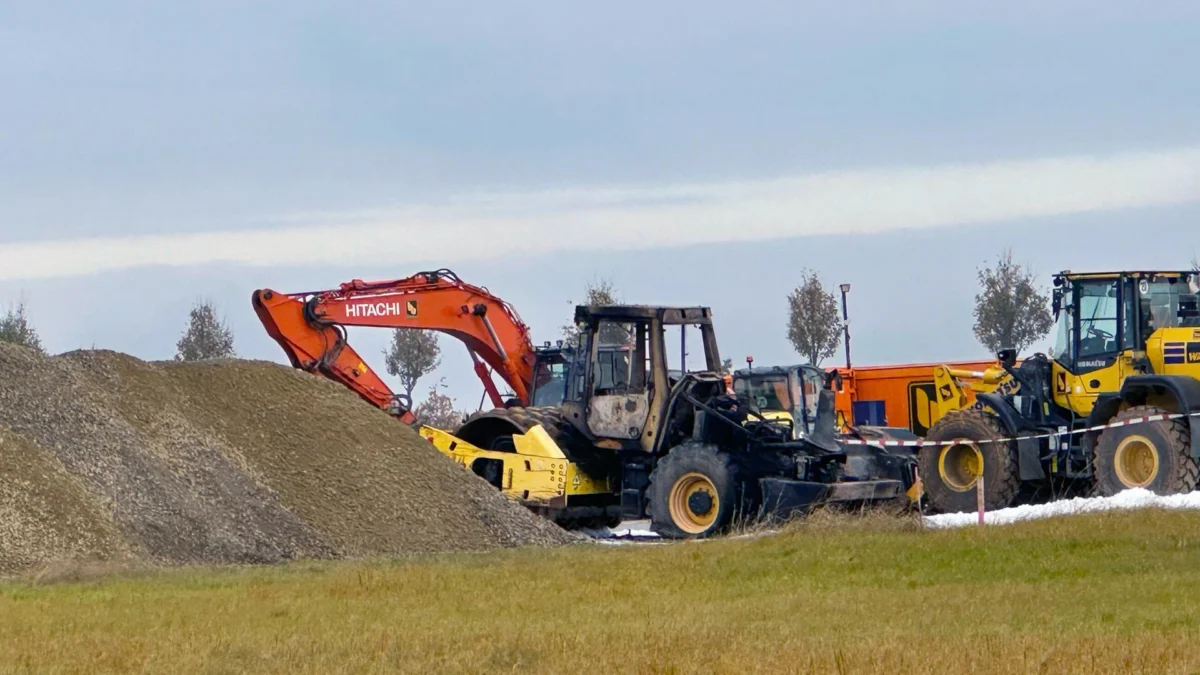
KASSEL/CALDEN – The quiet periphery of the Kassel-Calden Airport was shattered in the early hours of Friday morning by a targeted act of destruction. Three heavy construction vehicles were engulfed in flames, prompting an immediate investigation by the State Security division of the North Hesse Police. As the smoke cleared, it became evident that this was no ordinary fire; investigators are treating the incident as a deliberate act of arson, with the involvement of the specialized State Security unit signaling deep concerns regarding a potential political motive behind the attack.
The incident occurred at a high-profile construction site where the German defense giant Rheinmetall is currently expanding its footprint. The site, which is part of a broader infrastructure project at the former regional airport, is intended to house a major logistics and drone-development hub.
Main Facts: A Coordinated Strike
At approximately 3:15 a.m. on Friday, a vigilant witness alerted local authorities after observing flames erupting from the construction site located near the B7 federal highway. Upon the arrival of emergency services, three heavy-duty wheel loaders were found fully engulfed in fire. Despite the rapid deployment of local fire brigades, the intensity of the blaze caused collateral damage to several other pieces of machinery stationed nearby.
The Police Headquarters of North Hesse confirmed that forensic teams have cordoned off the site to conduct an extensive search for evidence. While initial assessments are still ongoing, the decision to involve the State Security (Staatsschutz)—a division typically tasked with investigating crimes against the state, politically motivated violence, and extremism—indicates that authorities are prioritizing the theory that this was a targeted strike against the arms manufacturer.
No injuries were reported, as the site was unoccupied during the nighttime hours. However, the financial damage to the specialized equipment is expected to be significant, though the police have yet to provide a precise monetary estimate.
Chronology of the Incident
- 03:15 AM: A bystander notices fire on the construction site adjacent to the Kassel-Calden Airport and alerts the emergency services.
- 03:30 AM: First responders from local fire departments arrive at the scene to find three large construction vehicles burning intensely.
- 04:00 AM: Firefighters successfully contain the blaze, preventing further spread, though multiple secondary machines sustain heat and smoke damage.
- 06:00 AM: Forensic investigators arrive on-site. Given the location—a Rheinmetall-linked project—the North Hesse Police officially task the State Security department with the investigation.
- Morning hours: The site is placed under strict lockdown to preserve forensic evidence, including potential traces of accelerants or mechanical tampering.
Context: The "Defence Hub" Controversy
The attack at Calden does not exist in a vacuum. The site is part of a massive industrial development project intended to cement North Hesse as a cornerstone of the German defense industry.
Rheinmetall, the primary contractor, is investing upwards of €260 million into the region, with the state government of Hesse contributing an additional €25 million in subsidies and infrastructure support. The project aims to establish a high-tech logistics center and a testing facility for unmanned aerial vehicles (drones).
For the state government and local economic promoters, the investment is a beacon of job creation and industrial revitalization. However, the project has faced vocal opposition from the outset. Various civil society groups, pacifist organizations, and local activists have staged protests, labeling the development as the transformation of a regional airport into a "military hub." Critics argue that the facility will serve as a logistical artery for the global arms trade, potentially facilitating the supply of weapon systems to conflict zones, thereby making the region a participant in international military entanglements.
Official Responses and Investigative Outlook
The police have remained tight-lipped regarding specific evidence found at the scene, citing the ongoing investigation. However, the public statement issued by the North Hesse Police underscores the severity of the situation:

"Because we cannot exclude a political motivation at this stage, the Criminal Investigation Department for State Security has assumed control of the case," a spokesperson stated. The police are currently appealing to the public, asking for any witnesses who may have observed suspicious vehicles or individuals in the vicinity of the airport or the B7 highway during the early hours of Friday to come forward.
Rheinmetall, for its part, has been relatively reserved in its official communication. The company has stated that it is cooperating fully with law enforcement and that the security of its personnel and project sites remains a top priority. Whether this incident will lead to a permanent increase in security staffing or the implementation of surveillance technologies at the site remains to be seen.
The Broader Implications: A Growing Divide
This act of arson serves as a stark illustration of the deepening polarization regarding Germany’s "Zeitenwende"—the fundamental shift in defense and security policy triggered by the war in Ukraine.
1. Security of Defense Infrastructure
The attack raises alarming questions about the vulnerability of critical defense infrastructure. If a construction site can be breached and heavy machinery sabotaged with relative ease, it suggests that industrial facilities connected to the military-industrial complex may require a higher tier of security protection. This incident may force a reassessment of how defense contractors and state authorities protect assets that are increasingly becoming lightning rods for radicalized opposition.
2. The Radicalization of Dissent
While opposition to the defense industry is a legitimate component of democratic discourse in Germany, the transition from protest to sabotage marks a significant escalation. Historically, groups operating under the guise of anti-militarism or eco-extremism have targeted infrastructure as a means of "direct action." If the perpetrators are indeed politically motivated, this incident could signal a shift toward more violent forms of protest, forcing security agencies to recalibrate their monitoring of extremist groups in the region.
3. Economic and Political Fallout
The incident is likely to increase pressure on local politicians who supported the Rheinmetall investment. Supporters of the project will undoubtedly frame the attack as a criminal assault on the rule of law and the regional economy. Conversely, opponents may use the arson as a catalyst to renew calls for a full public debate on the nature of the industrial activities being brought to the airport. The challenge for the regional government will be to uphold security without alienating the local population or stifling legitimate debate.
Conclusion
The charred remains of the construction vehicles at the Kassel-Calden airport serve as a grim monument to the rising tensions surrounding Germany’s rearmament efforts. As the investigation into the arson continues, the focus remains on identifying those responsible and determining whether this was an isolated incident of vandalism or a harbinger of organized, politically motivated sabotage.
For now, the site remains a crime scene—a silent reminder that the global shifts in defense policy are being felt acutely on the local level, where the physical machinery of war meets the volatile reality of civil dissent. The state security apparatus is currently racing against time to find the perpetrators, knowing that failure to do so could embolden further acts of aggression against the burgeoning defense industry in North Hesse. The coming days will be critical, as the police comb through the debris and the political fallout of the attack begins to take shape across the state.