By Science Editorial Desk
October 27, 2026
Thirteen point eight billion years ago, a singular, cataclysmic event set the stage for everything we see today. Yet, for all our technological prowess, the precise mechanics of how the primordial soup of the early universe coalesced into the majestic, structured cosmos of stars, galaxies, and dark matter filaments remains one of the most profound mysteries in astrophysics.
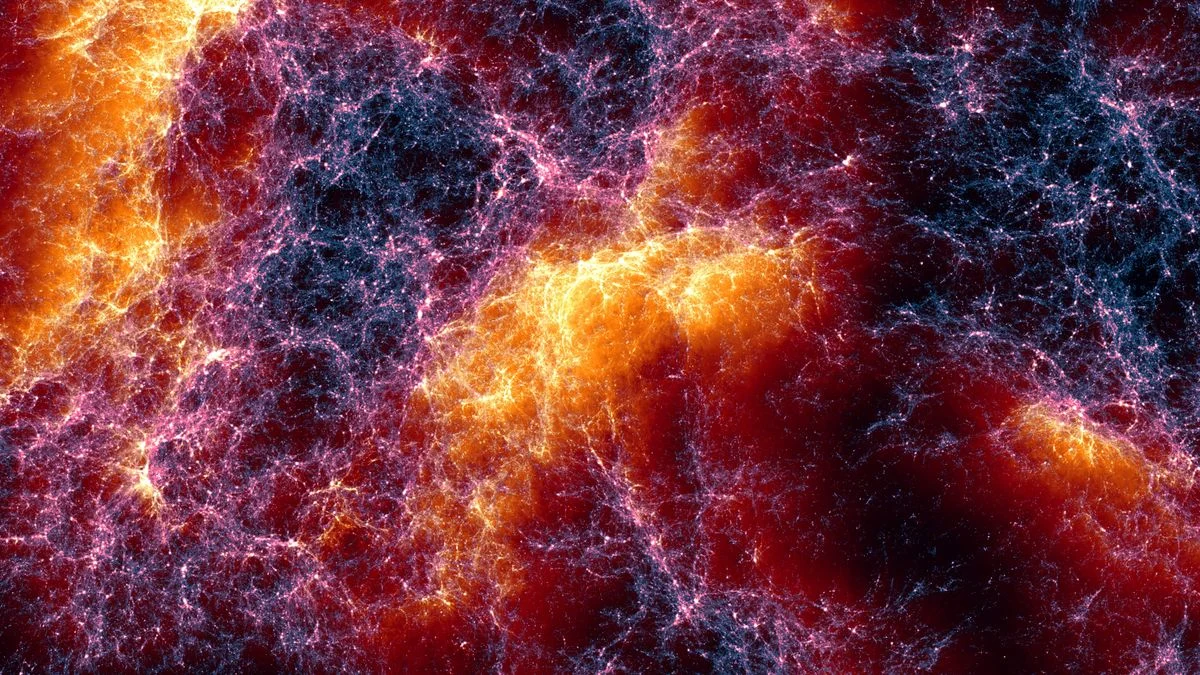
Today, that mystery has become slightly less opaque. An international team of researchers has unveiled "Lumina," the most detailed and expansive computer simulation of the early universe ever created. Running on the gargantuan computational power of the "Frontier" supercomputer, Lumina provides a high-fidelity look at the first two billion years of cosmic history. By modeling the complex interplay between gas, dark matter, and light with unprecedented resolution, scientists hope to bridge the gap between abstract theoretical models and the groundbreaking data currently being streamed back to Earth by our most sophisticated space telescopes.
The Genesis of Structure: From Echoes to Galaxies
To understand why Lumina is a watershed moment for cosmology, one must first appreciate the scale of the challenge. Roughly 400,000 years after the Big Bang, the universe reached a critical temperature threshold. As it expanded and cooled, subatomic particles—protons, neutrons, and electrons—finally settled into the first neutral atoms: hydrogen and helium.
This era, known as "recombination," was a pivotal turning point. Before this, the universe was an opaque, ionized plasma, effectively a dense fog that trapped light. As neutral atoms formed, the universe became transparent, allowing light to travel freely for the first time. This ancient light, which we observe today as the Cosmic Microwave Background (CMB), serves as the "echo" of the Big Bang—a uniform snapshot of the infant universe.
However, the universe did not remain uniform for long. Driven by tiny, random quantum fluctuations, regions of slightly higher density began to exert stronger gravitational pulls. This attracted the mysterious "Dark Matter," which accounts for roughly 80 percent of the total mass of the cosmos. Like an invisible scaffolding, Dark Matter dictated where the ordinary matter—the hydrogen and helium—would eventually cluster. It was within these gravitational "wells" that the first stars ignited and the first galaxies were born.

The Reionization Epoch: A Cosmic Tug-of-War
One of the most complex chapters of cosmic history is the period of "Reionization." As the first generation of stars and the intense, radiation-spewing cores of early galaxies (active galactic nuclei) came to life, they began to exert a profound influence on their surroundings. The high-energy radiation emitted by these objects heated the surrounding intergalactic gas, effectively stripping electrons from hydrogen and helium atoms—turning them back into ions.
This process acted as a brake on further galaxy formation; the heated gas was more resistant to collapsing into new stars. Understanding this delicate feedback loop—the dance between light, gravity, and gas—is the central challenge for modern cosmologists.
Lumina is unique in its ability to model both the hydrogen and helium reionization processes simultaneously. By observing how these elements respond to radiation across a volume one hundred times larger than previous simulations, researchers can finally see the "big picture" of how the cosmos regulated its own growth during its formative stages.
Computational Might: The "Frontier" Advantage
The sheer scale of Lumina is made possible by the "Frontier" supercomputer at the Oak Ridge National Laboratory. To simulate the physics of the universe at such high resolution requires a staggering amount of processing power. Lumina utilizes more than 15,000 graphics processing units (GPUs) working in parallel to calculate the gravitational interactions and radiative processes of billions of particles.
"Lumina represents a shift in how we approach computational cosmology," says Oliver Zier of the Harvard & Smithsonian Center for Astrophysics. "Previous models were often forced to choose between high resolution in a small volume or low resolution across a large volume. With Frontier, we are finally capturing both: the vastness of the cosmic web and the intricate details of individual galactic environments."
This increased volume is not just a vanity metric. It allows researchers to observe "rare objects"—extreme, massive galaxies or unusually dense regions—that were previously invisible in smaller-scale simulations. These rare objects have long been a source of frustration for astronomers, as they appeared in telescope data but were absent in simulations, suggesting that our understanding of early galaxy evolution was missing key components.

Synchronizing Theory with Observation
The timing of Lumina’s release is far from coincidental. We are currently in a "Golden Age" of observational astronomy. The James Webb Space Telescope (JWST) has spent the last four years fundamentally challenging our understanding of how quickly galaxies can form, often finding surprisingly mature structures in the very early universe.
Furthermore, the "Nancy Grace Roman" Space Telescope, which commenced its scientific operations earlier this year, is designed to conduct massive, wide-field surveys that will map the distribution of galaxies with unprecedented precision.
"With the James Webb telescope, the early universe has become a living, breathing laboratory," explains Zier. "But to make sense of what we are seeing, we cannot rely on observation alone. We need to translate our theories into detailed, predictive models. Lumina is that bridge. It allows us to ask, ‘If our current model of gravity and dark matter is correct, what should we see?’ And then, we compare that directly to the data from Roman and Webb."
Implications for the Future of Cosmology
The implications of the Lumina project extend far beyond mere cataloging. By observing how hydrogen and helium move between galaxies, and how the radiation of the Big Bang influenced the evolution of cosmic structures, researchers are effectively refining the "Standard Model" of cosmology.
If Lumina’s predictions align with the data from the Nancy Grace Roman telescope, it will bolster our confidence in the existence of Cold Dark Matter and the inflationary theory of the universe. Conversely, if discrepancies emerge—if we find that galaxies formed faster or in different shapes than Lumina predicts—it may force a rewrite of fundamental physics. It could point to a need for a more complex understanding of dark matter, or perhaps hint at new, undiscovered physical forces that operated in the high-energy environment of the early cosmos.
Furthermore, Lumina provides a sandbox for testing the "Cosmic Web"—the vast, filamentary network of dark matter that connects all galaxies. By visualizing how these filaments act as pipelines, channeling gas into the hubs where galaxies cluster, scientists are gaining a clearer picture of the universe’s "circulatory system."

A New Frontier
As the research team continues to analyze the petabytes of data generated by the Lumina simulation, the scientific community eagerly awaits the results. The project is already scheduled to be the subject of upcoming papers in the Monthly Notices of the Royal Astronomical Society, which will delve deeper into the specific impacts of black hole feedback on early star formation.
We are, in a sense, peering back into our own ancestry. Every atom in our bodies, every molecule in the air we breathe, was forged in the hearts of stars that trace their heritage back to the epoch being simulated by Lumina. By peering into the digital reflection of the early universe, we are not just observing the past; we are tracing the roadmap that led to the existence of life itself.
As Zier notes, "The universe is a story that has been writing itself for 13.8 billion years. We have only just begun to read the first few pages. With tools like Lumina, we are finally learning how to read the language in which it is written."
The data is clear: the universe is far more dynamic, chaotic, and interconnected than we ever dared to imagine. As the supercomputers continue to churn and the telescopes continue to gaze into the deep past, one thing is certain: the dawn of time is no longer a dark mystery, but a landscape coming into sharp, brilliant focus.