Introduction: A Titan Revealed
In the remote, mist-shrouded highlands of Taiwan, a botanical marvel has been unearthed—one that challenges our understanding of forest ecology in the Asia-Pacific region. Researchers from the Taiwan Forestry Research Institute (TFRI), led by Rebecca Chia-Chun Hsu, have officially documented the tallest known tree in all of East Asia. Standing at a staggering 84.1 meters (approximately 276 feet), the giant, a Taiwania cryptomerioides, has been christened the "Sword of the Daan River."
This discovery is not merely a record-breaking statistic; it is the culmination of a decade-long scientific odyssey through one of the most treacherous terrains on Earth. The find highlights the critical importance of Taiwan’s ancient, high-altitude forests, which act as biological reservoirs for species that have stood the test of time, shielded from the reach of human encroachment by the sheer verticality of their environment.
The Chronology of a Nine-Year Quest
The journey to identify the "Sword of the Daan River" began in 2014, a time when data on Taiwan’s tallest trees remained fragmented and largely anecdotal. For the TFRI team, the mission was twofold: to map the island’s hidden giants and to understand why these specific pockets of land foster such unprecedented vertical growth.
Phase One: Data Mining and Aerial Reconnaissance (2014–2020)
The early years of the project were characterized by meticulous data collection. The researchers turned to Lidar (Light Detection and Ranging) technology, a sophisticated remote-sensing method that uses laser pulses to create high-resolution, three-dimensional models of forest canopies. By flying aircraft over the rugged interior of Taiwan, the team generated massive datasets that required the assistance of hundreds of citizen-science volunteers to parse.
This collaborative effort resulted in a comprehensive map identifying 941 trees across the island with heights exceeding 65 meters. This "treasure map" provided the coordinates for the expedition teams, narrowing the search from vast, uncharted wilderness to specific, high-probability locations.
Phase Two: The Physical Expedition (2021–2023)
Identifying a target on a screen is vastly different from reaching it on foot. The terrain of central Taiwan is notorious for its steep, unstable slopes and deep river canyons. The expedition to reach the record-holder involved a grueling 20-kilometer trek along the Daan River, requiring the team to navigate high-risk slopes and dense, untouched undergrowth.
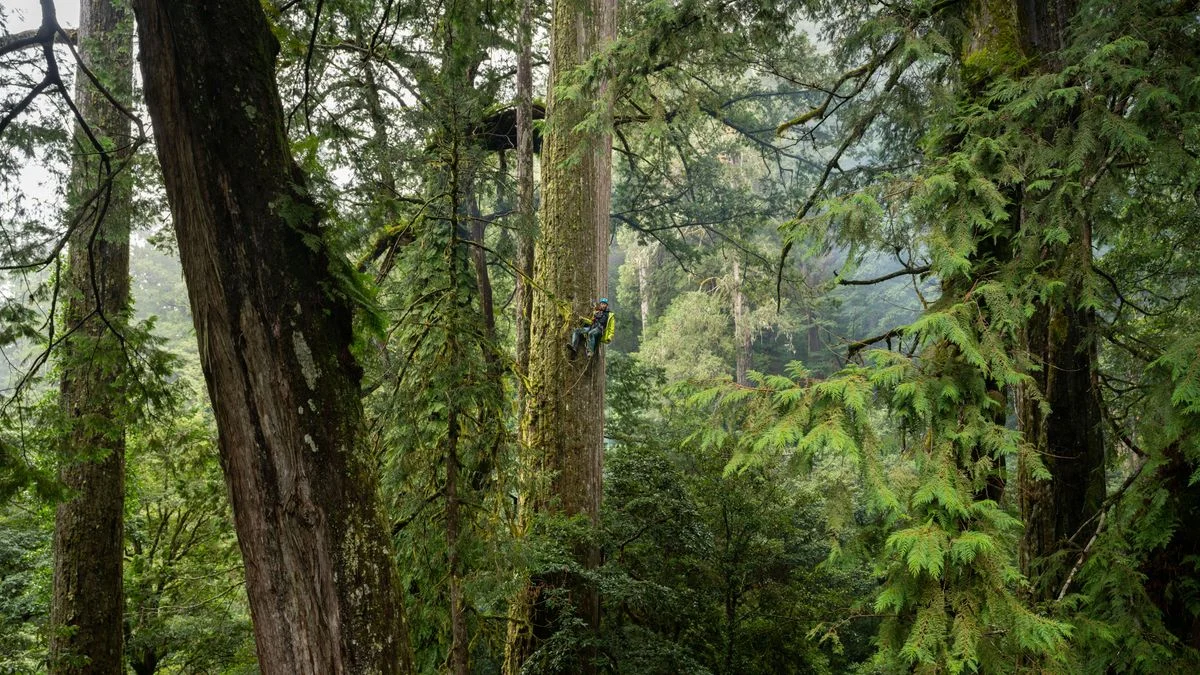
In 2023, after multiple scouting attempts, the team finally arrived at the base of the behemoth. The final measurement was not left to sensors; to ensure absolute accuracy, professional climbers scaled the tree, using measuring tapes from the crown to the forest floor to verify the Lidar estimates. The official height of 84.1 meters confirmed its status as the tallest tree ever recorded in East Asia.
Supporting Data: Understanding the Taiwania cryptomerioides
The Taiwania cryptomerioides, often referred to as the Taiwan cedar or the "Coffin Tree" (due to the historical use of its rot-resistant wood), is a conifer that holds a special place in both biological and cultural history.
Biological Significance
The tree is a relic of a bygone era. It belongs to the Cupressaceae family and is considered a "living fossil," a species that has survived largely unchanged for millions of years. Its ability to reach such extreme heights is attributed to the unique microclimates found in Taiwan’s central mountains. The island’s topography forces moisture-rich air upwards, creating consistent fog and rainfall that sustain these trees, even at high altitudes where temperatures drop significantly.
The Indigenous Perspective: "Trees that Touch the Moon"
Scientific inquiry often overlooks the traditional knowledge of indigenous peoples. The Rukai people, who have inhabited these mountain regions for centuries, have long known of these giants. Their name for the Taiwania—"trees that touch the moon"—is not merely poetic; it reflects a deep, ancestral understanding of the vertical scale of their environment. By integrating this traditional ecological knowledge with modern laser technology, researchers have gained a more holistic view of the forest’s history and structure.
Official Responses and Scientific Peer Review
The findings, published in the esteemed journal Frontiers in Forests and Global Change, have been met with excitement and validation from the global botanical community.
"This is a milestone for Asian dendrology," noted Dr. Hsu in her report. "We are not just documenting a tree; we are documenting a successful evolutionary strategy in an incredibly hostile environment."
The project has also received strong support from the Taiwanese government, which views the discovery as a vital component of its conservation strategy. The Ministry of Agriculture has emphasized that these "Super Trees" serve as benchmarks for climate resilience. As global temperatures rise, the survival of these ancient, deep-rooted giants provides researchers with a baseline to study how forests respond to shifts in precipitation and temperature.
Implications: A Call for Conservation
The discovery of the "Sword of the Daan River" and its neighboring giants—the team has since identified ten trees over 70 meters tall, two of which exceed 80 meters—has profound implications for environmental policy.
Protecting the "Sky Islands"
These tall trees are concentrated in what ecologists call "sky islands"—high-altitude regions that are isolated by the surrounding topography. Because these areas are so difficult for humans to access, they have remained pristine. However, climate change poses an existential threat. A slight shift in the cloud line or a change in the frequency of typhoons could disrupt the delicate hydrological balance that allows these trees to thrive.
Carbon Sequestration and Biodiversity
Large, old-growth trees are the heavy lifters of the carbon cycle. A single 80-meter tree sequesters a significantly larger volume of carbon than a younger, smaller forest patch. Furthermore, these trees act as structural anchors for entire ecosystems. Their complex canopies provide niches for unique epiphytes, insects, and bird species that cannot survive anywhere else. Protecting these giants is, by extension, protecting the biodiversity of the entire mountain range.
Future Research Directions
The TFRI has announced that the research is far from over. With the baseline data established, the next phase will focus on the health and longevity of these specimens. Researchers are currently installing sensors to monitor sap flow, growth rings, and nutrient uptake, aiming to solve the mystery of how these trees manage to transport water to their highest branches against the immense force of gravity—a feat that pushes the physiological limits of plant life.
Conclusion: A Legacy Standing Tall
The "Sword of the Daan River" serves as a poignant reminder of how much of our natural world remains hidden, even in an age of satellite imagery and digital mapping. It stands as a silent witness to history, having likely germinated long before modern civilization reached the island’s interior.
As we move forward into a future of uncertain climate conditions, the survival of these giants is not guaranteed. Their discovery is a call to action—a mandate to preserve the inaccessible, to respect the traditional knowledge of indigenous guardians, and to recognize that the most significant stories on Earth are often found in the quiet, vertical spaces of our remaining ancient forests. By documenting these trees, we are not just adding to a list of records; we are securing a vital piece of Earth’s biological heritage for generations to come.