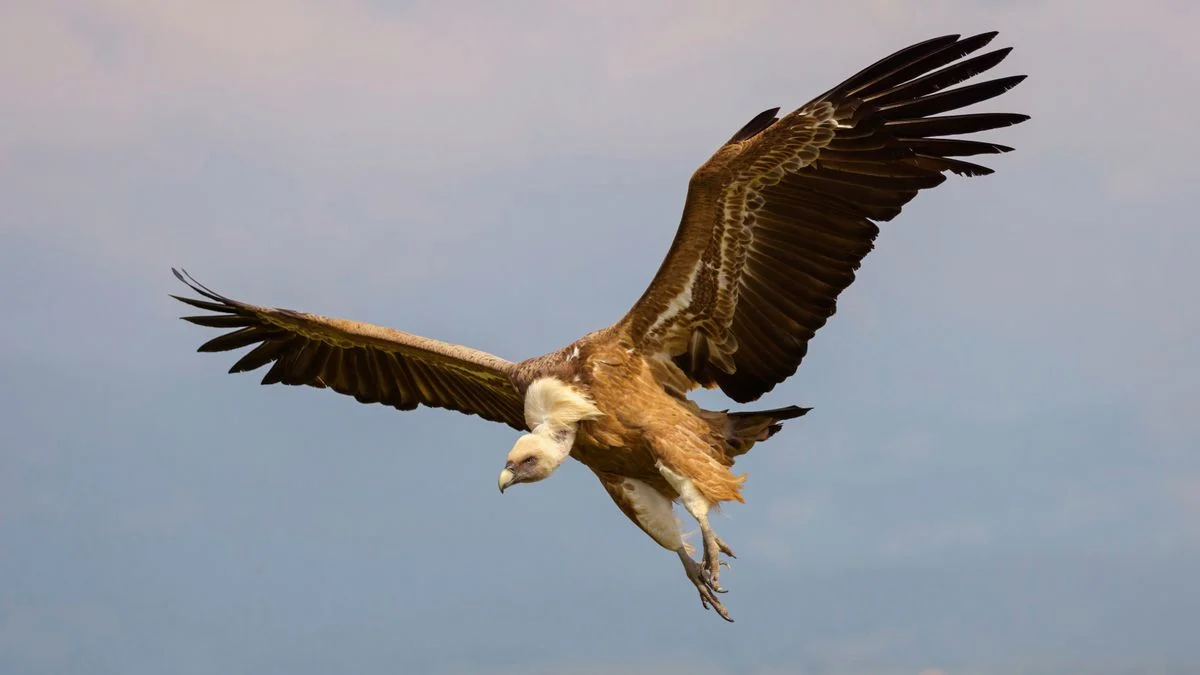
In the quiet, rural landscape of Klein Lobke, near Hanover, a biological anomaly has stunned local ornithologists and residents alike. A massive Griffon Vulture—a scavenger typically associated with the mountainous regions of Southern Europe—was documented engaging in behavior that defies conventional ecological understanding: the systematic predation of a White Stork’s nest.
While the Griffon Vulture (Gyps fulvus) is a majestic raptor known for its scavenging habits, it is fundamentally an obligate scavenger. It feeds almost exclusively on carrion. The incident in Lower Saxony, which has since sparked a flurry of scientific debate, challenges the boundaries of what we know about avian opportunistic behavior and the shifting environmental pressures facing migratory birds in Central Europe.
The Main Facts: A Rare Ecological Disruption
The incident occurred in late spring, a critical period for the White Stork (Ciconia ciconia), which is currently rearing its young. Witnesses and subsequent monitoring by local bird conservation groups confirmed that a lone Griffon Vulture, likely a vagrant individual that had strayed significantly north of its usual range, descended upon a nesting platform in Klein Lobke.
Unlike the common predatory behavior of Goshawks or large corvids, which might occasionally target stork chicks, the Griffon Vulture’s presence was startling due to its sheer size. With a wingspan reaching up to 2.8 meters, the vulture’s arrival triggered an immediate alarm response among the colony. However, the intruder did not merely intimidate; it actively dismantled the nest structure to access the contents.
Key Observations:
- The Perpetrator: A juvenile Griffon Vulture, identified by plumage characteristics typical of a sub-adult.
- The Target: A well-established White Stork nest containing at least two chicks.
- The Action: The vulture utilized its powerful beak to clear nesting material and, ultimately, preyed upon the defenseless nestlings.
- The Context: The bird had been tracked by local ornithologists as part of a wider monitoring program for rare vagrant raptors in the region.
Chronology of the Incident
Phase 1: The Arrival
The vulture was first spotted in the skies above the Hanover region three days prior to the attack. Initially, observers believed it was merely passing through, following the thermal currents that allow large raptors to cover vast distances with minimal energy expenditure.
Phase 2: The Encroachment
On the day of the incident, the vulture was seen circling the nesting platform multiple times. Local birdwatchers noted that the parent storks were visibly distressed, performing defensive postures and clattering their bills—a standard deterrent mechanism. However, the vulture, undeterred by the smaller storks, landed directly on the platform.
Phase 3: The Predation
Over the course of an hour, the vulture remained on the nest. Photographic evidence taken by a local nature photographer captured the moment the vulture consumed the contents of the nest. By the time the vulture departed, the nest had been significantly damaged, and the chicks were missing.
Supporting Data: Why Do Vultures Kill?
To understand this event, one must look at the physiological and environmental drivers of the Griffon Vulture. Under normal circumstances, these birds possess a digestive system specialized for rotting meat, protected by highly acidic stomach juices that neutralize pathogens. They do not hunt.
1. Energy Deficit and Malnutrition
Ornithologists hypothesize that the juvenile was severely malnourished. Having strayed far from its population center in the Pyrenees or the Balkans, the bird likely faced an acute lack of carrion in the agricultural landscape of Lower Saxony. In a state of starvation, the survival instinct can override the typical dietary specialization of a species.
2. The "Opportunistic Shift"
There is growing evidence that as climate change alters migration patterns and food availability, "facultative" behavior—where a species adopts a trait not normally found in its repertoire—is becoming more common. If a vulture finds a high-protein food source (like nestlings) and is desperate enough, the cognitive barrier to "predation" may break down.
3. Population Dynamics
The population of Griffon Vultures has seen a recovery in Southern Europe due to successful conservation efforts. This increase often leads to "dispersal," where younger, less experienced birds venture into territories where they are not equipped to survive, leading to abnormal behavioral outcomes.
Official Responses and Conservation Concerns
The incident has triggered a debate among the German Ornithological Society and local environmental agencies. The primary concern is not just the loss of the stork chicks, but the potential for increased conflict between rare species.
"We are witnessing a behavioral drift," says Dr. Elena Richter, a lead researcher in avian migration. "While this is a singular event, it serves as a warning. When we see a scavenger acting as a predator, it is a clear signal that the ecosystem is out of balance. We must ask: why is this bird not finding the carrion it needs?"
The local agricultural authorities in Klein Lobke have been pressured to increase monitoring of nesting sites. There is, however, a consensus that the vulture should not be culled. Instead, the focus has shifted toward "passive management"—ensuring that potential food sources are available elsewhere to steer such wanderers away from vulnerable nesting colonies.
Implications: The Changing Landscape of Europe’s Skies
The Klein Lobke incident has far-reaching implications for European biodiversity management. It highlights three critical areas of concern:
The "Northern Shift" of Mediterranean Species
As the climate warms, species that were historically confined to the Mediterranean basin are increasingly found in Central and Northern Europe. This "northern expansion" puts these species in contact with local populations that have no evolved defense mechanisms against them. The White Stork, while a resilient bird, is not prepared to defend its young against a predator of the vulture’s size.
The Failure of Traditional Food Chains
The fact that a vulture chose to prey on live chicks suggests that the "scavenging network"—the availability of dead livestock or wild ungulates—is broken in this region. Stricter veterinary regulations in the EU have limited the amount of carrion left in the field, which, while good for preventing disease, creates a "hunger trap" for large avian scavengers passing through.
Rethinking Predator-Prey Models
Textbooks often categorize birds into strict "predator" or "scavenger" boxes. The Klein Lobke case forces a revision of these categories. It suggests that in an era of ecological instability, animal behavior is becoming more fluid. Conservationists must now plan for "unpredictable" events where traditional inter-species hierarchies are inverted.
Conclusion: A Lesson from the Nest
The tragedy in Klein Lobke is more than a local news item; it is a microcosm of a larger, global environmental shift. The Griffon Vulture, a bird that symbolizes the clean-up crew of the natural world, was forced by hunger and disorientation to take the life of another, creating a ripple effect of concern for local wildlife conservationists.
Moving forward, the goal for regional authorities is twofold: to protect the remaining stork populations through physical shielding or deterrents and to continue the research into why such large-scale vagrants are failing to find their traditional food sources. The mystery of the Klein Lobke vulture serves as a stark reminder that as our climate changes, so too does the behavior of the creatures that share our world—often in ways that challenge our very understanding of nature.
For the residents of Klein Lobke, the sight of the massive bird sitting atop the nesting platform will long be remembered—a haunting image of nature’s struggle to adapt to an increasingly unpredictable environment.