In an era defined by algorithmic curation, the instant gratification of user reviews, and the commodification of culture, the role of the literary critic has undergone a radical, often diminishing, transformation. Yet, the fundamental premise remains: literature is not merely content to be consumed; it is a confrontation with the complexities of existence. As the German critic and essayist recently argued upon receiving the Johann-Heinrich-Merck-Preis, literature that believes it no longer requires criticism has already surrendered its soul.
The Historical Mandate: From Lessing to the Public Sphere
The German tradition of literary criticism is rooted in a specific, historical intensity. In the 18th century, the task was existential: writers had to forge a German literary language from the ground up. Operating under the constraints of small, absolutist courts, the emerging bourgeoisie found in literature a space for intellectual autonomy.
During this formative period, the distinction between "writer" and "critic" was porous. Gotthold Ephraim Lessing, perhaps the most iconic figure of the Enlightenment, was as renowned for his biting, analytical critiques as he was for his dramas. For Lessing, criticism was a vital literary genre in its own right. He did not mince words; when assessing the work of his contemporary Friedrich Gottlieb Klopstock, he famously noted: "It is as all of Mr. Klopstock’s songs are: so full of feeling that one often feels nothing at all."
This period established that criticism was "about something"—it was a high-stakes endeavor. In the absence of political power, the German bourgeoisie turned to aesthetic discourse as a surrogate for political debate. As Ludwig Börne famously captured: "Since I feel, I have hated Goethe; since I think, I know why!"
Chronology of a Shifting Landscape
The 19th Century: The Rise of the Academic Gatekeeper
By the 19th century, criticism shifted from the hands of the practitioners into the grasp of a new caste of academics. These critics often hid their subjective biases behind a facade of "objectivity," anchoring their assessments in the prevailing dogmas of the time: the nation, religion, and the family. Their goal was often to tame the raw, impetuous energy of literature, smoothing its rough edges to align with institutional standards. While these specific critics have long faded into obscurity, their pedagogical attitude remains a persistent ghost in contemporary discourse.
The Post-War Reconstruction (1945–1960s)
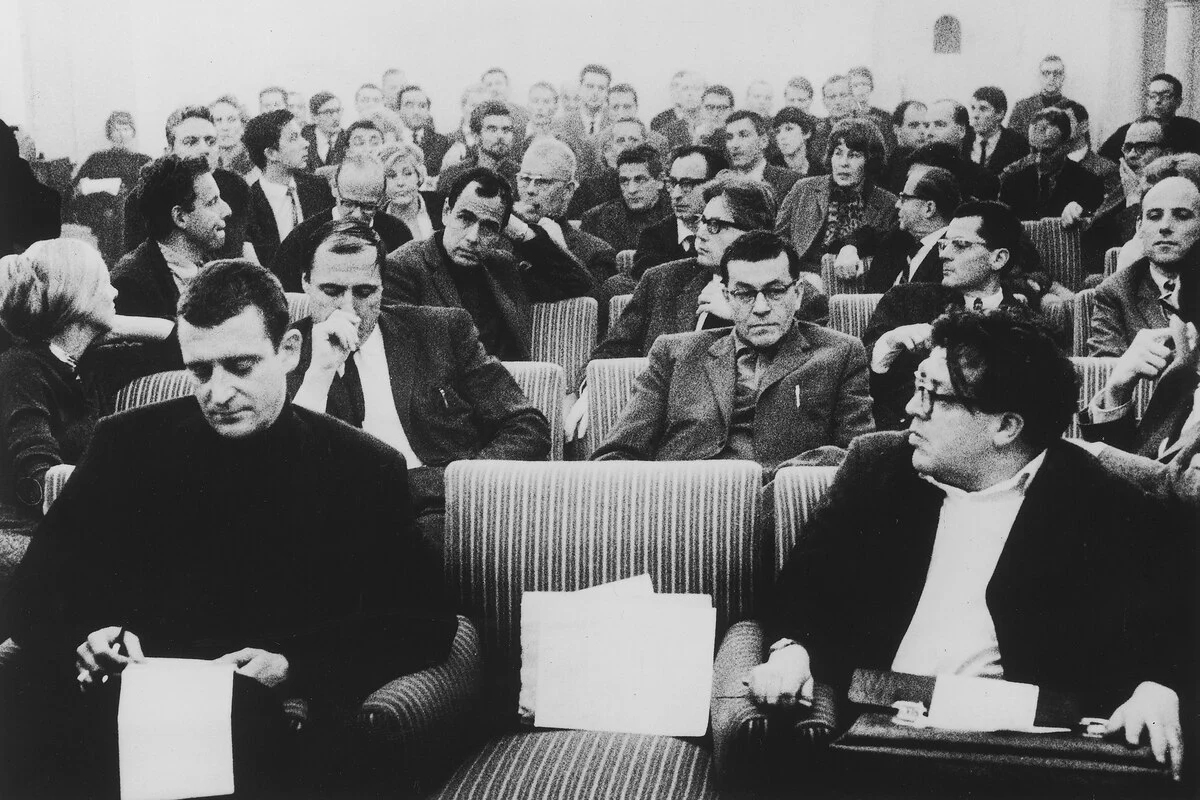
The catastrophic rupture of the NS regime necessitated a total rebuilding of critical practice. In the early days of the Gruppe 47, criticism functioned as a diagnostic tool, a means of confronting and overcoming the moral and linguistic rot of the Nazi era. It was an era of intense "speech and counter-speech." Critics like Günter Eich, with his iconic call to be "sand, not oil in the gears of the world," sought to disrupt the machinery of complacency.
The Prosperity and Pop Turn (1970s–1990s)
As West Germany transitioned into a prosperous consumer society, the tone shifted. By 1979, Hans Magnus Enzensberger introduced the ironic, playful column "Journal of Luxury and Fashion," signaling a move toward the aestheticization of consumption. The "pop culture turn" was initially welcomed as a liberation—a move toward coolness and away from the perceived gloom of earlier cultural pessimism. However, this shift birthed a new dynamic: the rise of the "all-knowing" columnist, whose subjective "I" became the lens through which the world was viewed, often resulting in a polished, narcissistic form of journalism.
The Professionalization of Culture and its Implications
By the mid-1980s, the political sphere began to view culture through the lens of economic utility. Lothar Späth, then-Minister President of Baden-Württemberg, famously defined culture as a "soft location factor" for the economy. This sparked a massive expansion of the cultural infrastructure—state subsidies, prizes, festivals, and networks flourished.
While this created a vibrant scene, it also led to a double-edged sword: the professionalization of the industry began to outpace the substance of the literature itself. Writers became brands, increasingly capable of self-marketing, and the critic’s role as an independent arbiter was undermined by the systemic reliance on institutional support.
Current Debates: The Populism of the Digital Age
In the 1990s and 2000s, the discourse shifted further toward the "accessible." Buzzwords like "low-threshold" became the mantra of cultural bureaucrats, often conflated with "democratic." Anything that appeared "difficult" or "elitist" was cast as an enemy of the new media-savvy public.
The 2015 survey by the online magazine Perlentaucher confirmed a grim reality: the traditional role of the "gatekeeper" critic is considered obsolete. Today, the space is occupied by culture managers, moderators, and media influencers. The "sand in the gears" described by Günter Eich has been replaced by the "oil" of the digital economy. Amazon reviews—characterized by phrases like "I enjoyed reading it" or "it was terribly exciting"—have become the primary metrics of success.
There is a profound irony here: while political journalism warns against the dangers of populist simplification, cultural journalism, particularly on platforms like BookTok, has embraced populism as its business model. The medium—the two-minute, emotional, sofa-bound video—has become the message.
Implications: The Death of the Essayistic Spirit
The danger of this trajectory is not that people are reading less, but that the way in which we engage with literature is narrowing. When the subjective reaction ("I don’t understand this," or "I don’t feel reached by this") is elevated to an objective argument, we lose the capacity for aesthetic discovery.
Literature at its best—as evidenced by the works of William Faulkner, Ingeborg Bachmann, or Uwe Johnson—is not designed to be "comfortable" or "immediately accessible." It aims to reach into the ambiguities and the uncanny. It requires a form of engagement that is patient and analytical.
As Marcel Proust, himself a master critic, noted in the final pages of In Search of Lost Time, realistic art can be inherently deceptive because it offers an expression of feelings that does not correspond to the actual complexity of the human experience. A true critic does not merely offer a "thumbs up" or "thumbs down." A true critic is an essayist who measures the shimmering, electric zone that radiates from art, stepping into that space to translate the invisible into the discernible.
Conclusion: The Necessity of Disruption
To treat literature as a consumer product, measurable by algorithms and "low-threshold" accessibility, is to strip it of its capacity to challenge our reality. If we allow criticism to be subsumed by consumer research and the demand for instant gratification, we risk turning literature into a sterile reflection of our own existing biases.
Literature needs to be "sand in the gears." It must provoke, disrupt, and refuse to be easily digested. If we lose the critical capacity to engage with the difficult, the ambiguous, and the truly transformative, then we are not merely losing a profession—we are losing the ability to articulate what it means to be human in a complex world. Without criticism, art loses its mirror; and in that silence, we ultimately lose the conversation about what matters most.