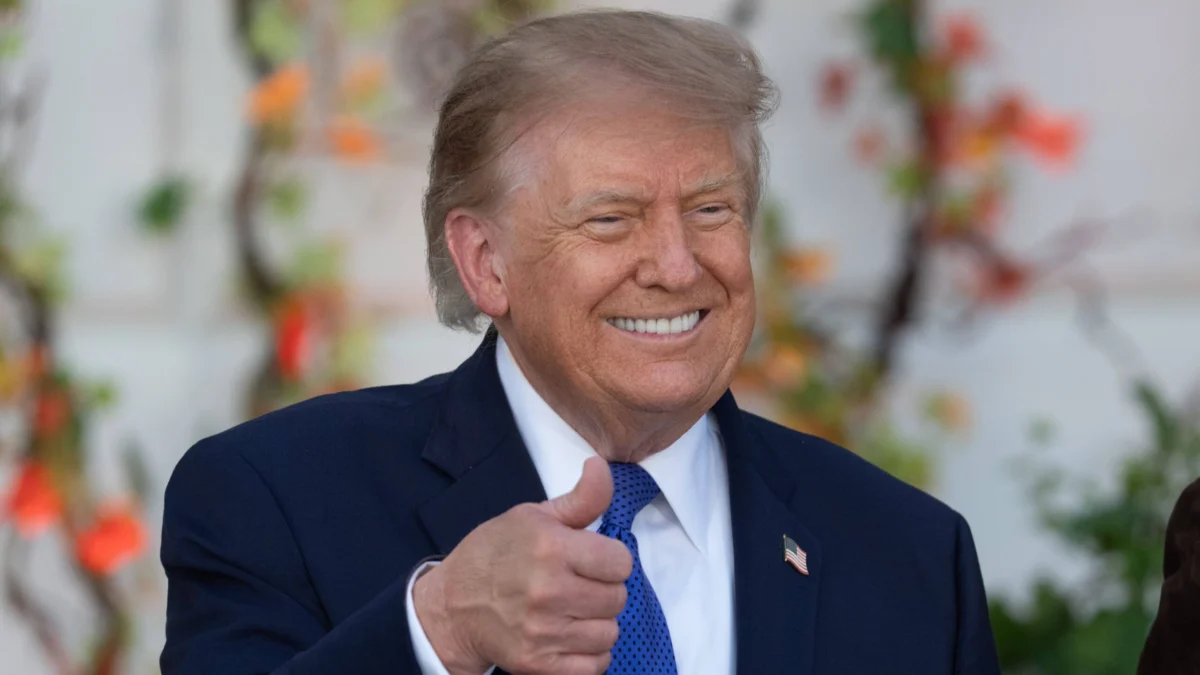
Washington D.C., November 2026 – Two years into his hypothetical second term, President Donald Trump stands at the podium, exuding the familiar blend of bravado and confidence that has defined his political career. From Washington to San Francisco, New York to Miami, his rallies echo with promises of an American "golden age," a stark contrast to the "dark cave" he claims to have rescued the nation from under his predecessor, Joe Biden. He jokes, he grins, and he rails against the alleged economic mismanagement of the Democrats, attributing soaring inflation, high energy prices, and a record trade deficit to "Sleepy Joe." Seated dutifully behind him, his hand-picked cabinet, including Treasury Secretary Scott Bessent, Health Minister Robert F. Kennedy, and Florida Governor Ron DeSantis, nod in deferential agreement, reflecting the administration’s unified front.
Yet, beyond the electrifying rhetoric of the campaign trail, a complex and often contradictory economic reality has taken root. While Trump’s assertions frequently diverge from verifiable facts, the underlying economic concerns he addresses – particularly the cost of living – resonate deeply with the American public. As the nation approaches the critical midterm elections, the economic legacy of this distinctive presidency reveals a mixed picture: periods of robust growth fueled by unprecedented technological advancement juxtaposed against a rapidly expanding national debt, persistent inflation, and a profound redefinition of America’s economic governance.

The Trump Economic Doctrine: A Paradoxical Presidency
Donald Trump’s economic philosophy, often dubbed "Trumpism," has proven to be a stark departure from traditional Republican tenets. His administration, two years into its hypothetical second term, has overseen policies that contradict the very principles of lean government, free markets, and low taxes historically championed by the Republican party.
Rhetoric vs. Reality: The "Golden Age" Narrative
The President’s rallies are a masterclass in populist economics. He frequently touts an era of unparalleled prosperity, declaring that America is experiencing a "golden age" after emerging from the "dark cave" of the Biden years. He attributes record-high inflation, energy prices, and trade deficits to his Democratic predecessor, warning that a Democratic victory in the upcoming midterms would usher in a return to economic hardship. This narrative, while powerful on the campaign stump, often struggles to withstand rigorous fact-checking, as Trump has consistently shown a flexible relationship with economic statistics. Nevertheless, his focus on the economy’s impact on everyday Americans remains a potent political weapon.

The Shift from Traditional Republicanism
Historically, the Republican Party has advocated for minimal government intervention, believing that a free market, unburdened by excessive regulation and taxation, is the most efficient engine of prosperity. Trump, however, has steered a dramatically different course. Far from promoting a slim and restrained state, his administration has pursued policies characterized by aggressive protectionism, direct intervention in corporate affairs, and an open challenge to the independence of the Federal Reserve.
This shift has led many economists, including Stephen Roach of Yale, to describe the evolving American economic system as a unique form of "state capitalism" or even a "command economy." Under this model, the government acts not merely as a regulator or facilitator but as an active participant, dictating terms, taking stakes in private enterprises, and using its power to achieve specific industrial and trade objectives. This represents a significant ideological pivot, one that has reshaped the landscape of American economic policy.

A Mixed Economic Report Card
The economic performance during the first two years of Trump’s hypothetical second term presents a nuanced and, at times, contradictory picture. While certain sectors have flourished, underlying vulnerabilities have simultaneously deepened.
The Bright Spots: AI-Driven Growth and Market Euphoria
On the surface, the American economy has demonstrated remarkable vitality. Growth projections for 2025 and 2026 hover around a robust 2.3 percent, with an annualized growth rate accelerating to 3.4 percent in the third quarter of the current year, as reported by the Commerce Department. A primary driver of this expansion has been colossal investments in Artificial Intelligence. This AI boom has ignited a fervent optimism in equity markets, with the "Big Seven" tech companies alone witnessing their market capitalization swell by an astonishing six trillion dollars. The Nasdaq, a bellwether for the technology sector, initially surged by approximately 36 percent, with the "Big Seven" closing 2025 with an average stock market gain of 25 percent. Furthermore, the unemployment rate has remained impressively low at 4.2 percent, signaling a tight labor market and widespread employment opportunities.

The Shadows: Escalating Debt and Persistent Inflation
Beneath this veneer of prosperity, significant economic challenges loom large. The national debt has ballooned to over $40 trillion, raising serious concerns about its sustainability. Refinancing this colossal debt has become increasingly difficult due to a rapid ascent in capital market interest rates. The International Monetary Fund (IMF) projects the US budget deficit for the current year to reach $2.8 trillion, an increase of nearly $700 billion from the previous year, constituting a staggering 8.5 percent of the Gross Domestic Product.
Compounding the fiscal strain is a stubborn inflation rate, exacerbated by the administration’s tariff policies and the geopolitical fallout from the conflict in Iran. The attack on Iran and the intermittent closure of the Strait of Hormuz have sent energy prices skyrocketing, pushing gasoline and diesel costs to record highs across the United States. This persistent inflation, alongside rising private debt in sectors like mortgages and consumer credit, places considerable pressure on household budgets and the broader financial system.

The Debt Tsunami: America’s Fiscal Tightrope Walk
The burgeoning national debt has become one of the most pressing economic issues, requiring unorthodox measures from the administration and raising red flags among financial experts.
Treasury Secretary Bessent’s "Creative Interventionism"
Treasury Secretary Scott Bessent, a veteran of Wall Street’s hedge fund circuit, has been a key architect of the administration’s unconventional financial maneuvers. In an attempt to manage the spiraling debt, Bessent has initiated a strategy of buying back longer-term government bonds and replacing them with shorter-term securities. The rationale behind this "creative interventionism" is twofold: to capitalize on lower short-term borrowing costs and to exert downward pressure on long-term interest rates.

However, this strategy has not yielded the desired results. The yields on ten-year Treasury bonds have stubbornly remained above five percent, indicating investor skepticism about the long-term fiscal outlook. While providing temporary relief, this approach significantly increases the government’s exposure to interest rate risk, meaning that future hikes in capital market rates or Fed policy changes could rapidly escalate debt servicing costs.
Bessent also garnered attention for a "spectacular intervention" to bolster the Japanese Yen. The true motivation behind this move was the administration’s apprehension that Japan, the largest foreign holder of US debt, might be compelled to sell off its vast portfolio of American government bonds to stem the Yen’s dramatic depreciation. Such a move, even a partial divestment of Japan’s trillion-dollar bond holdings, would undoubtedly send US refinancing costs soaring.

The Alarming Scale of US Indebtedness
The United States is grappling with a severe debt problem. The national debt currently stands at nearly 130 percent of its economic output, a figure that continues to climb, exacerbated by rising long-term capital market interest rates. The IMF’s projected budget deficit of $2.8 trillion for the current year underscores the magnitude of the fiscal imbalance.
Private debt levels in the US are also exceptionally high, contributing to upward pressure on interest rates across various credit markets. Mortgage rates for 30-year fixed loans, which Trump had once ambitiously vowed to drive down to two percent, have surged to 7.3 percent. When considering all liabilities to the rest of the world, the US owes an estimated $70 trillion, representing more than half of the global GDP.

This makes the US economy highly vulnerable to rising interest rates. Annual debt servicing costs, approaching one trillion dollars, have now become the second-largest expenditure in the federal budget, surpassing even defense spending and trailing only social security outlays. As economist Mohamed El-Erian once warned, "At six percent, the destruction process begins."
The Federal Reserve Under Pressure
The independence of the Federal Reserve, a cornerstone of stable economic policy, has come under unprecedented assault during Trump’s tenure. The President has relentlessly pressured the central bank to lower interest rates, openly threatening former Fed Chair Jerome Powell with dismissal and subjecting him to repeated public insults. Following Powell’s scheduled departure last May, Trump appointed Kevin Warsh to the top post, ostensibly in the hope that Warsh would be more amenable to White House influence.

Initially, a grace period seemed to apply, as Trump refrained from criticizing Warsh despite the Fed’s recent rate hikes. However, the central bank’s decision in September to raise interest rates to a range of 3.75 to 4.0 percent, followed by market expectations of further increases over the next twelve months, directly contradicts the President’s stated desires. Paradoxically, Kevin Warsh, nominated by Trump for his perceived dovish stance, is now presiding over the first interest rate hiking cycle in over three years.
The inherent dilemma is clear: a politically influenced central bank is rarely an effective inflation fighter. Should doubts emerge regarding Warsh’s commitment to economically sound decisions over political expediency, the crucial anchor of inflation expectations could quickly become unmoored. Trump finds himself in a tight spot: his base demands a resolute central bank to curb inflation, even if it means higher rates, while his administration desperately needs low interest rates to service the nation’s colossal and ever-growing debt burden. Harvard researcher Kenneth Rogoff warns of a "new debt crisis," accusing Trump of ignoring "this greatest danger to America’s economy."

The Affordability Crisis: Daily Struggles Amidst Economic Claims
Despite claims of a "golden age," the rising cost of living has become a tangible burden for millions of Americans, threatening to sway the upcoming midterm elections.
Soaring Costs for Everyday Americans
In places like Williams, Arizona, a town frozen in a 1960s aesthetic with its diners and neon signs, the legendary Route 66 still symbolizes freedom. Yet, this freedom has become significantly more expensive. Gasoline and energy prices are the top concern for Americans, vividly displayed on gas station marquees. Two years ago, Trump promised to push gas prices below two dollars per gallon (3.785 liters). Today, his constituents are filling their tanks at $4.30 per gallon, more than double his pledge. Diesel prices have soared even higher, hitting a new record of $6.35.

Beyond fuel, the cost of essential goods has also escalated. Since January 2025, a pound of coffee has increased by over two dollars, and ground beef by more than a dollar. These increases translate into real hardship for many households. An August Pew Research survey revealed that 82 percent of low-income respondents struggled to afford at least one of four basic necessities: daily transportation, rent, groceries, or healthcare.
Healthcare and Household Finances
The healthcare sector has also seen significant affordability challenges. Premiums for low-income individuals qualifying for "Obamacare" plans have surged by 58 percent since last year. Consequently, a growing number of Americans are choosing to forgo health insurance, with data from the Commonwealth Fund indicating that 11.2 percent of all adults in the US are uninsured, up from 8.9 percent in 2024.

Personal stories underscore these statistics. Susan, a 36-year-old mother of four from Frostburg, Maryland, is still struggling to pay off a nearly $30,000 bill for an emergency C-section. She recounts how her family’s weekly grocery bill now exceeds $300, forcing them to grow their own vegetables and raise chickens to make ends meet.
Policy Decisions Fueling Inflation
The latest inflation figures, showing a 3.7 percent rate in September, confirm the public’s perception of rising costs. A significant majority of Americans (65 percent) hold President Trump responsible for the current inflation, a stark contrast to four years prior, when only 44 percent blamed former President Joe Biden for a pandemic-induced inflation peak of 9.1 percent.

While the AI boom contributes to demand-side pressures, two key policy decisions by the Trump administration have significantly stoked inflationary fires. First, the widespread tariffs imposed in April 2025 have increased import costs, which are ultimately passed on to consumers. Second, the war in Iran, initiated in February of the current year, has had severe repercussions for energy markets. During this period, the price of US crude oil (WTI) has surged from approximately $60 to nearly $100 per barrel.
The ongoing conflict in the Middle East has led investors on Wall Street to abandon hopes for a swift resolution or a rapid decline in price increases. The President’s persistent pressure on Fed Chair Warsh to lower interest rates is proving counterproductive, as the central bank has continued to raise rates to combat inflation. Should the market perceive Warsh as compromising the Fed’s independence for political reasons, inflation expectations could spiral out of control, as a politically subservient central bank rarely proves to be an effective inflation fighter.

Trade Policy: Protectionism’s Unintended Consequences
Trump’s "America First" trade agenda, centered on tariffs and industrial repatriation, has largely failed to deliver its promised results, instead imposing costs on consumers and eroding international trust.
"America First" Manufacturing: A Broken Promise?
At a recent rally in Perry, Georgia, President Trump proudly announced a multi-billion dollar investment by German automaker Audi, led by CEO Gernot Döllner, to build a new factory in the state. The President lauded this as a testament to his successful economic policies, inviting Döllner onto the stage for a public pat on the back. While Döllner faced criticism in Germany for this appearance, for Trump, Audi merely served as another example of a foreign company compelled by trade restrictions to invest in the US, following similar commitments from Japan and South Korea.

On "Liberation Day" in April 2025, when the administration enacted massive tariff hikes, Trump promised that "jobs and factories will return to our country with great force." However, the reality has been disappointing. Far from creating new manufacturing jobs, their number has decreased by 21,000 since the beginning of Trump’s second term. The overall job market performance has also been underwhelming. The US Bureau of Labor Statistics initially reported 584,000 new jobs in the past year, but a subsequent, unusually sharp correction revealed the true figure to be a mere 180,000 – a significantly low number compared to the 1.46 million jobs created in 2024, the year before Trump’s second term began.
Workers across the country, many of whom had initially placed their hopes in Trump, now express disillusionment. David Green, head of the prominent UAW auto workers’ union in Ohio and Indiana, recently stated that "Donald Trump broke his promise," predicting that workers would vote against him in the November midterms, asserting that "workers will make the difference."

The Widening Trade Deficit and Consumer Burden
One of Trump’s primary trade objectives was to reduce the US trade deficit, particularly with China, which he deemed "harmful." While imports from China to the US have indeed decreased, economists note that the Chinese component in other foreign products entering the US has simultaneously increased. An analysis by the Peterson Institute for International Economics concluded that "US tariffs against China have changed the routes by which Chinese-made goods enter the US far more than they have reduced US dependence on China."
Consequently, Trump’s protectionist trade policies have failed to achieve their desired outcomes. On the contrary, the US trade deficit continued to expand, reaching