Data released by the Swiss Glacier Monitoring Network (GLAMOS) reveals that Switzerland’s glaciers have lost over five percent of their total volume in 2026 alone. As the "eternal ice" of the Alps retreats at an unprecedented pace, the nation faces a profound existential challenge regarding its water security, landscape, and climate legacy.
The State of the Ice: A Grim Milestone
For millennia, the glaciers of the Swiss Alps have been the defining feature of the European skyline. They are more than mere natural landmarks; they are massive reservoirs of freshwater that regulate the continent’s climate and river systems. However, new figures published on October 1, 2026, confirm that these giants are in terminal decline.
Following a winter of insufficient snowfall—which typically provides a protective, reflective shield for the ice—the region was subjected to a series of punishing heatwaves that stretched from May through September. The result is a loss of over five percent of total glacier volume in a single year, a statistic that places 2026 among the most devastating years for the cryosphere since record-keeping began over a century ago.
A Chronology of Retreat: From Eternity to Erasure
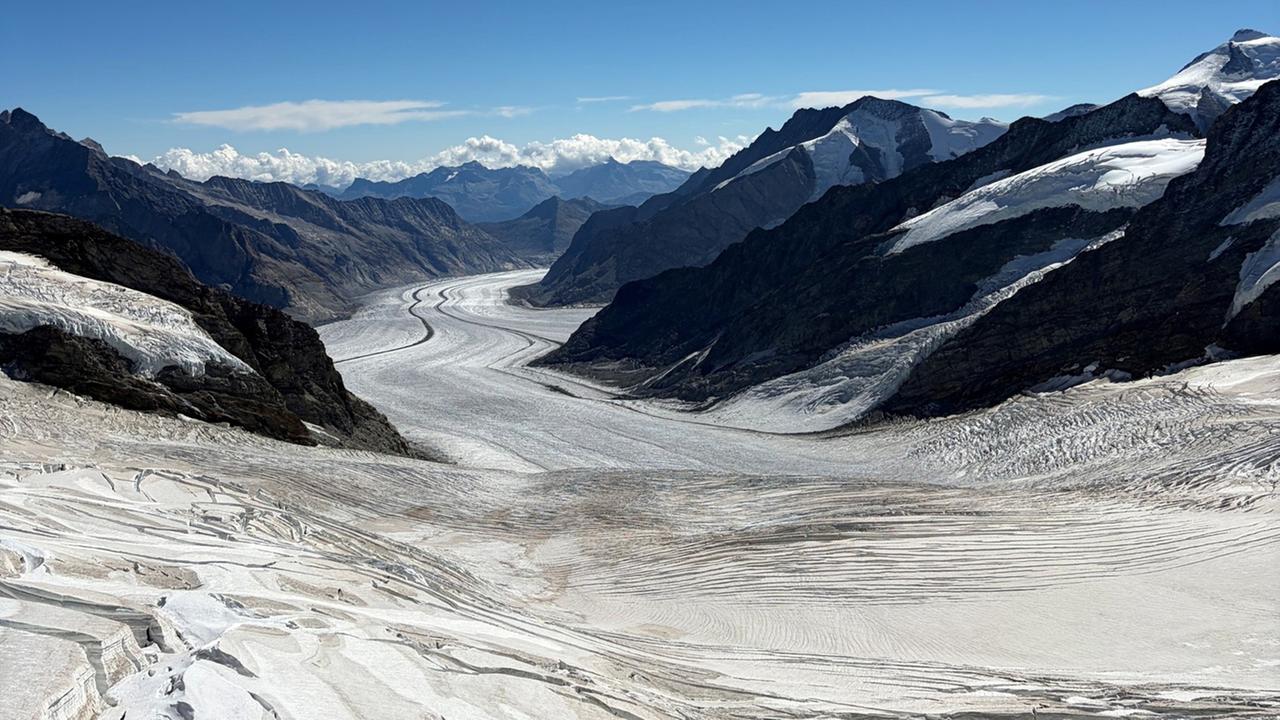
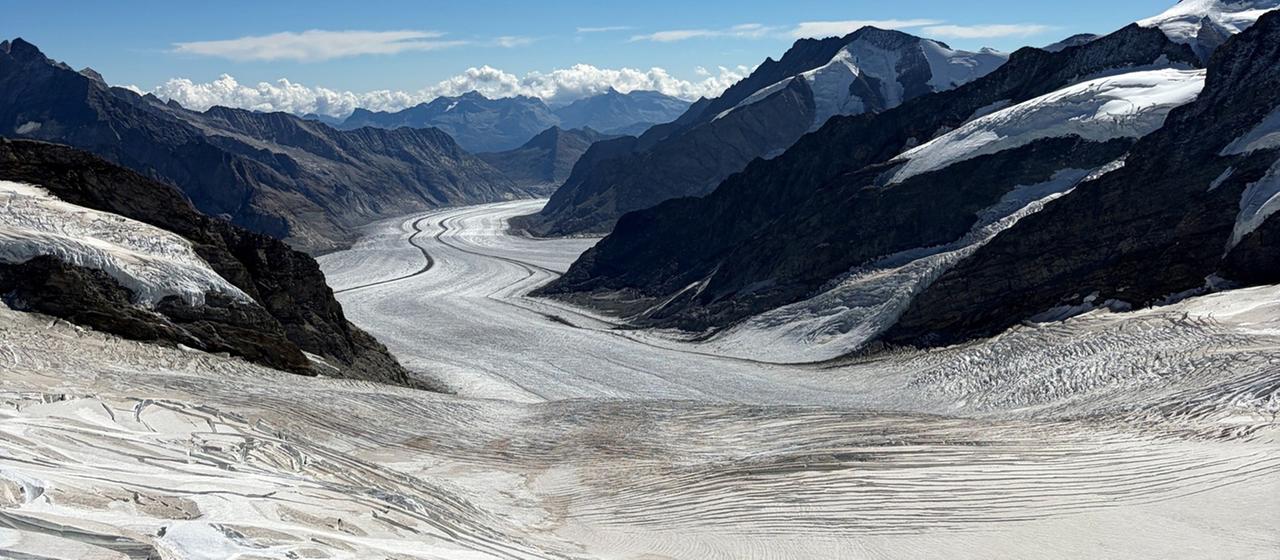
The visual evidence of this retreat is nowhere more striking than at the Aletsch Glacier, the largest in the Alps. Stretching nearly 23 kilometers and covering approximately 76 square kilometers, it has long been the crown jewel of the Jungfrau-Aletsch region.
The transformation is best understood through the lens of local infrastructure. Take the Konkordia Hut, a mountain refuge built roughly 150 years ago. At the time of its construction, the hut was situated conveniently near the surface of the glacier. Today, it stands as a haunting monument to the speed of climate change; the ice has retreated so drastically that the hut is now accessible only by a long, steep steel staircase that descends to where the glacier once reached.
This decline is not a sudden phenomenon but an accelerating trend. Throughout the 20th century, glaciers fluctuated with natural climate cycles, but the current rate of melt—driven by anthropogenic global warming—has broken the historical pattern. Each year, the "equilibrium line"—the altitude above which snow remains year-round—creeps higher, leaving more of the glacier exposed to the relentless summer heat.
Supporting Data: The Glaciological Perspective
Matthias Huss, a leading glaciologist at ETH Zurich and head of the GLAMOS network, has been at the forefront of tracking this environmental collapse. According to his analysis, 2026 serves as a harrowing benchmark.
"We haven’t quite reached the record-breaking lows of 2022, but we are dangerously close," Huss explains. The data highlights a "double-jeopardy" scenario: a lack of winter accumulation combined with extreme, sustained summer temperatures.
When a glacier loses its winter snow cover early in the season, the dark, exposed ice underneath absorbs solar radiation more efficiently, accelerating the melt process in a feedback loop. This loss of volume is not merely a loss of aesthetic beauty; it represents the disappearance of the "water towers" of Europe.
Implications: Beyond the Landscape
The retreat of the glaciers has immediate and long-term implications for the Swiss economy and ecology. Historically, glaciers have acted as a thermal and hydrological buffer. In the hot, dry summer months, they release water into the river systems, maintaining flow levels even when rainfall is scarce.
This year, that glacial meltwater provided a critical lifeline. It helped maintain levels in the major river arteries, which are essential for:
- Agriculture: Providing irrigation for crops during severe drought conditions.
- Infrastructure: Ensuring sufficient water levels for commercial river shipping.
- Energy Production: Cooling thermal power plants and, crucially, filling the hydroelectric reservoirs that power much of the Swiss nation.
However, this reliance on meltwater is a temporary subsidy from the past. As glaciers continue to shrink, the "peak water" phase—where meltwater increases due to rapid melting—will eventually give way to a permanent reduction in water availability. Once the glaciers are gone, the summer supply of water will rely entirely on transient rainfall, making the country significantly more vulnerable to future droughts.
Official Responses and Future Strategies
The Swiss government and scientific community are already grappling with the "post-glacial" reality. The discussion has shifted from how to save the glaciers to how to adapt to their absence.
One of the primary proposals currently under debate is the construction of new, high-altitude reservoirs. By creating artificial basins to capture seasonal rainfall and glacial runoff that would otherwise flow away, Switzerland hopes to replace the storage capacity of the disappearing ice. Yet, these projects are controversial, often facing pushback from environmentalists concerned about the impact of large-scale construction in sensitive, high-alpine ecosystems.
Furthermore, there is a renewed push for energy efficiency and a transition to more sustainable water management practices. The reality is that no amount of engineering can fully replace the massive, natural storage capacity provided by the glaciers, forcing a societal conversation about the limits of adaptation.
The Human Element: Tourists and the Weight of Awareness
On the Jungfraujoch, the highest railway station in Europe, the atmosphere is a poignant mix of wonder and melancholy. For the thousands of tourists who ascend to 3,500 meters to catch a glimpse of the Aletsch, the experience is often described as "spiritual" or "earth-shattering."
"You realize how small you are," says Michael Bock, a tourist visiting the site. "This is ancient ice. It gives you a sense of perspective on our role in the world."
For many, the sight of the receding ice is a wake-up call. Conversations among visitors often turn to the personal steps they are taking to combat global warming—from reducing air travel to shifting consumption habits. Yet, there is a palpable sense of unease. As visitor Uta Münter notes, "We don’t know how much longer this will be here. It’s beautiful, but it’s a fragile beauty."
Conclusion: A Legacy of Ice
The situation in Switzerland is a microcosm of a global crisis. The 2026 data serves as a stark reminder that the impacts of a warming climate are not theoretical—they are visible, measurable, and occurring at a pace that is outstripping our ability to mitigate them.
As the glaciers continue their retreat, they leave behind not just barren valleys of rock and silt, but a transformed relationship between the Swiss people and their environment. The challenge for the coming decades will be to manage this transition while addressing the root causes of the warming that is silencing these "eternal" giants. The glaciers are not just melting; they are speaking, and the message they convey is one of urgent, systemic change.