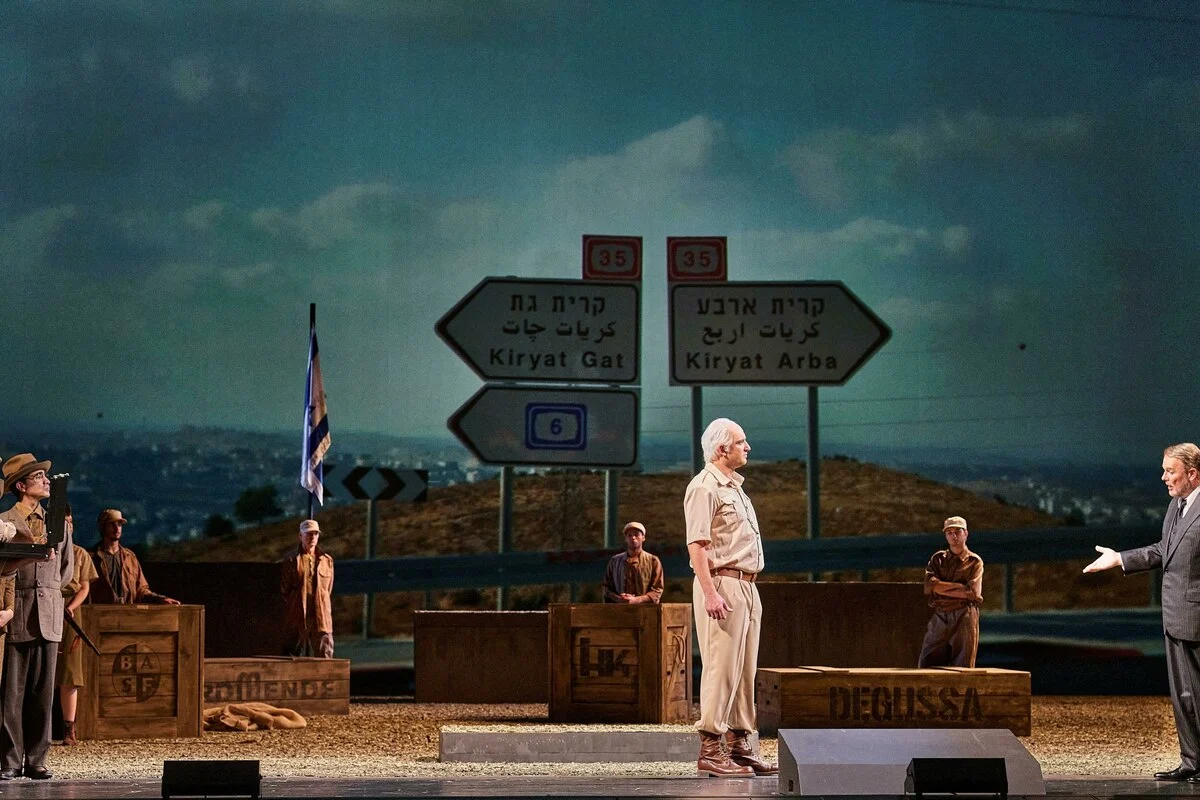
At the Deutsche Oper in Berlin, director Milo Rau has unveiled a production of Richard Wagner’s The Flying Dutchman that transcends traditional opera. By weaving together the tortured psyche of Wagner’s protagonist with the visceral, ongoing traumas of German-Israeli history, Rau has created a piece of documentary theater that challenges the audience to confront the "narcissism of guilt" and the crushing weight of historical responsibility.
Main Facts: A Convergence of Opera and History
Milo Rau, known for his provocative approach to contemporary theater, has turned his lens toward the most controversial composer in the German canon. The Flying Dutchman, a story of a cursed sailor seeking redemption through the devotion of a woman, is reimagined here not merely as a nautical myth, but as an allegory for the enduring, jagged intersections of German and Jewish history.
The production features a dual narrative layer. While the opera plays out on stage with baritone Tomasz Konieczny as a haunting, physically burdened Dutchman, the background is dominated by a projection of documentary footage captured by Rau himself during a recent tour through Israel. In this, he sought to perform the music of the famously antisemitic Wagner in the very places where his work remains a profound taboo.

The stage setting, designed by Anton Lukas, evokes the brutalist geometry of the Memorial to the Murdered Jews of Europe in Berlin. It is within this architectural landscape of remembrance that Rau explores three pivotal moments in German-Israeli relations: the 1948 founding of the state, the 1972 Munich Olympic massacre, and the 2005 inauguration of the Berlin Holocaust memorial.
Chronology: From Bayreuth to Jerusalem
The genesis of this production lies in a deliberate, often painful act of artistic confrontation. Twenty-five years ago, conductor Daniel Barenboim famously broke the informal, long-standing boycott of Wagner in Israel by conducting his music with the Berlin Staatskapelle. Rau takes this legacy further.
Last August, Rau embarked on a journey through Israel, accompanied by actors Sarah von Schwarze and Shlomi Moto Wagner. They performed excerpts and engaged with the local populace, documenting the responses to Wagner’s music. This footage does not serve as a mere backdrop; it acts as an intrusive, critical interlocutor.

In the opera, the character of the Dutchman is no longer just a sailor; he is an embodiment of German historical guilt. Daland, Senta’s father—traditionally a man who sells his daughter for wealth—is transformed into a politician clutching an attaché case full of reparations contracts. Meanwhile, Erik, the jilted lover, is reimagined through the lens of a Palestinian perspective, adding a contemporary layer of geopolitical tension to the internal dynamics of the libretto.
Supporting Data: The Documentary Layer
The effectiveness of Rau’s production relies heavily on the integration of its documentary elements. The "three-act structure" of the production maps onto the aforementioned historical milestones:
- 1948 – The Foundation: The initial act mirrors the birth of the state of Israel, setting the stage for the Dutchman’s arrival.
- 1972 – The Munich Tragedy: The middle act draws parallels between the personal betrayal in the opera and the political failures that defined the era.
- 2005 – The Memorial: The final act takes place within the symbolic space of the Berlin Holocaust memorial, questioning whether the institutionalization of memory has led to true redemption or merely a static state of "managed" guilt.
The use of video is not decorative. When the Israeli singer Tamara Nishri performs the aria of Senta at the central bus station in Jerusalem or in front of an Israeli-Palestinian theater in Jaffa, the audience is forced to reconcile the soaring, Romantic beauty of the music with the gritty, dusty reality of the urban landscapes projected behind the live performers. The synchronization between the live Senta on stage, Aušrinė Stundytė, and the projected Nishri creates a disorienting, powerful tension that underscores the universal reach of the work’s themes.

Official Responses and Artistic Intent
Milo Rau has consistently positioned his work as a tool for social and political inquiry. His stated aim with this production is to move beyond the aesthetic "overwhelmingness" typically associated with Wagnerian opera. "Guilt is narcissistic," notes the artist Majd Asadi in the film footage, a sentiment that becomes a mantra for the production.
The creative team argues that the traditional, cathartic experience of listening to Wagner is, in the context of the 21st century, insufficient. By stripping away the romantic veneer and exposing the structural, political, and moral underpinnings of the work, Rau seeks to transform "guilt" into "responsibility."
Critics and audience members have noted the intensity of the performance. The Deutsche Oper’s orchestra, led by Giedrė Šlekytė, provides a focused and warm accompaniment that refuses to succumb to the grandiose, sweeping sentimentality often associated with the Wagnerian "sound world." Instead, the music is treated as a clinical, surgical instrument meant to dissect the action on stage.

Implications: The End of the Wagner Myth?
The implications of this production are profound. For decades, the "Wagner Question" has centered on whether the art can be separated from the man’s virulent antisemitism. Rau’s production effectively renders this question obsolete by refusing to separate them. He forces the music to exist in the context of the crimes it inspired and the societies it haunts.
The Shift from Redemption to Responsibility
In the original opera, Senta’s self-sacrifice redeems the Dutchman. In Rau’s vision, there is no easy redemption. The "Dutchman’s curse" is identified as the perpetual, unresolved nature of German guilt. By making the characters represent states and political ideologies, Rau posits that the "redemption" of the German nation is not a singular event that occurred in the past, but a continuous, active process of engagement with the present.
A New Form of Opera
This production signals a potential evolution for the genre. By incorporating "documentary theater" techniques, the opera moves from being a museum piece to a living, breathing commentary on current affairs. The inclusion of telephone calls to Gaza during the performance, and the dialogue about the nature of responsibility, shatters the fourth wall in a way that is rarely seen in traditional opera houses.

The Future of Cultural Memory
Ultimately, the success of this production lies in its refusal to offer comfort. When the audience leaves the Deutsche Oper, they are not left with the familiar glow of a Wagnerian finale. Instead, they are left with the echoing words of Majd Asadi and the visual reminder of the persistent, unresolved tensions in the Middle East and Europe.
Rau has succeeded in creating a "Wagner against Wagner" experience. He has used the master’s own tools to deconstruct the myths that have sustained his supremacy, while simultaneously challenging the audience to look beyond the stage and into the mirror of history. Whether this approach will be adopted by other houses remains to be seen, but the Flying Dutchman at the Deutsche Oper is undoubtedly a landmark moment in the history of contemporary theater. It serves as a stark reminder that in the face of infinite cycles of violence, the only way forward is to stop, listen, and, as the production suggests, actively transform the weight of the past into the work of the future.