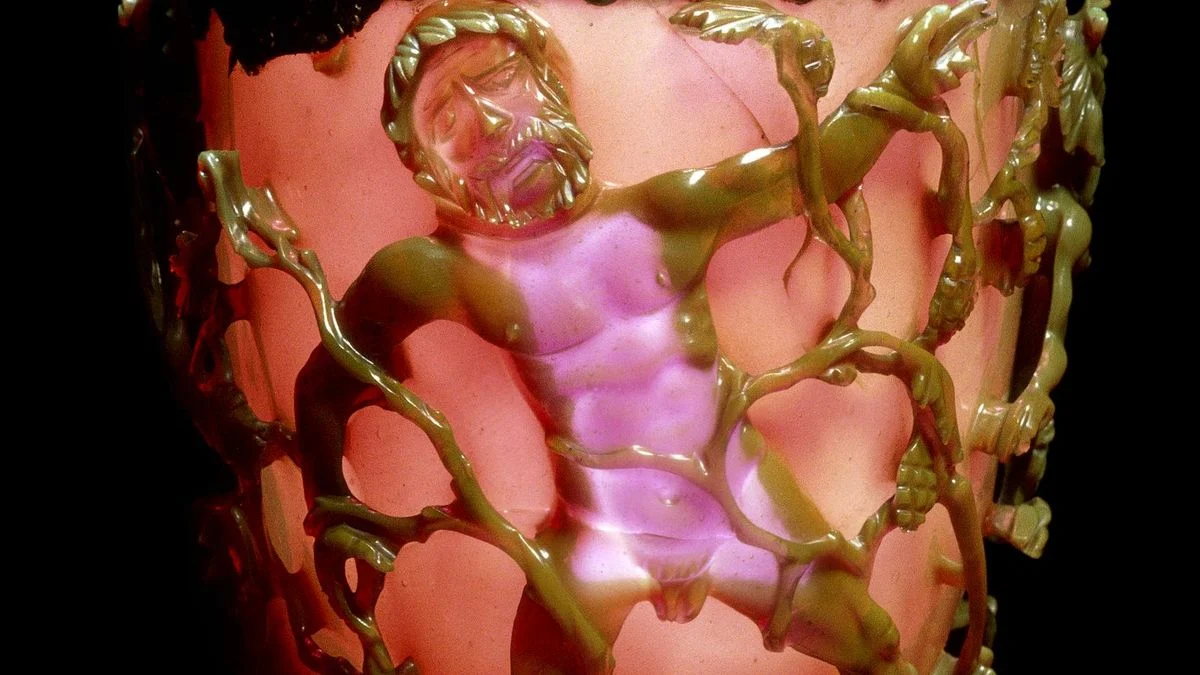
For sixteen centuries, the Lycurgus Cup has stood as one of the most enigmatic artifacts of the Roman world. Housed within the hallowed halls of the British Museum, this glass vessel possesses a property that seems to defy the constraints of the ancient world: it changes color based on the direction of light. When illuminated from behind, the glass glows with a deep, pulsating ruby red; when lit from the front, it shifts to a translucent, ethereal jade green.
For generations, this "chameleon glass" has baffled historians, chemists, and glassmakers alike. How could artisans in the 4th century AD, long before the invention of the scanning electron microscope or modern nanotechnology, manipulate matter at the molecular level? According to a recent report in The Guardian, a team of researchers at the University of Sheffield has finally cracked the code, successfully replicating the precise optical phenomenon that has fascinated humanity for over a thousand years.
The Science of Ancient Nanotechnology
At the heart of the cup’s mystery lies a sophisticated application of nanotechnology that predates our modern understanding of the field by roughly 1,600 years. To achieve the dramatic color shift, Roman craftsmen integrated gold and silver nanoparticles into the glass matrix. These particles are incredibly small—roughly 50 nanometers in diameter, or about one-thousandth the size of a grain of salt.
The color change is a result of surface plasmon resonance. When light hits the gold and silver particles, the electrons oscillate, scattering specific wavelengths of light. The particles effectively act as a filter: they block the blue and green light when the cup is backlit, allowing only the red and orange spectrum to pass through. Conversely, when the cup is front-lit, the particles scatter the light in a way that manifests as a rich, verdant green.
Achieving this consistency required a level of metallurgical precision that is staggering. The Sheffield team, led by technician Lisa Hollands, discovered that the success of the replication process depended heavily on the placement of the glass within the furnace and the precise chemical ratios of the metallic additives.
A Chronology of a Masterpiece
The Lycurgus Cup was likely crafted in the 4th century AD, a period of transition and cultural synthesis in the late Roman Empire. The vessel depicts a scene from Greek mythology: the death of King Lycurgus, who, according to the legend, was ensnared by a vengeful grapevine after attacking the god Dionysus and his followers.
- 4th Century AD: The cup is produced in the Roman Empire. Its intricate carving and chemical composition suggest it was a luxury item of the highest order, likely intended for a member of the imperial elite.
- The Middle Ages to the 19th Century: The cup remains in private hands, its true origins and the nature of its craftsmanship largely misunderstood by those who owned it.
- 1958: The British Museum acquires the cup, which has since been fitted with a decorative silver foot adorned with vine leaves.
- 2022: The cup is officially designated as one of the "Seven Wonders of the Glass World," cementing its status as an icon of both art history and materials science.
- 2026: Researchers at the University of Sheffield announce they have successfully synthesized glass that mimics the Lycurgus effect, providing a modern proof-of-concept for the ancient technique.
The Human Element: “For Me, It Is Magic”
For the researchers involved, the project was far more than a laboratory exercise; it was a deep dive into the ingenuity of ancient predecessors. Lisa Hollands, who spearheaded the experimental phase at the University of Sheffield, described the endeavor as a "heart-driven project."
"For me, it is magic," Hollands remarked in an interview with The Guardian. She noted that while others had attempted to replicate the effect in the past, their results were often inconsistent or failed to capture the depth of the color transition. The Sheffield team used a fragment of an original Roman glass piece as their template, painstakingly attempting to recreate the environment of an ancient furnace.
Hollands offered a poignant reflection on the gap between modern science and ancient craft. "If the Romans could have watched me experimenting," she mused, "they probably would have laughed and asked, ‘Why doesn’t she know how to do that?’" This sentiment highlights a profound irony: we possess the analytical tools to describe the how and why of the Lycurgus Cup, but we remain humble in the face of the Romans’ intuitive, masterful command of materials.
Expert Perspectives and Historical Context
The implications of this discovery extend beyond chemistry; they reshape our understanding of Roman technological capacity. Ian Freestone, an emeritus professor of archaeological materials at University College London, has long championed the study of the cup’s unique properties. He suggests that the dual-color nature of the glass was not a accidental byproduct of production, but a deliberate, sophisticated aesthetic choice.
One prevailing theory among scholars is that the color transition is meant to symbolize the maturation of wine—a theme perfectly suited to the cup’s mythological imagery of the god Dionysus. The transition from green to red, mirroring the ripening of grapes, would have been a visual marvel during the symposia and banquets of the Roman aristocracy.
Furthermore, the cup’s weight—roughly 700 grams—and its height of 16 centimeters make it a tactile, substantial object. The fact that it survived in such pristine condition, despite the fragility of its composition, speaks to the high level of care afforded to it throughout the centuries.
Implications for Modern Material Science
Why does a 1,600-year-old cup matter to 21st-century science? The answer lies in the quest for new, sustainable, and adaptive materials. The Roman technique for incorporating nanoparticles into glass is a precursor to modern "metamaterials"—substances engineered to have properties not found in nature.
By understanding how the Romans achieved this level of control, modern engineers can refine their own production of photonic sensors and color-changing surfaces. The study serves as a masterclass in "bottom-up" engineering, where the artisans didn’t build with machines, but with the fundamental laws of chemistry and physics.
Moreover, the research validates the idea that ancient technology was not merely a primitive version of our own, but a distinct path of innovation. The lack of microscopes and formal theories of atomic structure did not prevent the Romans from manipulating the physical world at the nanoscale; it simply meant they relied on centuries of trial, error, and an intimate, tactile knowledge of their materials.
Conclusion: Bridging the Millennium
The Lycurgus Cup remains a testament to the fact that human creativity and technical curiosity are not products of the digital age, but inherent traits that have driven progress for millennia. As researchers continue to peer through the lens of modern science at this ancient treasure, they are not just solving a puzzle; they are engaging in a cross-temporal dialogue with the artisans of the 4th century.
Whether the cup was intended as a scientific curiosity or a religious totem, it remains a "Wonder of the Glass World." Its red-and-green glow serves as a reminder that the boundary between art and science is thin, and that sometimes, the most sophisticated answers are hidden in plain sight, waiting for the right light to reveal them. With the Sheffield team’s successful replication, we have bridged a gap of sixteen hundred years, proving that while our tools have changed, the human desire to capture the magic of the light remains unchanged.