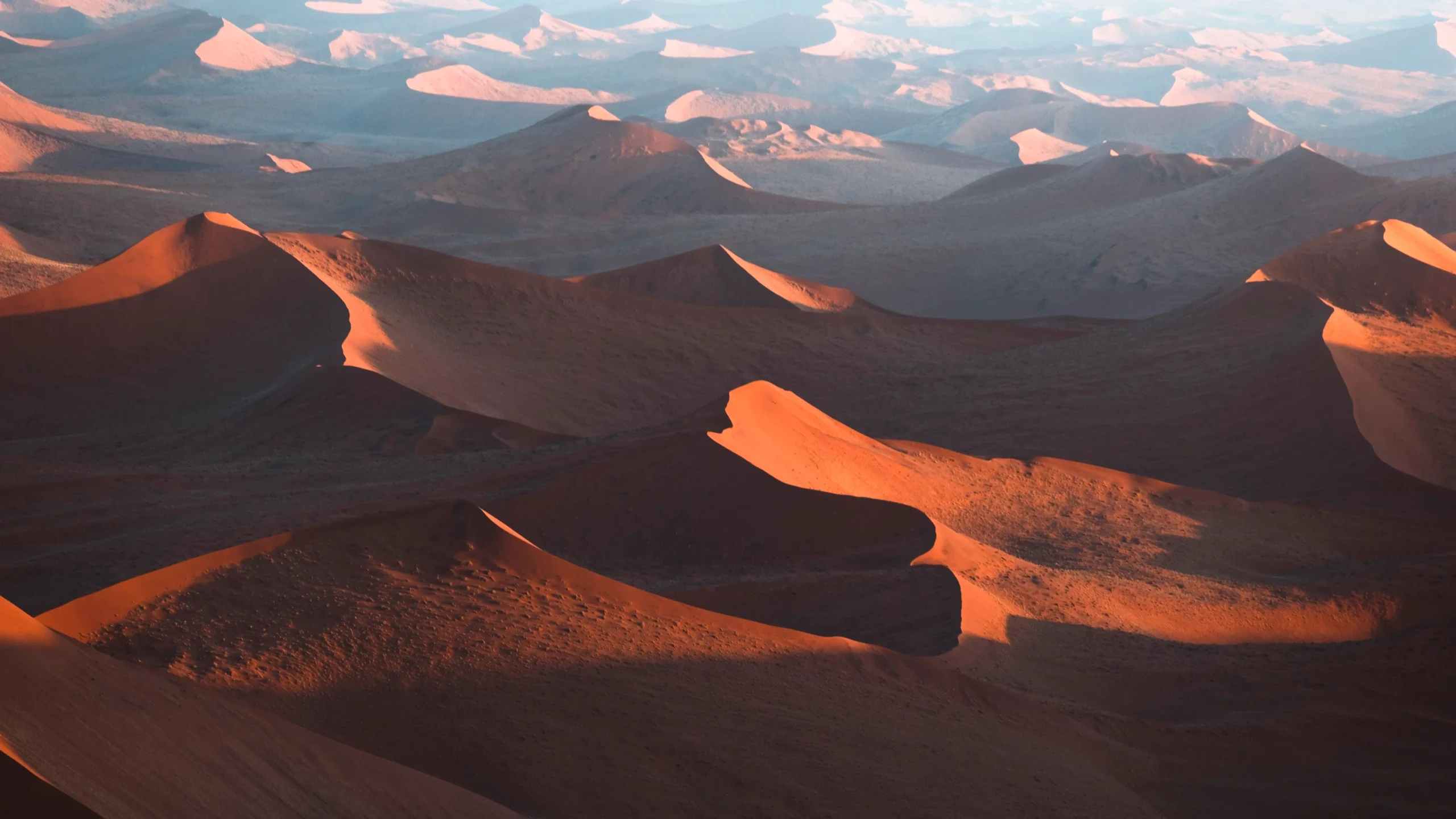
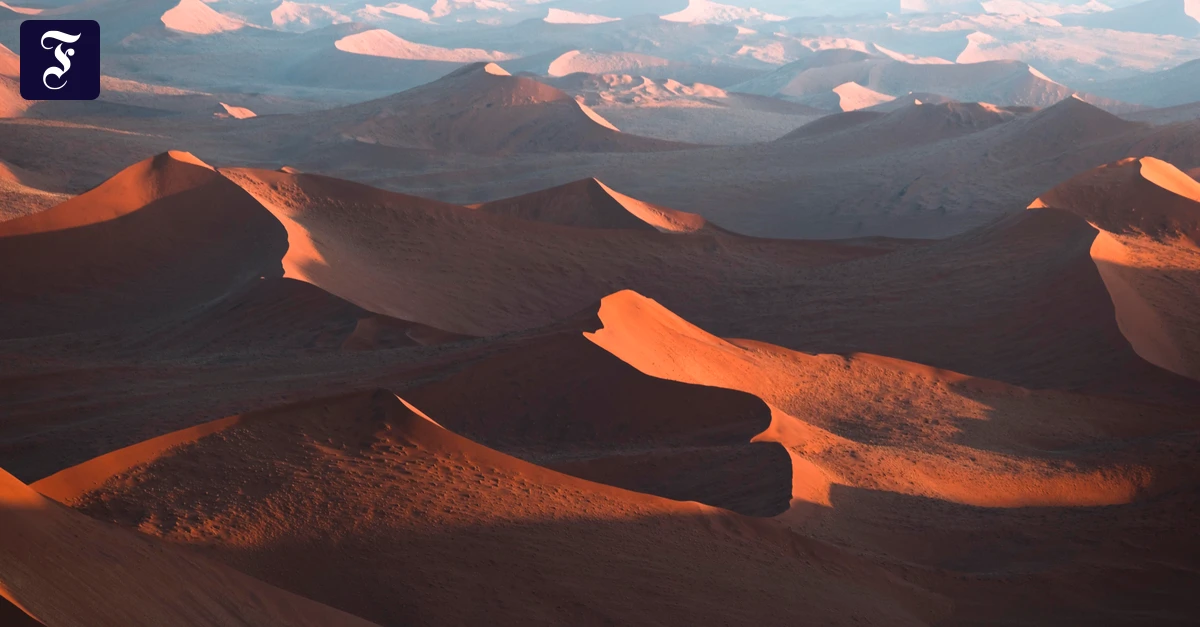
The Namib Desert does not merely exist; it performs. To stand amidst its vast, shifting dunes is to feel as though one has wandered onto a colossal, meticulously crafted stage. You half-expect a silent crew of stagehands to emerge from the horizon at any moment, folding the mountain ranges like painted backdrops, packing the red dunes into crates, and spiriting them away to a storage depot, leaving you standing on nothing but bare, empty earth.
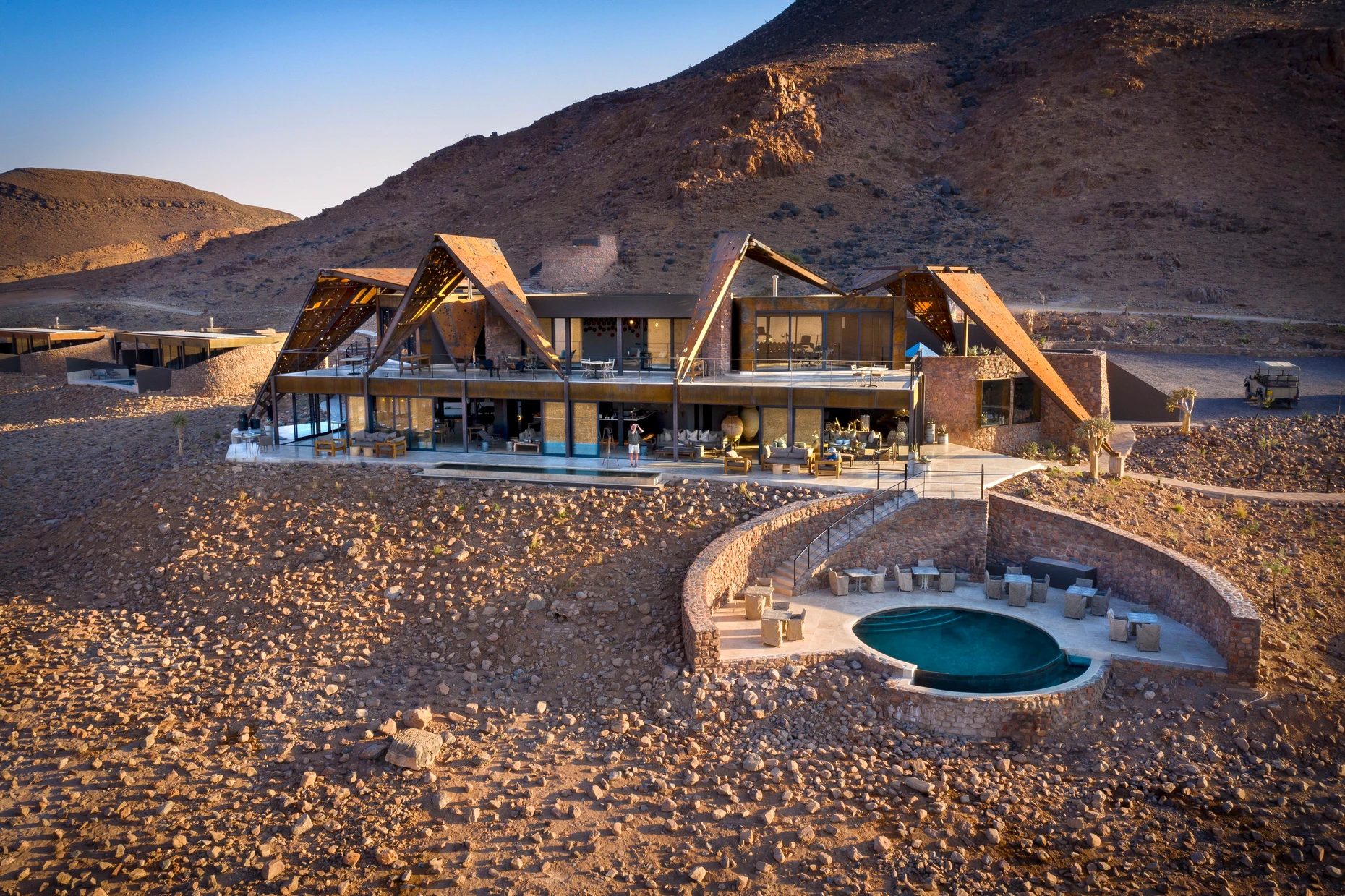
Yet, for now, the performance continues. The peaks rise gently against a piercing, cobalt sky; the dunes glow with an otherworldly, rusted crimson; and the vast plains are dappled with the faint, watercolor green of sporadic grass—a lingering memory of recent rains. At the center of this surreal theater sits the &Beyond Sossusvlei Desert Lodge, a structure so attuned to its environment that it feels like part of the set design itself.
Architecture of Immersion: The Sossusvlei Desert Lodge
The lodge consists of twelve bungalows, each featuring glass walls that blur the line between the interior comfort of the suite and the raw, prehistoric wilderness outside. Here, time is measured not by clocks, but by the slow migration of clouds and the graceful ballet of Pale-winged Starlings. These birds, with their jet-black plumage shimmering in a metallic blue, are the local jesters. They hop across dining tables with impudent curiosity, their bright yellow-orange eyes scanning for a stray cookie crumb, while the wind carries them effortlessly across the plains without a single beat of their wings.
The landscape is punctuated by the solitary silhouette of a camel thorn tree. Nestled within its branches lies a massive structure—a communal home for Sociable Weavers, housing over a hundred individual nesting chambers, a testament to the cooperative survival strategies required in this arid theater.
The Astronomer’s Promise: Gazing into the Infinite
While the dunes capture the eye, the true protagonist of the Sossusvlei experience is the night sky. Away from the encroaching light pollution of modern civilization, the Namibian heavens unfold with a clarity that borders on the spiritual.
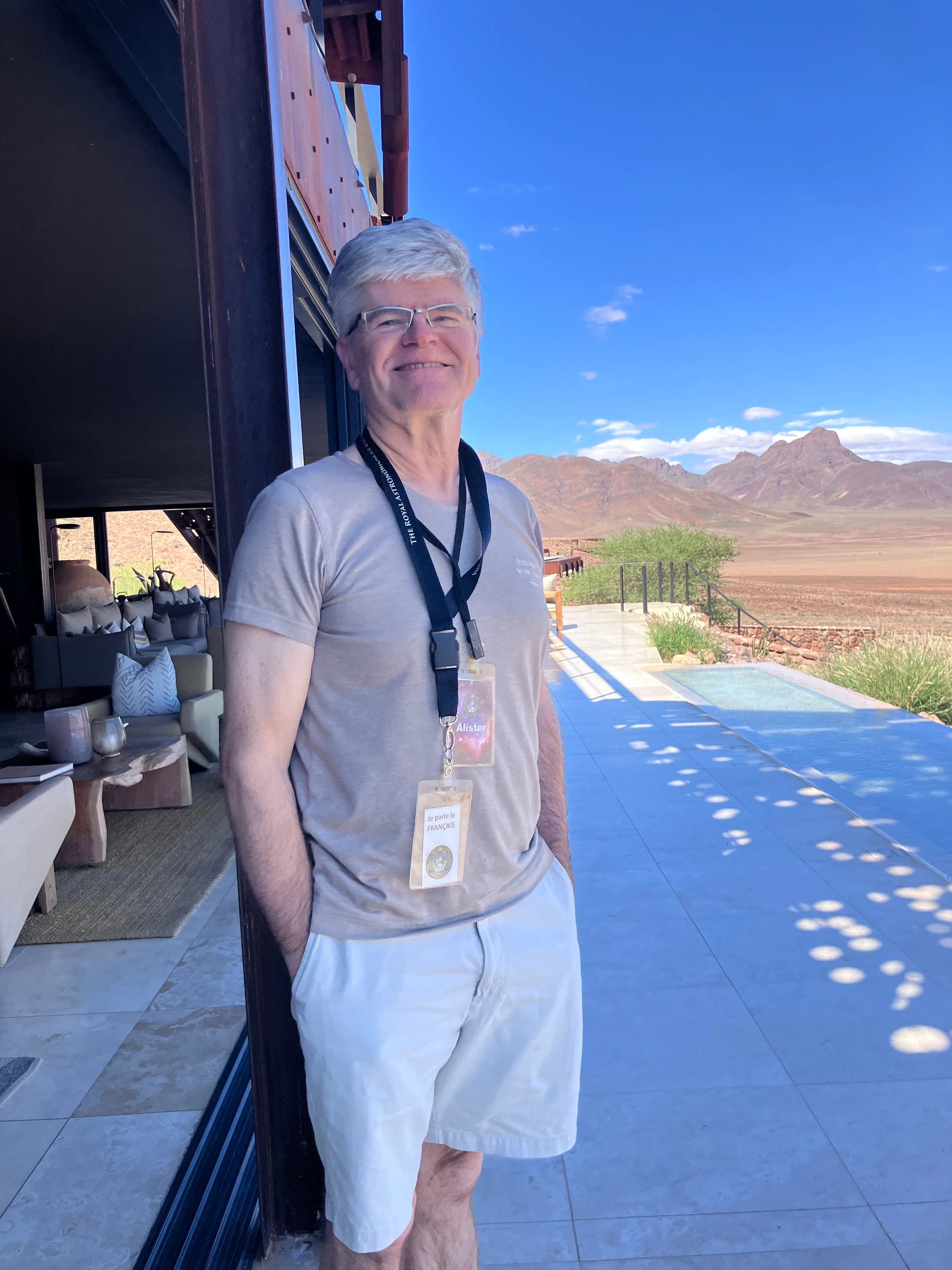
The lodge’s resident astronomer, Alister, a Canadian expatriate and retired meteorologist, serves as the interpreter of this celestial script. With his shock of white hair and an intensity that suggests his consciousness spends more time among the nebulae than on Earth, Alister is a man possessed by the stars. His passion was ignited during childhood fishing trips in the Canadian wilderness, where he and his father would sit by the campfire, staring into the abyss of the night sky, wondering about the possibility of life beyond our pale blue dot.
"Don’t you think there must be someone else out there?" he asks, his gaze fixed on the constellations.
Alister spends six-week stints at the lodge, guiding guests through the mysteries of the cosmos. As darkness descends, he calibrates his telescope using an iPad, the mechanism whirring softly as it aligns with a distant target. He points his laser toward Jupiter, which appears through the lens as a glowing, pill-like entity.
For many guests, this is the emotional peak of the journey. An elderly British couple, celebrating their sixtieth wedding anniversary, were moved to silence, eventually sinking into their chairs, necks craned toward the Milky Way. "Just for these stars," the husband remarked, "the journey was worth it." It is a sentiment that Alister appreciates, though he remains bemused by those who glance up, mutter a casual "cool," and return to their drinks. For Alister, the stars are not just a backdrop; they are a calling. He sleeps in split shifts, waking at 3:00 a.m. to catch specific stellar movements, his life dictated by the rhythm of the galaxy.
The Chronology of the Sands: A Journey to Sossusvlei
The following morning, as the Milky Way fades into the pale light of dawn, our journey begins toward the iconic Sossusvlei. Our guide, Denvel, a man dressed in desert-beige with a deep-seated knowledge of the terrain, navigates the gravel tracks with the urgency of someone expecting the park to close at any second.
06:00 AM – The Desert Awakens
As the sun crests the horizon, the dunes are transformed. The low-angled light carves deep shadows into the sand, modeling every ripple and wind-sculpted ridge. The dunes glow with an intense, iron-oxidized red—a process that has taken millennia. Denvel explains that the older the dune, the deeper the hue.
08:00 AM – The Human Procession
We pass Dune 45, a tourist magnet named for its distance from the park entrance. It is a scene of organized chaos: buses and 4x4s clog the parking lot, and a steady, rhythmic stream of hikers makes the arduous climb to the eighty-meter crest. We opt to bypass the crowd, pushing deeper into the park, passing a rickety bus filled with tourists peering out from under broad-brimmed hats.
10:00 AM – The Paradox of Water
The most striking event of the trip occurs as we approach the legendary Big Daddy dune. After days of heavy, unseasonal rainfall, the ephemeral Tsauchab River has defied its reputation as a "dead end." A large, sparkling lake sits nestled amidst the towering orange sand dunes. It is a scene of impossible contrast: verdant green bushes clinging to the shoreline and a lone tree standing in the center of the water. Denvel, who has worked here for nine years, is visibly stunned. "I have only seen water here twice," he admits, shaking his head at the miracle of the desert.
Supporting Data and Observations
The Sossusvlei area, located within the Namib-Naukluft National Park, is characterized by its hyper-arid climate, yet it is home to a surprising array of specialized fauna. The presence of water, while rare, triggers a rapid, if fleeting, biological explosion.
- Geological Composition: The deep red color of the dunes is primarily due to the high concentration of iron oxide in the quartz sand.
- Biological Resilience: Trees found in the Deadvlei area have been dead for centuries. Due to the extreme lack of moisture, they do not rot; they simply mummify, standing as dark, skeletal sentinels against the white clay floor.
- The San Legacy: The San, or Bushmen, are among the world’s oldest indigenous groups. Their historical presence is marked by rock art—faint, haunting images of antelopes and giraffes etched into the red rock.
The Human Impact: A Fragile Balance
As we descend from the dunes into the Deadvlei, the silence of the desert is shattered. The site has been "colonized" by groups of young travelers who treat the ancient, mummified trees like a jungle gym. Selfies are taken, poses are struck, and the historical gravity of the site is ignored in favor of social media curation.
Denvel watches with a mixture of sadness and professional resignation. "Eventually, this place will have to be fenced off," he predicts. "The trees will have to be protected from the very people who come to see them." It is a sobering reminder that even the most remote theaters of nature are not immune to the pressures of mass tourism.
The Perspective of the San
On our final afternoon, we embark on a "Desert People Walk" with Mario, another of the lodge’s expert guides. Even Alister, usually tethered to his telescope, joins us, trading his observatory gear for hiking boots.
Mario leads us across the rocky, scrub-covered landscape, pointing out the smooth patches on boulders where the San once sharpened their tools. He speaks of their extraordinary ability to read the desert—identifying not just the species of an animal by its track, but its gender, health, and state of mind.
He tells us the San creation myth of the Milky Way: a group of women, waiting for their husbands to return from a hunt, threw the embers of their fire into the sky to light the way home. The sparks scattered, creating the galaxy. It is a story that brings a rare, childlike delight to Alister’s face.
However, the reality of the San people is far less poetic. Mario touches only briefly on their history of displacement, persecution, and systemic poverty. Today, the San live scattered across southern Africa, often on the fringes of the society that once sought to study them as mere curiosities.

Conclusion: The Final Glimpse
As the sun dips below the horizon, painting the sky in shades of bruised purple and burning gold, we sit together on a rocky outcrop. The desert begins its transformation into the cool, quiet theater of the night.
"Look," Alister whispers, pointing to a single, brilliant point of light. "The first star."
The Namib remains a place of profound contradictions: a landscape of extreme death that supports life in its most resilient forms; a site of ancient history currently being trampled by the modern world; and a place where one can stand in the dust and, if only for a moment, feel the sheer scale of the universe. The performance in the Namib is not for the faint of heart, but for those willing to look, it is the most spectacular show on Earth.
Travel Information:
- Lodge: &Beyond Sossusvlei Desert Lodge (www.andbeyond.com/lodge-editorial/sossusvlei-desert-lodge)
- Bookings: Flights and travel arrangements are best coordinated via Signature Travel, Rosenheimer Str. 143c, 81671 Munich (www.signaturekollection.travel).