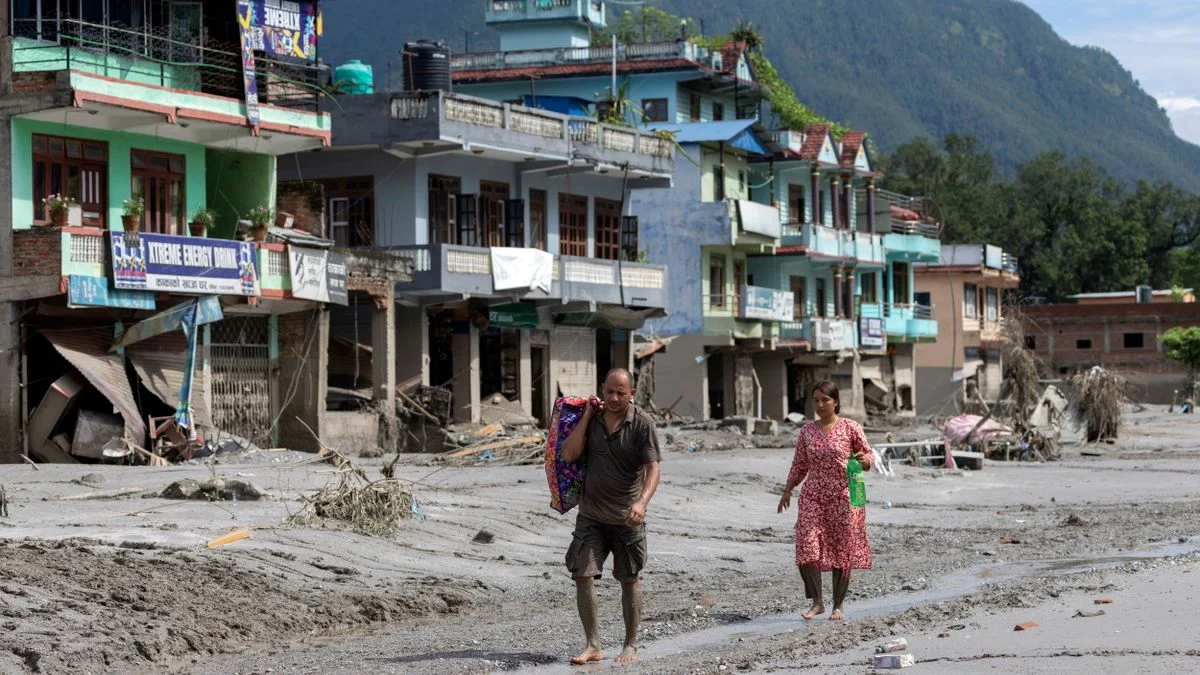
The majestic peaks of the Himalayas, often referred to as the "Third Pole," are currently undergoing a transformation so rapid and volatile that they pose an existential threat to the millions living in their shadow. Among the most harrowing phenomena are Glacial Lake Outburst Floods (GLOFs)—sudden, catastrophic releases of water from unstable glacial lakes.
Recent investigations into catastrophic flooding events in the Himalayan region have revealed a terrifying reality: the margin between safety and disaster is measured in mere minutes. When the natural barriers containing these high-altitude reservoirs fail, the resulting deluge does not merely flow; it explodes, carving paths of destruction through valleys that have stood undisturbed for centuries.
The Anatomy of the Catastrophe: Main Facts
A GLOF occurs when a glacier melts, forming a lake held back by unstable debris, moraines, or ice. As global temperatures rise, these lakes expand rapidly. When the damming material—often a mix of loose rock and ice—suddenly collapses due to tectonic movement, heavy rainfall, or simply the weight of the water, the contents of the lake are released in a violent surge.
In the most severe cases, the water picks up boulders, mud, and forest debris, transforming into a massive, viscous slurry known as a debris flow. This flow moves with a velocity that renders early warning systems virtually ineffective. For the communities located downstream, the event is not a rising tide, but a sudden explosion of kinetic energy that levels infrastructure, buries agricultural land, and leaves no time for evacuation.
Chronology of a Disaster: The Minutes Before the Surge
While every flood event carries unique characteristics, the timeline of a major Himalayan outburst typically follows a harrowing, compressed sequence:
1. The Pre-Event Equilibrium
Glacial lakes are often situated in remote, high-altitude basins. Local communities have historically lived in a state of precarious coexistence with these giants, monitoring changes in water levels with traditional knowledge. However, the current rate of climate-driven glacial retreat has rendered historical data unreliable.
2. The Trigger Moment
Whether triggered by a small rockfall or the sheer pressure of water against a weakened moraine, the failure begins with a minor breach. Within seconds, this breach widens. The hydrostatic pressure of millions of cubic meters of water turns a trickle into a catastrophic tear in the landscape.
3. The "Explosion" Phase
Eyewitnesses to such events often describe a sound like a "mountain shattering." As the water exits the basin, it does not follow the gentle descent of a riverbed; it thunders down the steep gradients of the Himalayan valleys. The water column gains momentum, picking up immense amounts of sediment.
4. The Impact Window
Communities located 10 to 30 kilometers downstream often have less than 15 minutes of lead time. In this window, the sound of the approaching deluge is often the only warning. The water arrives as a front, destroying bridges, communication lines, and homes, effectively cutting off the affected areas from the outside world before the bulk of the flood has even arrived.
Supporting Data: A Warming Trend
Scientific data provided by organizations such as the International Centre for Integrated Mountain Development (ICIMOD) paints a grim picture. The Hindu Kush-Himalayan region is warming at a rate significantly higher than the global average.
- Accelerated Melting: Glaciers in the region have lost mass at an accelerating rate over the last two decades.
- The Lake Count: Recent satellite surveys have identified thousands of glacial lakes in the region, with hundreds classified as "potentially dangerous."
- Volumetric Growth: The volume of water held in these high-altitude basins has increased by nearly 50% in the last 30 years, drastically increasing the potential energy of a GLOF.
This data suggests that we are not looking at isolated incidents but a systemic shift in the region’s hydrology. The "Third Pole" is losing its ice, and the water is finding nowhere to go but down.
Official Responses and Governance Challenges
Governments across the Himalayan belt—including India, Nepal, Bhutan, and Pakistan—have been under immense pressure to address the GLOF threat. The response has been multifaceted, though often hindered by the sheer scale of the terrain.
Early Warning Systems (EWS)
Several nations have begun installing sophisticated sensor networks. These systems use ultrasonic water-level sensors and satellite-linked telemetry to provide real-time data to government agencies. However, the "last mile" problem remains: even if a sensor detects a rise in water, transmitting that alert to a village in a deep, shadowed valley within the 5-to-10-minute window of safety is a gargantuan logistical challenge.
Engineering Interventions
In regions like Bhutan, engineers have conducted complex "controlled lowering" operations, digging channels into the moraines of high-risk lakes to prevent them from reaching a critical volume. While effective, these projects are expensive, labor-intensive, and require working in some of the most inhospitable environments on Earth.
International Cooperation
The "Hindu Kush Himalaya Assessment" report serves as a foundational document for trans-boundary cooperation. Because water does not respect national borders, a GLOF in the Tibetan Plateau can devastate communities in Nepal or India. Regional cooperation is no longer a matter of diplomacy; it is a matter of civil defense.
Socio-Economic and Environmental Implications
The implications of these events extend far beyond the immediate loss of life and property.
The Loss of Agricultural Resilience
The valleys of the Himalayas are the breadbaskets of the mountain people. When a GLOF deposits meters of sediment and boulders over fertile terraces, that land is often permanently ruined for agriculture. This forces migration, creating "climate refugees" who move from the highlands to overcrowded urban centers.
Infrastructure Fragility
The Himalayan region is seeing an influx of investment in hydroelectric power. While these projects provide green energy, they are also incredibly vulnerable. A single GLOF can destroy a multi-billion-dollar dam, leading to downstream flooding and energy crises. The tension between the need for renewable energy and the reality of geological instability is one of the most pressing policy conflicts in the region.
The Psychological Toll
The constant fear of the "mountain exploding" creates a psychological burden for inhabitants. This chronic stress affects community cohesion, mental health, and the willingness of the youth to remain in their ancestral homes, potentially leading to the erosion of unique high-altitude cultures.
Conclusion: The Need for Urgent Adaptation
The story of the Himalayan flood is a microcosm of our global climate reality. It is a story of a system pushed beyond its natural threshold, where the feedback loops of a warming planet are no longer theoretical, but physical and violent.
Adaptation in this region requires more than just better sensors. It requires a holistic rethinking of Himalayan settlement patterns, infrastructure design, and trans-boundary disaster management. We can no longer rely on the mountains to provide the stability they have offered for millennia. As the glaciers recede, they leave behind a landscape that is fundamentally more volatile.
The question for the international community is whether we have the political will to invest in the long-term, high-cost solutions required to protect these mountain populations, or if we will continue to react to the "explosions" only after the water has already claimed the valley floor. The time for proactive engineering and regional integration is narrowing, much like the window of opportunity for those in the path of the next great flood.