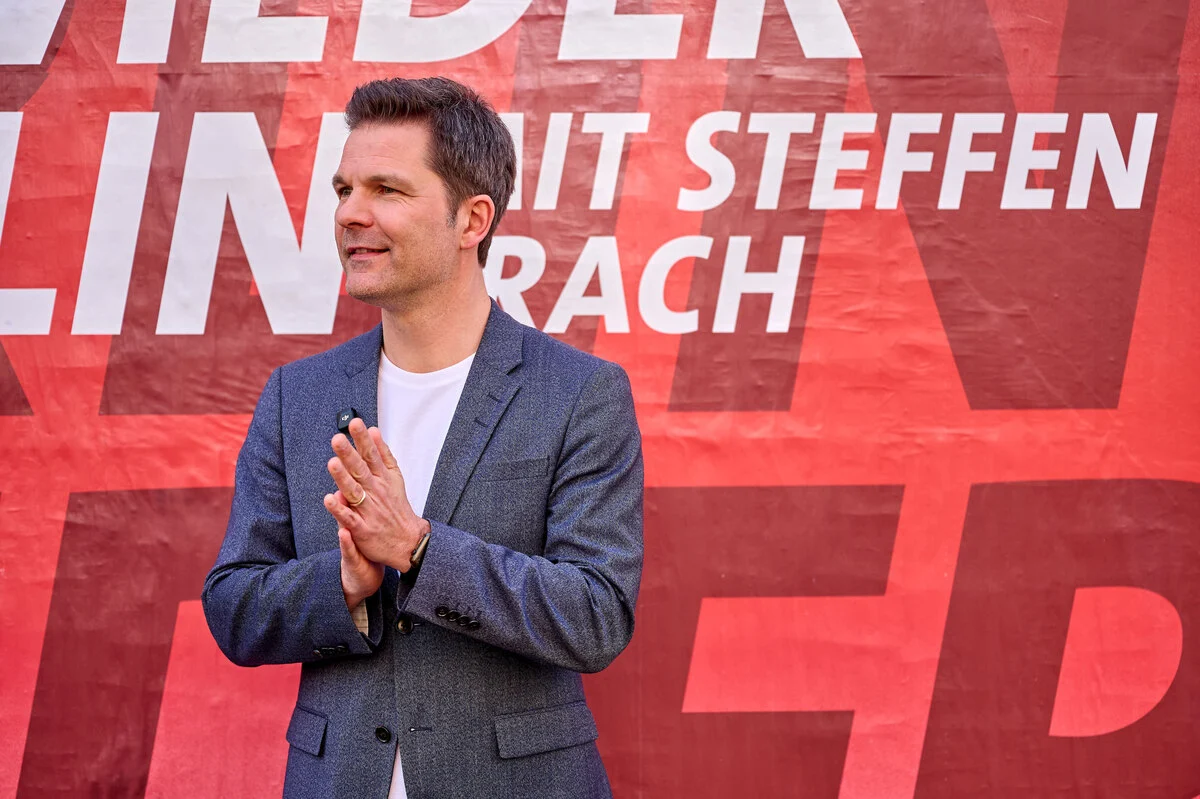
In the bustling heart of Steglitz, SPD mayoral candidate Steffen Krach is working the room—or, more accurately, the sidewalk. With a stack of "Berlin Promises" in hand, he attempts to engage passersby near a snack stand. Yet, as the September 20th election for the Berlin House of Representatives approaches, the reality for the party of Willy Brandt is stark: they are currently holding the "red lantern"—the German idiom for being in last place. For Krach, the path forward is a high-stakes race against time, dwindling poll numbers, and a political landscape that seems to be moving on without his party.
The Current State of Play: A Party in Freefall
The SPD’s trajectory in Berlin is, by any metric, alarming. According to the latest Infratest Dimap polling published by RBB, the Social Democrats are languishing at just 12 percent. To put this in perspective, the party garnered 21.4 percent in the 2021 election. The "Aufbruchstimmung"—the mood of renewal—that accompanied Krach’s nomination in November 2025 has largely evaporated, replaced by a sense of resignation among the electorate.
While CDU and The Left (Die Linke) are locked in a high-profile battle for the top spot, the SPD finds itself squeezed in the middle, struggling to define its relevance. For Steffen Krach, a 46-year-old former state secretary for science, the challenge is not just to win, but to survive the systemic malaise that has gripped the capital’s politics.
Chronology of a Stalled Campaign
Steffen Krach’s journey to the top of the SPD ticket was framed as a "stroke of luck" by party delegates. As a Hannover-born political veteran who had spent seven years (2014–2021) navigating the complex machinery of Berlin’s government, he was marketed as the "outsider with insider knowledge." He was the clean slate the party desperately needed.
The Failed Launch
In March, the campaign took its first significant hit during the unveiling of the "Wieder Berlin" (Berlin Again) campaign in a trendy Kreuzberg venue. Krach attempted to tap into the nostalgia of his arrival in the city in 2002—a time of creative dynamism and optimism. However, the slogan fell flat. Critics dismissed it as "retro," and social media wags quickly rebranded it "Nie wieder Berlin" (Never Again Berlin). The attempt to frame the election as a battle between "ambition" and the "stagnation" of the current Rote Rathaus (Red City Hall) failed to gain traction, largely because the SPD itself has been part of nearly every government coalition since 1989.
The Missing Sparring Partner
Krach’s campaign was meticulously designed to contrast him against the then-CDU leader, Kai Wegner. When reports emerged regarding Wegner’s delayed response during a major power outage, Krach took a sharp, uncharacteristic turn, declaring that he would "not allow Kai Wegner to play a role in a future Senate under any circumstances."
It was a breach of political protocol that backfired. When Wegner ultimately stepped down from his candidacy, Krach lost the very foil he had built his campaign around. The vacuum left by Wegner was quickly filled by Stefan Evers, but the momentum Krach hoped to capitalize on had vanished.
Supporting Data: The Visibility Gap
A critical hurdle for Krach is simple name recognition. While he currently holds higher recognition ratings (33%) than his direct competitors, Elif Eralp of The Left (27%) and Werner Graf of the Greens (24%), he remains miles behind the benchmark set by his predecessor, Franziska Giffey, who entered the 2023 campaign with a staggering 97% recognition rate.
This data point underscores a deeper problem: the SPD is not just losing votes; it is losing its voice. The party is viewed as a co-author of the city’s current failures, from the "construction site chaos" to the "E-scooter clutter" and the broader housing crisis. Krach’s "100-day program," which includes promises to clear construction sites and crack down on waste, feels to many voters like a list of symptoms rather than a cure for the systemic disease.
Official Responses and Strategic Pivots
As the campaign enters its final weeks, Krach has been forced to shift his focus. Recognizing that he cannot win by merely defending the status quo, he has begun to attack the CDU’s new candidate, Stefan Evers, on ideological grounds.
The "Family" Defense
The flashpoint for this new strategy is the issue of school meals. When Stefan Evers suggested the abolition of free, universal school lunches, Krach seized the moment. "Stefan Evers is finally dropping the mask and leading a frontal attack on families in Berlin," Krach declared, effectively trying to frame the election as a choice between a "social" SPD and an "unsocial" CDU.
By targeting the CDU’s perceived drift to the right, Krach is attempting to shore up his base and prevent the further exodus of voters to The Left. He has explicitly stated: "The Left is promising everything. We, in contrast, stand for serious and realistic policy."
Implications: The Squeeze in the Center
The implications for the Berlin SPD are existential. Caught in a "sandwich" position, the party faces a two-front war:
- The Left: Attracting younger voters and those disillusioned by the slow pace of the current administration.
- The CDU: Appealing to conservative-leaning voters who prioritize law and order and economic efficiency over the SPD’s traditional social-democratic agenda.
The Green Party, despite also being part of the governing machinery, maintains a clear brand identity—fewer cars, more bike lanes, and a consistent environmental platform. The SPD, by contrast, has struggled to articulate why a voter should check their box on September 20th.
The Experience Trap
Krach’s campaign is leaning heavily on his tenure as Regionspräsident of Hannover, where he managed a municipal association of 1.1 million people. The narrative is clear: "Look at the candidates; look at the experience." Yet, this "technocratic appeal" has yet to resonate with an electorate that is increasingly driven by emotion and a desire for radical change.
Conclusion: A Reckoning in September
Steffen Krach is currently a prisoner of his own party’s history. Despite his personal efforts to distance himself from the failures of the current administration, he is inevitably tethered to the party that has held power for decades. Whether his late-stage pivot to a more aggressive, social-justice-focused campaign will be enough to avert a historic defeat remains to be seen.
The Berlin election on September 20th will be more than just a contest of personalities; it will be a verdict on the SPD’s ability to reinvent itself in a city that is moving, often impatiently, toward the political fringes. For Krach, the challenge is to turn his "100-day promises" into a reality that voters believe in—before the "red lantern" becomes a permanent fixture of his party’s legacy.