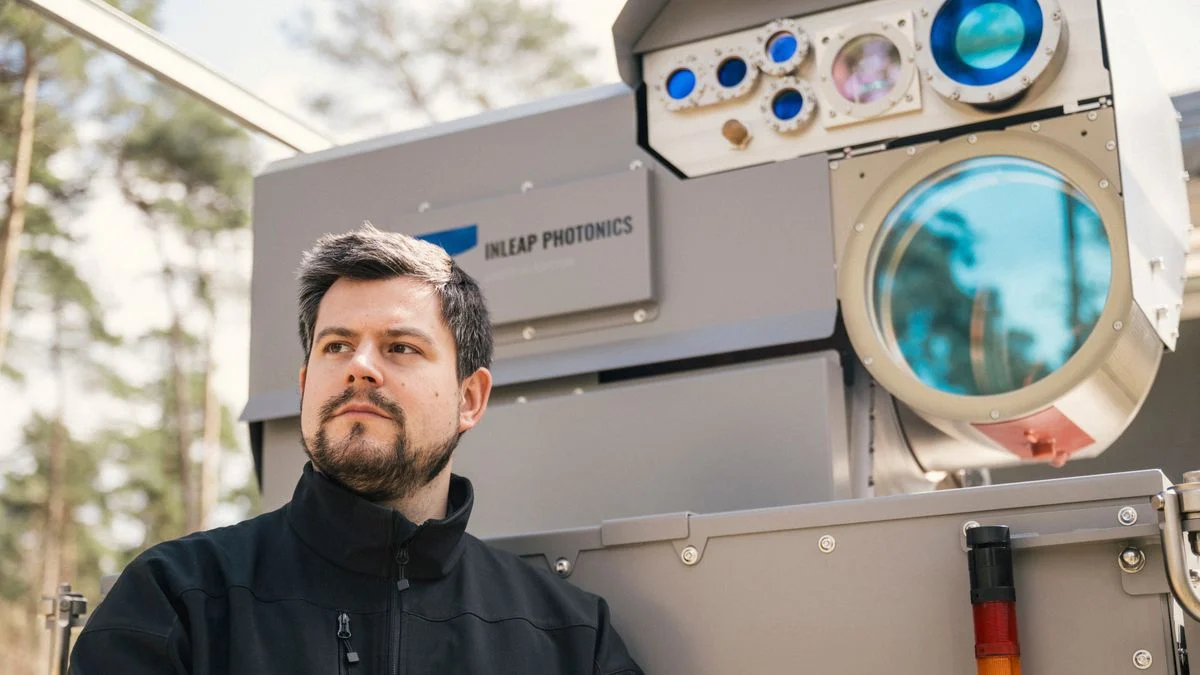
In the quiet, rolling landscape of the Lower Saxon countryside, where the rhythm of life is dictated by the slow grazing of horses and the seasonal harvest, a silent revolution is taking place. Behind a nondescript, barbed-wire-topped steel gate, far from the prying eyes of the public and potential industrial spies, the future of modern warfare is being tested. Here, Marius Lammers, the 33-year-old CEO of the Hannover-based startup Inleap Photonics, is refining a technology that could fundamentally alter the tactical landscape of the battlefield: a high-precision laser weapon designed to neutralize the growing threat of unmanned aerial vehicles (UAVs).
The Main Facts: Precision at the Speed of Light
The device, mounted on a standard trailer, appears unassuming at first glance. It is a roughly two-meter-tall gray apparatus, distinguishable primarily by a large, bluish-shimmering glass lens. This lens is the heart of the system—the aperture through which high-energy laser beams are emitted to intercept and disable hostile drones with surgical precision.
Unlike traditional kinetic air-defense systems, which rely on projectiles that are expensive, heavy, and potentially dangerous to civilian infrastructure due to collateral damage, the Inleap Photonics system offers a "soft-kill" or "hard-kill" capability that is both cost-effective and remarkably accurate. As the drone hovers in the distance, the laser locks onto its target, focusing energy onto a singular point to compromise the drone’s structural integrity or its sensitive electronic sensors.
The system operates in near-total silence, powered by a modest diesel generator that rumbles on the forest floor—a stark contrast to the thunderous roar of traditional artillery.
A Chronology of Innovation
The path to this testing ground has been one of iterative development and rigorous engineering.
- Phase 1: Conceptualization. Recognizing the proliferation of low-cost, off-the-shelf drones in conflicts ranging from the Middle East to Eastern Europe, Lammers and his team at Inleap Photonics began mapping the vulnerabilities of small-scale UAVs.
- Phase 2: Laboratory Prototyping. The team spent months in their Hannover labs, refining the beam-steering optics. The challenge was not just creating the laser, but ensuring it could track a rapidly moving, erratic target at significant distances.
- Phase 3: Field Testing. The move to the Lower Saxon site marked the transition from theoretical physics to practical application. Here, they have spent the last few months subjecting the system to "real-world" weather conditions, testing its efficacy against various drone models, ranging from slow-moving quadcopters to high-speed fixed-wing surveillance drones.
- Current State: The company is now in the optimization phase, fine-tuning the target acquisition algorithms and hardening the system against environmental variables such as humidity, fog, and light refraction.
Supporting Data: The Drone Threat Landscape
The urgency behind Inleap Photonics’ work is underscored by the shifting nature of modern security. The "democratization of the air" has allowed non-state actors and smaller military units to acquire surveillance and strike capabilities that were once the exclusive domain of superpowers.
Recent data from global conflict zones indicate that:
- Cost Asymmetry: A military-grade missile costing $100,000 is often deployed to intercept a drone that costs less than $500. This economic imbalance is unsustainable for defense budgets. Laser systems like Inleap’s reduce the cost-per-shot to virtually the price of the electricity used.
- Saturation Tactics: Modern defense systems are often overwhelmed by "swarms" of drones. Laser weapons offer a virtually unlimited magazine, limited only by power supply, allowing for rapid-fire engagement that kinetics cannot match.
- Collateral Mitigation: Laser beams travel in straight lines and dissipate quickly, minimizing the risk of "falling debris" or unexploded ordnance landing in populated areas, a common concern with traditional interceptor missiles.
Official Responses and Industry Perspectives
While Inleap Photonics remains tight-lipped about specific contracts, the broader defense sector has taken notice. Military analysts suggest that the German startup is part of a "second wave" of defense innovation—small, agile companies that are successfully integrating dual-use technologies for defense applications.
"The industry is moving away from massive, monolithic platforms toward modular, scalable solutions," says Dr. Elena Fischer, an analyst at the European Institute for Defense Research. "What Lammers is doing in Lower Saxony is the archetype of this shift. They aren’t trying to build a tank; they are building a specialized tool that solves a specific, acute problem."
However, the path to commercialization remains fraught with regulatory hurdles. Export controls on dual-use technology, stringent safety certifications for laser operations, and the long-term process of military procurement mean that Inleap must navigate a bureaucratic labyrinth even as they perfect their hardware. The company maintains that its focus remains on defensive applications—protecting critical infrastructure, borders, and personnel from unauthorized aerial intrusion.
Implications for Future Warfare
The implications of the Inleap Photonics project extend far beyond the small clearing in the woods.
The Shift in Tactical Doctrine
If the Inleap system proves effective at scale, it will necessitate a rethink of how militaries approach air defense. We are entering an era where "air supremacy" is no longer solely contested by manned fighter jets, but by an invisible war of electromagnetic spectrums and light-based weapons.
The Ethical and Legal Dimension
The use of laser weapons brings forth significant ethical questions. While lasers are often marketed as "humane" because they are precise, the potential for permanent eye damage to anyone in the vicinity of a beam—or even its reflection—poses significant safety challenges. Furthermore, the ability to "blind" or destroy surveillance assets without an audible warning creates a new layer of ambiguity in international skirmishes.
Economic Sovereignty
For Germany and the European Union, the success of companies like Inleap is a matter of strategic autonomy. By developing sovereign capabilities in high-energy laser technology, Europe reduces its reliance on non-European defense manufacturers, ensuring that the critical infrastructure of the continent is protected by locally developed, reliable technology.
Conclusion: The Quiet Revolution
As the sun sets over the Lower Saxon forest, the test team packs away their equipment. The generator is silenced, the trailer is covered, and the site returns to its serene, pastoral state. Marius Lammers, checking the data logs on his laptop, remains focused. The journey from a garage startup to a key player in European defense is long, and the challenges are immense.
Yet, as the drone threat continues to evolve, growing faster, smarter, and more autonomous, the work being done in this secret location becomes increasingly vital. Whether the Inleap Photonics laser becomes the standard-issue shield for the modern military remains to be seen. But one thing is clear: the future of defense is being written not in the grand halls of massive corporations, but in the quiet, methodical testing of new ideas, far from the cameras, in the heart of the German countryside.
The "bluish-shimmering lens" is not just a piece of glass; it is a lens into a future where the sky is once again secure, guarded by the silent, relentless speed of light.