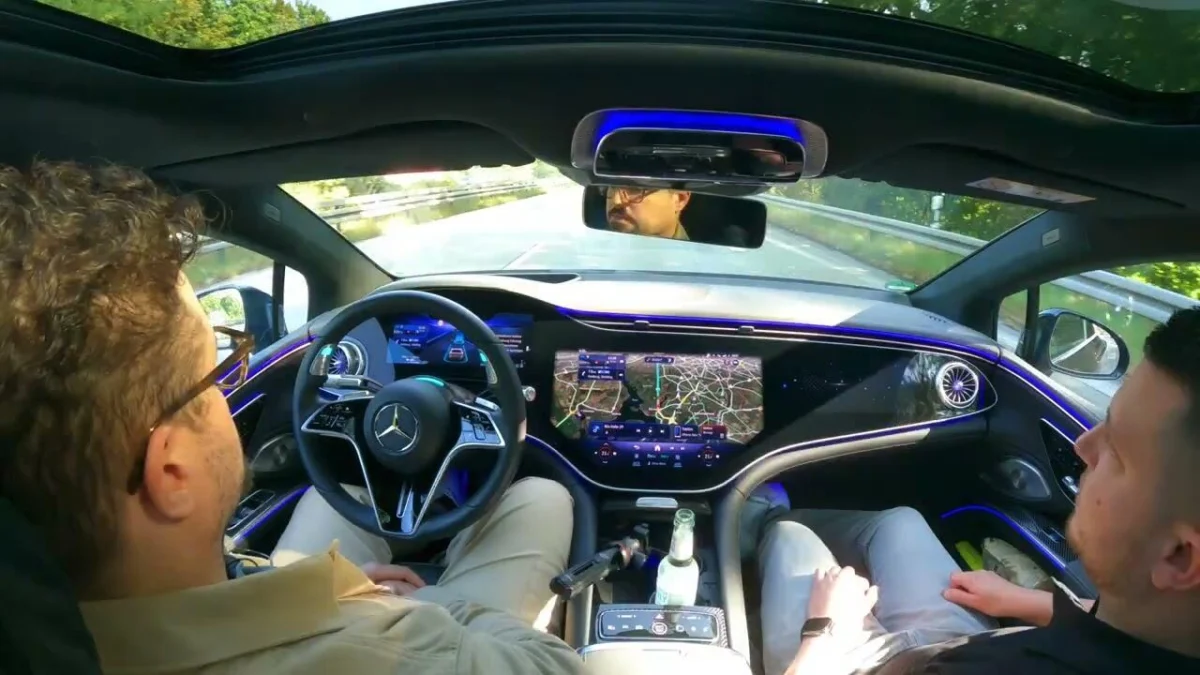
In a move that signals a fundamental shift in the automotive landscape, Mercedes-Benz and Nvidia have announced a significant expansion of their long-standing partnership. By integrating Mercedes’ proprietary MB.OS operating system with Nvidia’s cutting-edge Hyperion platform, the Alpamayo AI stack, and the Halos safety architecture, the two companies aim to accelerate the transition from Level 2+ driver assistance to full SAE Level 4 autonomous driving within the coming decade.
This collaboration is not merely a supplier agreement; it represents a deep technological synthesis. It encompasses everything from the in-car computing architecture to the digital twin simulation of production lines, reflecting the immense complexity involved in bringing reliable, "eyes-off, mind-off" autonomous driving to public roads.
The Technological Architecture: A Multi-Layered Approach
The synergy between Mercedes-Benz and Nvidia is built on a modular, software-defined architecture. At its core, the collaboration focuses on four primary pillars:
1. MB.OS and the Hyperion Platform
Mercedes-Benz’s MB.OS serves as the central nervous system of the vehicle. By coupling this with Nvidia’s Hyperion platform, the partners have created a robust foundation for high-performance computing and sensor data processing. Hyperion provides the hardware backbone, including the high-speed processors and camera/LiDAR sensor suites necessary to perceive the environment in real-time.
2. The Alpamayo Stack: Intelligent Reasoning
A critical component of this expansion is the Alpamayo stack. Unlike traditional rule-based driving assistants, Alpamayo introduces advanced AI reasoning capabilities. This allows the vehicle to navigate complex urban environments, handle point-to-point routing, and perform sophisticated parking maneuvers. The software is designed to "learn" from vast amounts of data, enabling the vehicle to make human-like decisions in unpredictable traffic scenarios.
3. Halos: The Safety Sentinel
Safety is the primary hurdle for Level 4 autonomy. To address this, the partners are introducing the "Halos" safety system. Halos functions as an independent, secondary safety stack that runs parallel to the primary autonomous driving software. In the event of a system fault or a conflict in the primary stack, Halos provides immediate redundancy and fail-safe mechanisms, ensuring the vehicle can reach a "minimal risk condition" (such as pulling over safely) without human intervention.
4. Beyond the Road: The MO360 Ecosystem
The scope of the partnership extends beyond the driving experience. Nvidia’s simulation technologies are being integrated into the Mercedes-Benz MO360 production ecosystem. By creating digital twins of factories and assembly lines, Mercedes can simulate manufacturing workflows, optimize logistics, and enhance quality control before a single physical component is moved. This integration aims to bring the same level of digital precision to the production line that they are applying to the road.
Chronology: A Relationship Built on Iteration
The current announcement is the latest milestone in a partnership that has matured significantly since its inception.
- 2020: The Foundation: Mercedes-Benz and Nvidia first revealed their intent to collaborate, promising to create a unified computing architecture for all next-generation vehicles.
- 2021: Level 3 Milestone: Mercedes-Benz secured the world’s first international regulatory approval for a Level 3 "Drive Pilot" system, marking a watershed moment in the industry.
- 2022: Deployment: The Drive Pilot system launched in Germany for the S-Class and EQS, allowing for hands-off driving at speeds up to 60 km/h under specific conditions.
- 2024: Pushing Boundaries: The German Federal Motor Transport Authority (KBA) approved a version of Drive Pilot capable of operating at up to 95 km/h.
- 2026 and Beyond: Despite the technical success of the Drive Pilot, the industry has seen a pivot. Mercedes-Benz’s decision to remove the current iteration of the system from its 2026 S-Class lineup suggests a move toward a more comprehensive, integrated platform—the very one being developed now with Nvidia.
The Evolution of the "Drive Pilot" and Industry Shifts
The history of the "Drive Pilot" serves as a microcosm for the broader challenges of the autonomous vehicle (AV) sector. Initially hailed as a revolutionary step for luxury commuters, the system’s limited availability and operational design domain (ODD) constraints—primarily restricted to specific highway sections—highlighted the gap between Level 3 "conditional automation" and true Level 4.
The transition away from the original Drive Pilot setup indicates that Mercedes-Benz is moving toward a more scalable, software-centric approach. By integrating the Alpamayo stack and moving away from legacy hardware configurations, the company is preparing for a future where autonomous features are delivered as over-the-air (OTA) updates, rather than fixed-feature hardware packages.
Implications for the Future of Mobility
The partnership between Mercedes and Nvidia has profound implications for the automotive market, particularly regarding the concept of the "Robotaxi."
1. The Quest for Level 4
Level 4 autonomy, by definition, implies that the vehicle can handle all aspects of the driving task in specific areas or conditions without any expectation of human intervention. This is the "holy grail" of the industry. The combination of Nvidia’s AI reasoning and Mercedes’ rigorous safety engineering aims to solve the "edge cases"—the rare, unpredictable events that currently prevent cars from driving themselves in city centers.
2. Software-Defined Vehicles (SDVs)
The shift toward MB.OS underscores the reality that the modern vehicle is increasingly a computer on wheels. The competitive advantage no longer lies solely in engine performance or chassis dynamics, but in the speed of the software update cycle. By partnering with Nvidia, Mercedes ensures it remains at the forefront of the AI-driven vehicle revolution, maintaining its reputation for luxury while pivoting to a tech-first identity.
3. Economic and Production Efficiency
By utilizing Nvidia’s simulation tools within the MO360 production system, Mercedes-Benz is likely to see significant cost reductions in R&D. Testing autonomous algorithms in a virtual, high-fidelity environment is orders of magnitude faster and safer than logging millions of physical test miles. This creates a feedback loop: better simulation leads to better software, which leads to more efficient production, creating a barrier to entry that smaller or less integrated manufacturers will find difficult to overcome.
Official Stance and Market Outlook
While both companies remain tight-lipped about the exact financial specifics of the expanded deal, the strategic intent is clear. Mercedes-Benz executives have repeatedly stated that they view software as the future of the brand, while Nvidia continues to cement its role as the "picks and shovels" provider for the AI revolution in the automotive space.
Industry analysts observe that this partnership is a direct response to the pressure from both pure-play EV manufacturers and traditional competitors who are also racing to solve the autonomy puzzle. The collaboration is not merely about beating rivals to the market; it is about establishing a standard for safety and performance that will define consumer expectations for the next decade.
As the industry moves toward 2030, the collaboration between Mercedes-Benz and Nvidia serves as a critical indicator of where the money and the engineering talent are flowing. While the dream of fully autonomous, "mind-off" travel in any environment remains a formidable technical challenge, the alignment of high-performance hardware, advanced AI stacks, and redundant safety architectures provides the most viable path forward.
For the end consumer, this means the car of the future will not just be a vehicle, but a constantly evolving digital companion—capable of handling the drudgery of traffic, optimizing its own performance, and, eventually, allowing the driver to become a passenger. The road to Level 4 is long and fraught with regulatory and technical complexities, but the combined might of Mercedes-Benz and Nvidia suggests that the destination is within reach.