The political climate in Berlin has reached a fever pitch as the city moves toward a potential red-green-red coalition government. However, the discourse surrounding these negotiations has transcended standard policy disagreement, morphing into a high-octane campaign of existential dread. Leading the charge against this prospective alliance is the Christian Democratic Union (CDU/CSU), which has adopted a rhetorical strategy that analysts argue is increasingly indistinguishable from the far-right Alternative for Germany (AfD).
Main Facts: The New Berlin Coalition and the Union’s Backlash
As negotiations for a left-leaning government in the German capital gain momentum, the conservative Union has responded with a barrage of apocalyptic warnings. Figures within the CDU/CSU describe the impending coalition not as a legitimate democratic process, but as an existential threat to the rule of law and the fundamental structure of the German state.
The core of the Union’s grievance focuses on the policy agenda of the prospective coalition, which includes potential socializations of housing corporations and efforts to expand local voting rights for long-term foreign residents. While these are common subjects of democratic debate, the Union has framed them as evidence of an orchestrated attempt to undermine German society. Critics point out that this hyperbolic framing mirrors the "great replacement" conspiracy theories often championed by the far-right, signaling a significant shift in the Overton window of conservative discourse.
Chronology of Escalation
The hardening of the Union’s stance did not happen overnight. It is the result of a calculated shift in messaging that has unfolded over several months:
- Early Negotiations: As SPD, Greens, and The Left (Die Linke) entered initial coalition talks, the Union immediately framed the potential partnership as a "taboo break."
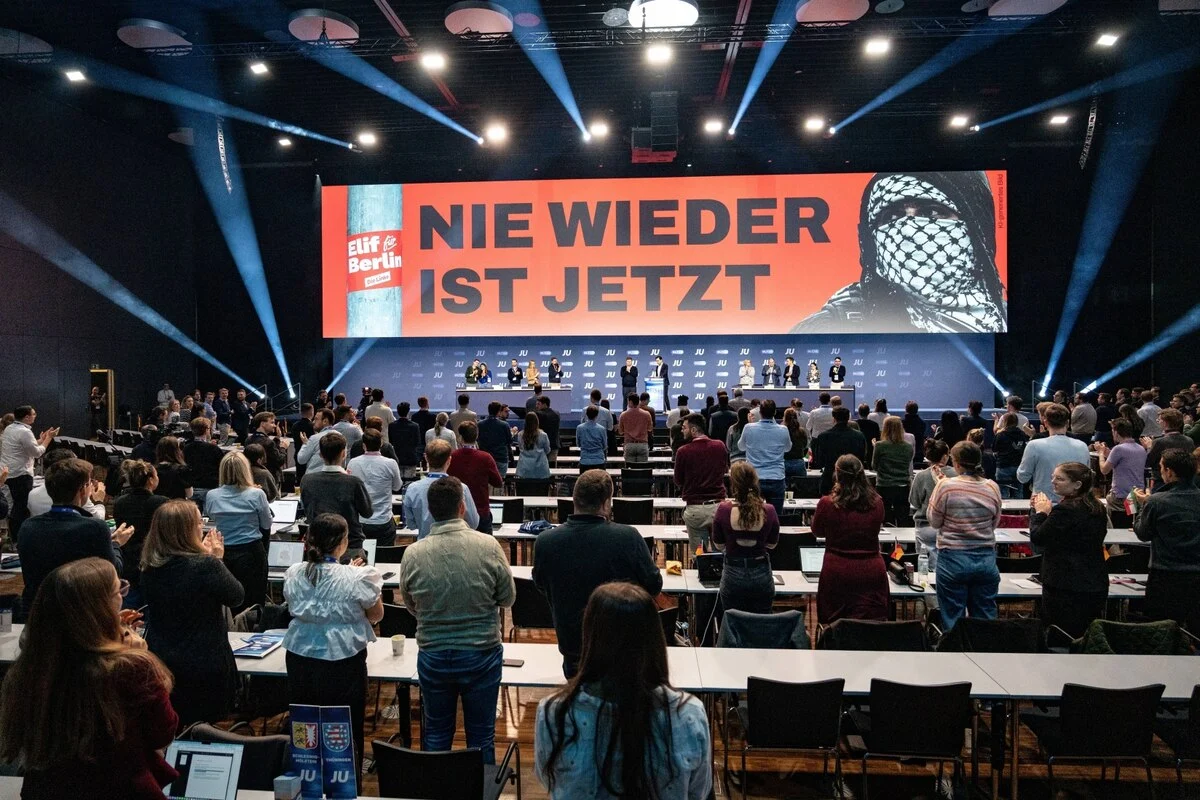
- The "Deutschlandtag" Incident: During the Young Union’s (JU) annual convention, a banner depicting a person wearing a Kufiya alongside a photo of Berlin’s top Left party candidate, Elif Eralp, was displayed. The accompanying slogan, "Never again is now," weaponized Holocaust remembrance to delegitimize political opponents.
- The "Brandmauer" (Firewall) Rhetoric: CSU leader Markus Söder escalated the tension by calling for a "firewall to the left," suggesting that fiscal sanctions (an "extremism clause") should be imposed on Berlin should they pursue policies like the socialization of property.
- Ministerial Hyperbole: Federal Interior Minister Alexander Dobrindt (CSU) labeled the coalition plans an "experimental field for left-wing extremist and clan-criminal milieus," effectively conflating democratic policy proposals with criminal activity.
- Digital Disinformation: The Mittelstands- und Wirtschaftsunion (MIT) in Potsdam recently shared a doctored image of Berlin’s Red City Hall adorned with hammer-and-sickle symbols and minarets, declaring the "’Jewish Question’ settled, now we expropriate," a move widely condemned as both antisemitic and alarmist.
Supporting Data: Examining the Claims vs. Reality
The Union’s campaign relies on the premise that the incoming coalition is a radical departure from the German democratic tradition. However, objective analysis of the policies under fire reveals a different story:
1. The Question of Socialization
The proposal to socialize large housing corporations is rooted in Article 15 of the German Basic Law (Grundgesetz), which explicitly permits the socialization of land and natural resources. It is, by definition, a constitutional mechanism. Labeling it an "attack on the state" is a fundamental mischaracterization of the legal framework.
2. Voting Rights for Non-EU Residents
The proposal to grant municipal voting rights to long-term residents from outside the EU is a common practice in various European democracies. Similar models exist in countries such as Sweden, Denmark, and the Netherlands, none of which have experienced the systemic collapse of public order that conservative politicians warn would befall Berlin.
3. The Antisemitism Consensus
While the Left party has faced valid criticism regarding its handling of antisemitic rhetoric within its own ranks, the parties involved in the coalition have signed a formal agreement pledging to address these issues through established mechanisms. To equate a formal government negotiation with "state-sponsored antisemitism" ignores the actual efforts being made to establish a unified front against hate.
Official Responses and Political Implications
The intensity of the Union’s campaign has drawn sharp criticism from political scientists and opposition parties, who warn that the CDU is inadvertently—or perhaps intentionally—normalizing the rhetoric of the far-right.
The Normalization of Extremism
"The danger," notes one political analyst, "is not just that the Union is overplaying its hand, but that it is preparing the ground for a real shift." By adopting the vocabulary of the far-right—talking about the "exchange of the electorate" or "Islamization"—the Union risks legitimizing narratives that they once claimed to firmly reject.
The "Thuringia" Paradox
The Union’s claims of an existential threat are further weakened by their own track record. In Thuringia, the Left party previously held the premiership and currently supports a CDU-led minority government. If the Left is a "threat to democracy," the Union’s cooperation with them in other states becomes a logical contradiction.
The Risk to the "Firewall"
Perhaps the most significant implication of the Union’s current trajectory is the weakening of the "firewall" against the AfD. As the CDU/CSU shifts its focus to attacking the center-left with extreme rhetoric, it has been observed cooperating with the AfD on localized issues in Bundestag committees and district councils. In some regions, the party has even joined forces with the far-right to remove commemorative Stolpersteine (memorial stones for Holocaust victims), raising serious questions about the party’s commitment to its own historical values.
Conclusion: A Dangerous Path Forward
The rhetoric deployed by the Union in the lead-up to the Berlin coalition suggests a party in the midst of a identity crisis. By choosing to combat the democratic left with the tools of the extremist right, the CDU/CSU is not merely playing politics; it is eroding the foundational consensus of the Federal Republic.
When democratic parties are portrayed as enemies of the state for exercising their right to form coalitions, the concept of "democratic competition" is replaced by a binary of "us versus them." If the Union continues to prioritize populist outrage over substantive policy debate, they may find that they have not only failed to stop the red-green-red coalition but have also fundamentally compromised their own role as a guardian of the liberal, democratic order.
The stability of German democracy relies on the ability of its major parties to distinguish between policy disagreement and existential enmity. In its current, agitated state, the Union appears to be losing that distinction, and in doing so, they are creating a political environment where the boundaries of acceptable discourse are becoming dangerously blurred. Whether this is a short-term tactical error or a long-term strategic realignment remains to be seen, but the consequences for the German political landscape are already becoming alarmingly clear.