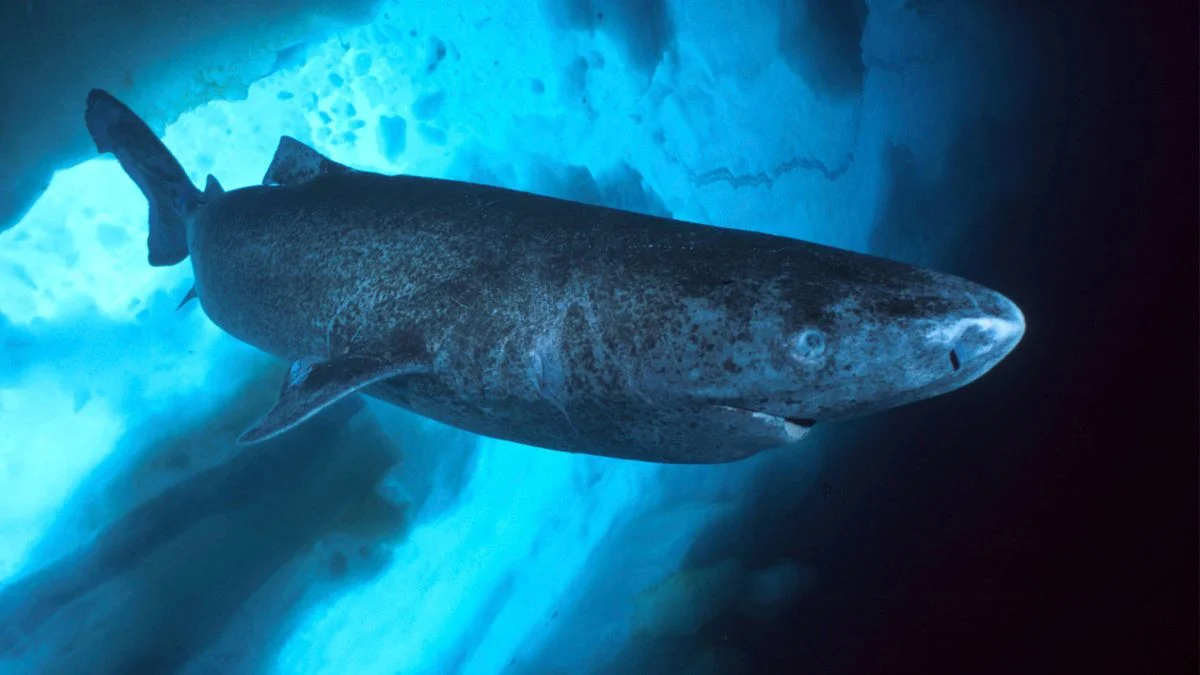
In a rare and somber discovery that has captivated the marine science community, the carcass of a Greenland shark (Somniosus microcephalus) was discovered washed ashore on the coast of County Sligo, Ireland. The arrival of this deep-sea titan, a species that typically dwells in the crushing pressures and freezing darkness of the high Arctic, has provided researchers with a unique, albeit tragic, opportunity to study one of the most enigmatic creatures on the planet.
For the members of the Irish Whale and Dolphin Group (IWDG), who are accustomed to responding to strandings of whales and dolphins, the sight of a Greenland shark was unprecedented. Despite the frequency with which marine life washes up on Ireland’s rugged Atlantic coastline, there is no record of a Greenland shark ever being documented in these waters before. The discovery has launched a comprehensive forensic investigation by the National Museum of Ireland, revealing a story of a life that spanned centuries—a life that ended prematurely in a place it should never have been.
A Life Measured in Centuries: The Chronology of an Ancient Resident
The Greenland shark is a creature of superlatives. Known for their extreme longevity, these animals are the longest-living vertebrates on Earth. Initial biological assessments of the three-meter-long, 200-kilogram specimen found in Sligo suggest that the shark was between 150 and 200 years old.
To put this lifespan into historical perspective, this shark may have been born in the mid-19th century, potentially during the era of the American Civil War or the height of the British Victorian period. It lived through the industrial revolution, two World Wars, and the dawn of the digital age—all while remaining in the slow-motion, frigid depths of the North Atlantic.
Despite its advanced age by human standards, the shark was effectively in the prime of its youth. According to marine biologists, Greenland sharks do not reach sexual maturity until they are approximately 150 years old. This particular individual had only just reached the threshold of adulthood when its life was cut short, potentially robbing it of another 200 to 300 years of existence. Scientists estimate that these creatures can live for up to 500 years, making them living witnesses to half a millennium of history.

Biological Marvels: Anatomy of a Deep-Sea Scavenger
The examination of the shark’s remains has offered scientists a rare window into its physiological adaptations. During the necropsy, researchers were struck by the sheer scale of the creature’s internal anatomy. Its heart, a massive organ required to pump blood through a slow-moving body in freezing temperatures, weighed 34 kilograms, while its liver—an essential component for buoyancy and energy storage in deep-sea sharks—tipped the scales at 50 kilograms.
Dr. Jasmine Stavenow Jerremalm, one of the researchers involved in the analysis, highlighted the shark’s highly specialized feeding apparatus. Greenland sharks are known to be opportunistic scavengers, feeding on carcasses that drift down to the ocean floor, regardless of the state of decay.
"Its teeth were perfectly adapted for this task," Dr. Stavenow Jerremalm noted. "The upper teeth were sharp and straight, designed to grip, while the lower teeth were serrated and angled in two different directions, functioning essentially like a biological saw. This allows them to carve substantial chunks of flesh from carcasses on the seafloor, ensuring they survive in environments where food is notoriously scarce."
The Unanswered Question: A Forensic Puzzle
Despite a meticulous necropsy, the cause of the shark’s death remains a haunting mystery. Researchers inspected the animal for external injuries, such as entanglement in fishing nets or propeller strikes from maritime vessels, but found no evidence of trauma that would explain its demise.
Internal investigations revealed some anomalies: a twisted testicle and an unusually discolored spleen. However, experts are hesitant to label these as the primary cause of death, as the animal appeared otherwise healthy and well-nourished. The lack of an obvious cause of death suggests that the shark may have succumbed to a silent, internal illness, or perhaps an environmental factor that remains hidden from standard forensic examination.

"We were all filled with awe," said Emilie De Loose, a marine biologist with the IWDG. "When you consider the sheer amount of time this creature has spent in the ocean, the places it has traveled, and the things it has witnessed, the loss feels profound. It had so much life left to live."
Implications for Marine Conservation
The presence of a Greenland shark in Irish waters raises significant questions about climate change and shifts in marine migration patterns. Greenland sharks are typically found in temperatures ranging from -1°C to 10°C, predominantly in the Arctic and sub-Arctic regions. As the world’s oceans warm, species that are highly sensitive to thermal changes may be forced to migrate further south in search of cold-water refuges.
However, researchers caution against drawing premature conclusions. While this may be a sign of shifting ecosystems, it could also be a solitary case of an animal that strayed from its migratory path due to illness or navigation error. The IWDG and the National Museum of Ireland are currently conducting further toxicological and genetic tests on the harvested organs, hoping that the tissue samples will provide the final piece of the puzzle.
A Legacy of Mystery
The death of this Greenland shark serves as a poignant reminder of how little we still know about the deep ocean. These creatures spend their lives in the "midnight zone," thousands of meters below the surface, far removed from human interference. They are the silent sentinels of the North Atlantic, existing in a realm that is largely inaccessible to human exploration.
For the scientific community, the data gleaned from this specimen is invaluable. It provides a baseline for understanding the health, diet, and biology of a species that is notoriously difficult to track. Yet, for the public, the story of the shark is one of existential reflection. It represents a link to the past, a creature that has persisted for generations, only to vanish on a beach in County Sligo.

"It is truly a tragedy," added De Loose. "This individual spent 150 years navigating the deep, only to reach a point where it could finally contribute to the continuity of its species, and it never got the chance. It leaves us with a profound sense of loss, and a renewed commitment to understanding and protecting these ancient travelers of the deep."
As the investigations continue, the remains of the shark are being preserved for research and potential display. Its story will undoubtedly continue to be told, serving as a reminder that the mysteries of the deep sea are vast, and that even the oldest and most resilient creatures are not immune to the uncertainties of the modern world.