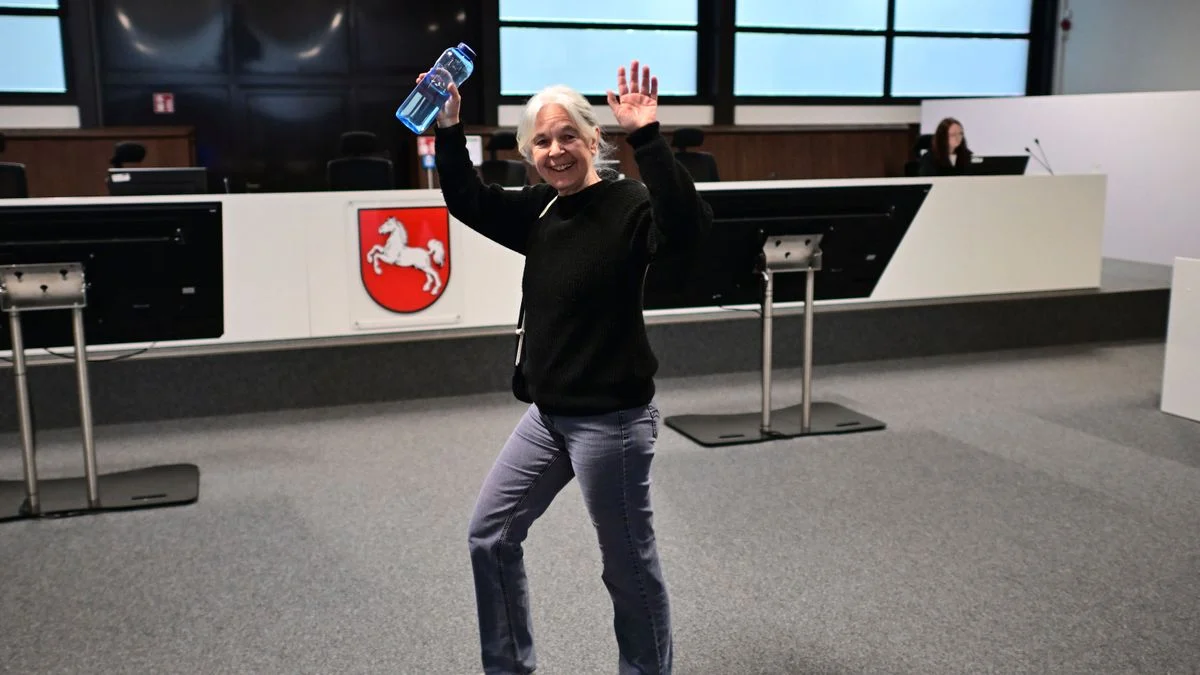
The scene at the district court in Verden, Lower Saxony, serves as a stark reminder of the long, lingering shadows cast by West Germany’s most notorious militant past. Inside a courtroom converted from a riding arena to accommodate the high-security requirements, 67-year-old Daniela Klette—once a key figure in the “third generation” of the Red Army Faction (RAF)—appeared before the bench. As she entered, the atmosphere was thick with tension; half the public gallery rose in a show of solidarity, applauding a woman they view not as a common criminal, but as a political icon of the underground resistance.
Klette, smiling and waving to her supporters, projected a defiance that has defined her decades in hiding. Yet, beyond the performative support of the autonomous scene, the reality of the courtroom is defined by the grim nature of the charges: violent armed robberies and attempted murder, not the historical acts of terror for which the RAF was originally infamous.
The Core Allegations: A Life in the Shadows
While her supporters celebrate her as an elusive revolutionary who successfully evaded state authorities for over 30 years, the prosecution’s case is grounded in cold, forensic evidence. Daniela Klette is not currently standing trial for the bombings and assassinations that defined the RAF’s peak in the 1970s and 80s. Instead, she faces a string of charges spanning from 1999 to 2016.
Prosecutors allege that Klette, alongside her long-time accomplices Ernst-Volker Staub and Burkhard Garweg—both of whom remain at large—orchestrated a series of violent raids. The targets were predominantly cash-in-transit vehicles and supermarket cash offices. The methods were professional and brutal: the group allegedly utilized heavy weaponry and masks to intimidate guards and employees, netting over two million euros.
The state argues that these were not ideological acts of resistance, but pragmatic, criminal endeavors designed to bankroll the trio’s existence in the underground long after the RAF had officially declared its self-dissolution in 1998. The forensic breakthrough that led to her arrest occurred when investigators matched DNA evidence found in a burned-out getaway vehicle to Klette, Staub, and Garweg, finally shattering the anonymity she had meticulously maintained.
A Chronology of Evasion and Discovery
To understand the gravity of the current proceedings, one must look back at the timeline of the RAF’s final chapter and Klette’s improbable decades of invisibility:

- 1998: The RAF officially declares its dissolution, yet its most prominent members—including Klette—do not surrender to authorities.
- 1999–2016: A long, silent period of high-stakes criminal activity. The "RAF trio" is linked to multiple armed robberies across Lower Saxony and North Rhine-Westphalia, characterized by their clinical, military-style execution.
- 2020–2023: Advances in DNA sequencing and facial recognition technology provide German investigators with new leads. The search intensifies, leading to public appeals and media pressure.
- February 2024: After decades of living under a false identity in Berlin, Daniela Klette is apprehended in a raid on her apartment. Her capture sends shockwaves through the German security apparatus.
- March 2025: The trial begins in Verden. The courtroom is transformed into a high-security fortress, reflecting the continued threat posed by the remaining fugitives and the sensitivity of the trial.
The Courtroom Atmosphere: A Clash of Ideologies
The scene at the Verden courthouse was a microcosm of the polarized view of the RAF in modern German society. As Klette entered the room, the divide was visible: one side of the gallery stood in applause, while the other—comprising legal representatives and journalists—observed the proceedings with professional detachment.
The court, following standard legal procedure, ordered everyone to stand as the judges entered—an act of acknowledging the authority of the German state. While most complied, some supporters of Klette remained seated, necessitating explicit instructions from court officials. This small act of civil disobedience underlined the core friction of the trial: the defendant and her followers reject the legitimacy of the judicial system, while the state seeks to finally close a dark chapter of its post-war history through the rule of law.
Klette, who has spent the last two years in investigative detention, appears remarkably prepared for this moment. Sources indicate she has drafted a 30-page handwritten statement, a manifesto of sorts that she intends to deliver in her own defense. Whether this document will be a factual rebuttal of the robbery charges or a broader ideological statement remains to be seen.
Supporting Data and Security Implications
The security measures surrounding the Verden trial are unprecedented for a case involving robberies. Heavily armed police officers with submachine guns patrol the perimeter, and the site is under constant surveillance. The regional authorities are operating under the highest security level, not only because of the risk of potential rescue attempts by the radical left but because of the status of the two remaining fugitives.
The presence of Staub and Garweg, who remain at large, turns the trial into a manhunt as much as a criminal proceeding. Every witness statement and every piece of evidence presented is analyzed for clues that might lead to the arrest of the final two members of the “third generation.” The cost of the security operation, combined with the duration of the trial, underscores the state’s determination to demonstrate that there is no "statute of limitations" on justice for violent crimes.
Official Responses and Public Discourse
Government officials have framed the capture and trial of Klette as a triumph of modern investigative techniques and a victory for the rule of law. Interior Minister Nancy Faeser has consistently reiterated that the state will not rest until all members of the RAF have been brought to justice.

Conversely, the public discourse remains divided. For the generation that lived through the "German Autumn" of 1977, Klette’s trial is a moment of closure. For younger members of the autonomous scene, her trial is a rallying point against what they perceive as the overreach of the state. Critics of the state’s handling of the case point to the decades-long failure to locate Klette as evidence of incompetence, while proponents argue that the persistence required to eventually catch her demonstrates the state’s unwavering commitment to accountability.
The Long-term Implications
The conviction of Daniela Klette—which appears increasingly likely given the forensic evidence—would mark the symbolic end of the RAF. While it will not erase the trauma of the past, it provides a legal conclusion to a period of history that has haunted German justice for over half a century.
The trial also highlights the evolution of the German judiciary. By focusing on the robberies rather than the historical terrorist activities, the court is avoiding a politicized spectacle, opting instead to treat Klette as a perpetrator of modern violent crime. However, by allowing her to speak, the court acknowledges the political weight of her past.
As the trial moves toward its conclusion, the focus will remain on the 30 pages of testimony Klette has prepared. Whether she chooses to express remorse or remains defiant will determine how history remembers her: as a tragic figure lost in a failed revolution, or as a common criminal who hid behind a fading ideology to fund a life of violence. Regardless of the outcome, the Verden trial serves as a final, resonant note in the long, discordant symphony of the Red Army Faction.