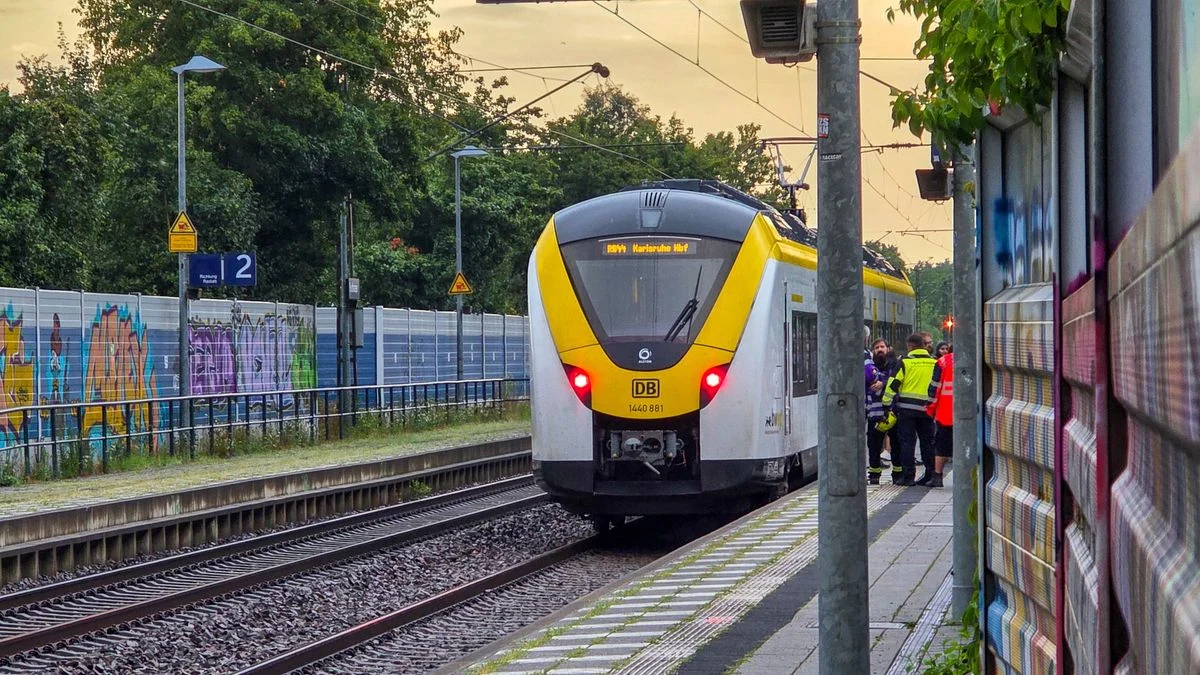
The high-speed rail network is designed for safety, precision, and efficiency. Yet, the tranquility of a routine journey near Karlsruhe was shattered by an event that defies immediate logic: a railway employee falling from a moving train while it was traveling at 120 kilometers per hour. As investigations into the incident continue, the rail industry, labor unions, and the public are left grappling with a harrowing question: How could such a catastrophic failure of safety protocols occur in a system governed by strict operational standards?
Main Facts: A Routine Shift Turned Fatal
The incident occurred on a standard regional rail corridor near Karlsruhe, Germany. Reports confirm that a staff member, tasked with duties inside the train, exited the vehicle while it was in motion. At a velocity of 120 km/h, the impact with the external environment is almost invariably fatal, and in this instance, emergency services arriving at the scene were unable to save the individual.
The primary focus of the ongoing investigation is the mechanism of the door systems and the protocols governing staff movement between cars or access to external areas. Modern trains are equipped with sophisticated interlocking systems—electronic safeguards that prevent doors from opening while the train is in motion. The investigation is now shifting toward whether there was a mechanical override, a human error, or a systemic failure in the hardware that allowed access to the outside of the train at high speed.
Chronology: The Sequence of Events
While the full forensic report is pending, the timeline of the day suggests a standard operational day that escalated into a crisis in a matter of seconds.
- Pre-departure: The train underwent standard technical checks. No mechanical anomalies were reported, and the train was certified for service.
- The Journey: The train departed on time, moving through the Karlsruhe region. The staff member was performing routine duties.
- The Incident: Eyewitness accounts and sensor data indicate the fall occurred between two stations. The train was maintaining a steady speed of 120 km/h.
- Emergency Response: Upon the detection of an open-door alarm or a sudden drop in pressure/personnel check failure, the train was brought to an emergency stop.
- Immediate Aftermath: First responders, including federal police and paramedics, were dispatched to the site. The area was cordoned off for several hours, leading to significant disruption of the regional rail network.
Supporting Data: Safety Protocols and Mechanical Interlocks
To understand the magnitude of this tragedy, one must look at the rigorous safety standards of the German rail system. Modern European trains utilize a "speed-dependent interlock" (Sicherheitsverriegelung). This system is designed so that the door control unit (DCU) receives speed data from the train’s computer. If the velocity is above a nominal threshold—usually 5 km/h—the command to unlock or open a door is physically ignored by the hardware.
However, the question remains: Did the victim have a reason to access a service door or a maintenance hatch? These areas are strictly off-limits to passengers and subject to additional security measures for staff. Data from similar historical incidents suggest that when such an event occurs, investigators look for "shadow scenarios"—rare instances where sensors fail to report speed correctly, or where a manual override was engaged for maintenance purposes but not properly disengaged.
Official Responses: The Investigation Gains Momentum
The German Federal Railway Authority (Eisenbahn-Bundesamt) has launched a formal inquiry. Their statement emphasized that the priority is to determine if this was an isolated mechanical failure or a systemic vulnerability that requires an urgent recall or software update across the fleet.
"We are conducting a thorough forensic analysis of the train’s data logs," a spokesperson for the rail operator stated. "Our cooperation with the police and the state prosecutor’s office is absolute. Our deepest condolences go out to the family of our colleague. We are committed to uncovering the truth, regardless of where the findings lead."
The labor unions have also spoken out, demanding a review of lone-worker policies. They argue that if an employee is working in a high-risk area of the train, there must be secondary checks or "dead-man’s switches" that prevent doors from being opened even if the primary system is bypassed.
Implications: The Future of Rail Safety
The ramifications of this incident extend far beyond the legal proceedings. The rail industry is currently undergoing a period of intense modernization, with increased automation in train operations. This tragedy serves as a grim reminder that as we rely more on automated sensors, we must ensure the "human-in-the-loop" safety protocols remain robust.
1. Technical Implications
If the investigation concludes that a mechanical failure allowed the door to open, it could trigger a massive technical audit of thousands of similar train cars currently in operation. The potential for a nationwide mandatory inspection of door interlock sensors could cause significant delays in the rail schedule, but such steps are considered essential for restoring public and employee trust.
2. Operational Implications
The rail operator will likely be forced to revise its manual for staff movement during transit. If it is found that the employee was performing a task that required being near an external door, the company may need to move toward a "no-access during motion" policy, requiring all such checks to be performed only when the train is stationary at a platform.
3. Legal and Human Resource Implications
The family of the deceased will undoubtedly pursue a civil investigation into whether the employer provided a safe working environment. The legal battle will likely center on whether the train’s maintenance records were up to date and if any previous complaints had been filed regarding the door systems on this specific train model.
A System Under Scrutiny
The tragic death in Karlsruhe is more than a news headline; it is a catalyst for a critical review of safety. In an age where we trust machines to transport us at high speeds, the fall of a railway employee acts as a stark, human-centered reminder that even the most advanced systems have points of failure.
As the authorities continue to sift through the black-box data and technical logs, the industry stands at a crossroads. The findings of this investigation will dictate the future of train door engineering, staff safety regulations, and the overall perception of risk in the rail transport sector. For now, the focus remains on the grieving family and the quest for answers in a case that has shocked a nation known for its precision and reliability.
This article is intended for informational purposes. For ongoing updates regarding the investigation, please monitor the official statements from the German Federal Railway Authority and regional law enforcement agencies.