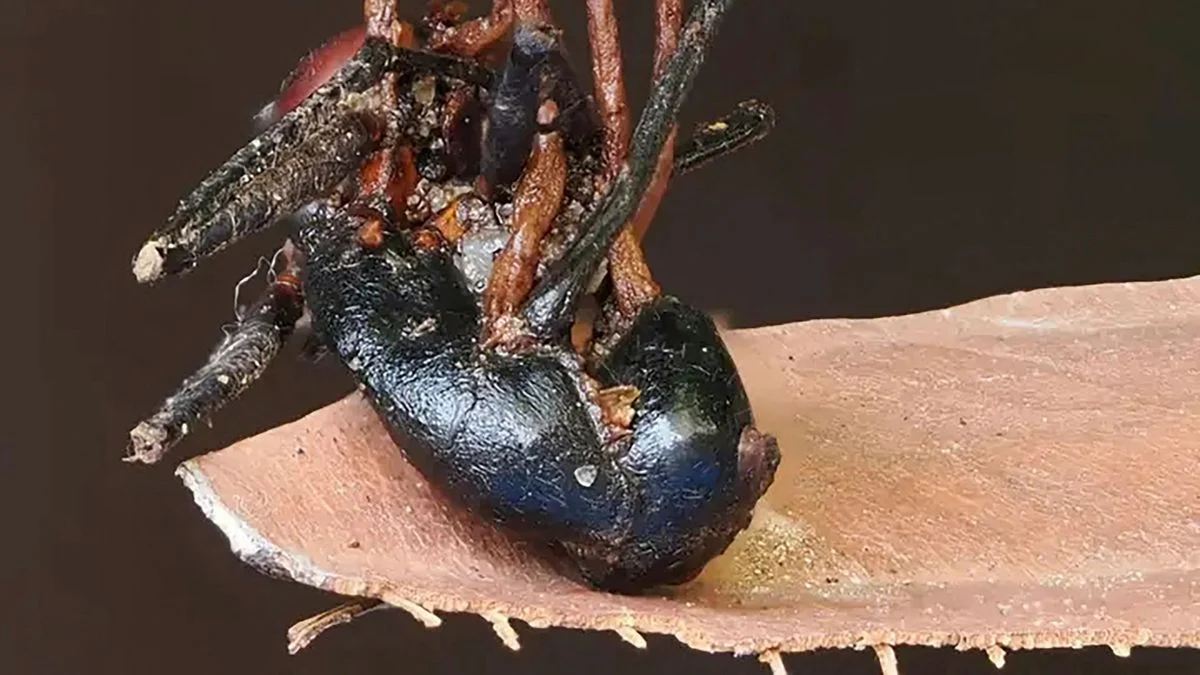
In the dense, humid rainforests of Borneo, a biological drama of "parasite-eat-parasite" has been uncovered, revealing a level of complexity in nature that borders on the macabre. Malaysian researchers from the Institute for Tropical Biology and Conservation at Universiti Malaysia Sabah (UMS) have identified a new species of fungus that does not merely infect insects, but specifically hunts and consumes the infamous "zombie fungi" that dictate the movements of their hosts.
The discovery, recently detailed in the peer-reviewed journal Phytotaxa, highlights the existence of a "hyperparasite"—a biological entity that parasitizes another parasite. This finding provides a rare glimpse into the complex, multi-layered ecological warfare taking place within the microscopic architecture of the jungle floor.
Main Facts: A Predator of Predators
The newly classified fungus, scientifically named Pleurocordyceps cornusynnemata, was discovered in the remote Danum Valley of the Sabah state in Malaysian Borneo. Its primary target is not an insect, but rather the mycelial network of the Ophiocordyceps genus—the world-renowned "zombie fungi" known for hijacking the nervous systems of ants and other arthropods.
Unlike conventional parasites that derive nutrients directly from their host’s tissues, P. cornusynnemata functions as a hyperparasite. It effectively "hunts" the zombie fungus while it is in the process of consuming an ant. By feeding on the internal growth of the Ophiocordyceps, the hyperparasite disrupts the life cycle of the master manipulator, potentially serving as a natural check and balance on the population of mind-controlling pathogens in the rainforest.
Chronology of the Discovery
The identification of P. cornusynnemata is the culmination of years of field research in the biodiverse habitats of Sabah.
- Initial Fieldwork (2022–2023): Biologists from the Institute for Tropical Biology and Conservation conducted systematic surveys in the Danum Valley, a protected lowland dipterocarp forest. Their objective was to document the diversity of fungal pathogens impacting local insect populations.
- The Rare Specimen: During a routine collection, researchers retrieved a deceased ant exhibiting the tell-tale signs of Ophiocordyceps infection. However, upon closer inspection in the laboratory, the researchers noticed an unusual, horn-like growth emerging from the fungus.
- Molecular and Morphological Analysis: Over the following months, the team performed DNA sequencing and microscopic examination. They observed that the secondary growth was not part of the Ophiocordyceps structure but a distinct fungal species.
- Peer Review and Publication (2024): The formal description of Pleurocordyceps cornusynnemata was published in the journal Phytotaxa, marking the official entry of this hyperparasite into the biological record.
Supporting Data: The Anatomy of a Hyperparasite
The classification of P. cornusynnemata as a hyperparasite rests on its specialized anatomy and behavior. Jaya Seelan Sathiya Seelan, the deputy director of the Institute, explained that the name cornusynnemata is derived from the Latin cornu (horn) and synnemata (a group of fungal hyphae), referencing the unique, horn-shaped structures the fungus develops as it emerges from the host.
Biological Mechanism
- Infection: The Ophiocordyceps infects an ant, navigating its nervous system to force the host to climb to a specific height and lock its jaws onto a leaf. This provides the ideal microclimate for the fungus to grow.
- Hyper-Infection: P. cornusynnemata spores land on the infected ant. Instead of attacking the ant, the hyperparasite bores into the mycelium of the Ophiocordyceps.
- Nutrient Extraction: The hyperparasite drains the energy reserves that the zombie fungus has accumulated from the ant’s body, effectively starving the primary parasite and preventing it from releasing its spores.
This dynamic demonstrates that the Ophiocordyceps is not at the top of the food chain in its own niche. Even the "master of puppets" is susceptible to being exploited, suggesting that the ecosystem of the rainforest is governed by a series of cascading dependencies.
Official Responses and Expert Commentary
The scientific community has received the discovery with significant interest. According to Jaya Seelan Sathiya Seelan, the find is a testament to the untapped biological wealth of Borneo.
"We are dealing with a highly specialized organism," Seelan stated. "The evolution of Pleurocordyceps to recognize and specifically feed upon the tissue of another parasite is a fascinating example of extreme biological adaptation."
Independent mycologists note that while hyperparasitism is documented in other fungal groups, observing it in the context of Ophiocordyceps is particularly rare. Most research on Ophiocordyceps focuses on the host-pathogen relationship, often ignoring the secondary organisms that might colonize the fungus. This study shifts the focus, urging researchers to look closer at the "parasite of the parasite" to understand the full complexity of forest health.
Implications: The Ecological Balance
The discovery of P. cornusynnemata carries significant implications for our understanding of forest ecology, evolutionary biology, and even potential applications in biotechnology.
1. Natural Population Control
One of the most immediate implications is the role this fungus plays in limiting the spread of zombie fungi. If P. cornusynnemata is widespread, it may act as a natural population control for Ophiocordyceps, preventing the primary parasite from decimating local ant colonies. This indicates that the "zombie" phenomenon, while terrifying to observe, is part of a complex, self-regulating system.
2. Evolutionary "Arms Races"
This discovery provides a concrete example of an evolutionary arms race. As the Ophiocordyceps evolved to control insects, it inadvertently created a new, untapped ecological niche for a hyperparasite. P. cornusynnemata has evolved the specific chemical and physical tools required to breach the defenses of the zombie fungus. This evolutionary pressure likely drives the rapid diversification of both species, as they continue to adapt to one another’s strategies.
3. Biotechnology and Medicine
While currently in the realm of basic science, the discovery of specialized fungi often leads to breakthroughs in pharmacology. Fungi are nature’s chemists, producing an array of bioactive compounds to survive in competitive environments. By studying the chemical mechanisms P. cornusynnemata uses to infiltrate and neutralize Ophiocordyceps, researchers may eventually uncover novel antimicrobial or antifungal agents that could have applications in medicine.
4. Biodiversity Conservation
The Danum Valley, where this fungus was found, is one of the most protected areas in Malaysia, yet it remains under pressure from climate change and habitat fragmentation. The discovery of such a niche-specific organism serves as a reminder that biodiversity is not just about the large, charismatic species like orangutans or pygmy elephants, but also about the complex microscopic networks that sustain the forest. Protecting the ecosystem requires preserving the environment for the smallest, most obscure inhabitants as much as for the largest.
Conclusion
The identification of Pleurocordyceps cornusynnemata is a stark reminder that nature often operates on a level of complexity that defies human intuition. By turning the tables on one of nature’s most effective manipulators, this hyperparasitic fungus offers a new chapter in the study of fungal ecology.
As the researchers at Universiti Malaysia Sabah continue their work, the scientific world will be watching closely. Whether this discovery leads to medical breakthroughs or simply deepens our awe of the natural world, it serves as a powerful testament to the importance of continued exploration. The jungles of Borneo have once again proven that even the most formidable forces of nature are subject to the relentless, intricate, and often brutal laws of biological competition.
In the quiet, dark corners of the Danum Valley, the "zombie" is no longer the final word in the story; it has found its own master, and in doing so, has opened a door into the hidden, hyper-connected world of the forest floor.