For decades, the British luxury brand Jaguar has existed in a precarious state of suspended animation. It has been a marque sustained by the nostalgic fervor of its devotees—a loyal base that worshipped at the altar of the E-Type and the XJ while often looking askance at the brand’s more recent, commercially struggling output. After years of financial volatility and an identity crisis that threatened its very existence, Jaguar has opted for the automotive equivalent of a scorched-earth policy.
In a move that has sent shockwaves through the industry, Jaguar ceased production of its entire model lineup, with the final F-Pace SUV rolling off the assembly line in December 2025. Since that moment, the company has effectively been a dormant giant, shedding its past to prepare for a singular, high-stakes future. Now, the curtain has been pulled back on the vehicle intended to redefine the brand: the Type 01. Scheduled for series production in 2027, the Type 01 is not merely a new car; it is a declaration of total independence from the Jaguar of the 20th century.
A Chronology of Rupture: From Concept to Reality
The journey to the Type 01 began in earnest with the unveiling of the Type 00 study in December 2024. The debut was met with a mixture of confusion and visceral disdain by traditionalists, yet the controversy was entirely by design. Jaguar’s leadership sought to create an unmistakable divide between the heritage of the past and the technology-led future they envisioned.
Following that polarizing debut, Jaguar has refined the concept for series production with surprising restraint in its deviation from the original study. The result is a vehicle that shares absolutely no DNA with the sedans or sports cars of the last fifty years.
Key milestones in the transformation:
- December 2025: The "End of Era" milestone, as the last legacy internal-combustion Jaguar (the F-Pace) leaves the production line.
- December 2024: The controversial unveiling of the Type 00, signaling the shift to a pure EV, ultra-luxury aesthetic.
- 2026: The period of industrial silence, during which manufacturing facilities were retooled for the new architecture.
- 2027: Scheduled market entry for the production-ready Type 01, representing the first step in the company’s new chapter.
Design Philosophy: Provocation in Metal
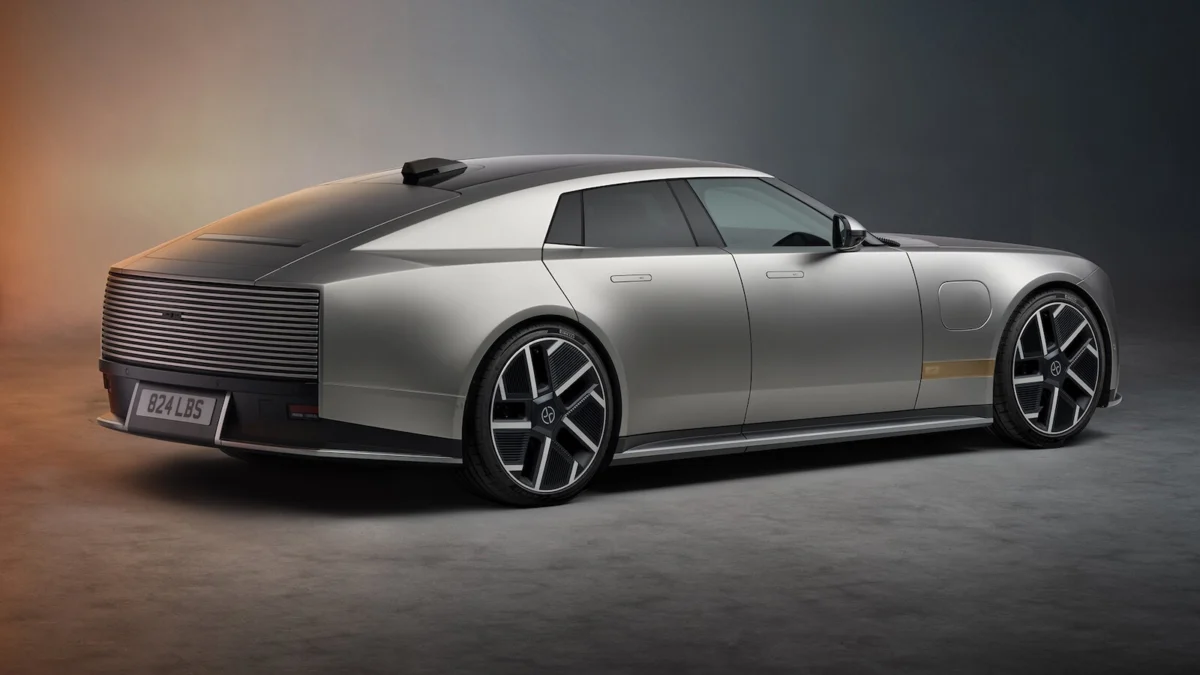
The Type 01 is a monolithic statement. Measuring 5.24 meters in length but standing only 1.4 meters tall, the vehicle defies the current market obsession with high-riding SUVs. Its profile is defined by an exceptionally long hood—an aesthetic choice that serves little functional purpose in an electric platform but communicates a sense of "grand tourer" drama.

Jaguar has sculpted cavernous wheel arches to accommodate massive 23-inch alloy wheels, which are wrapped in tires with ultra-low profiles. One of the most striking—and perhaps polarizing—features is the total absence of a rear window, a design choice popularized by the Polestar 4. Instead, the driver relies on a high-definition camera mounted on the roof, which feeds a digital display. While this maintains the sleek, uninterrupted flow of the roofline, the camera housing itself remains a visual point of contention, breaking the otherwise seamless silhouette.
Supporting Data: Technical Specifications and Performance
While the exterior design is intended to provoke, the technical specifications aim to dominate. The Type 01 is built on a high-performance electric architecture that prioritizes raw output and charging efficiency.
Drivetrain and Dynamics
Jaguar has opted for a tri-motor configuration: one motor powering the front axle (260 kW) and two motors driving the rear (310 kW each). The combined power output is a staggering 757 kW, supported by a massive 1,365 Nm of torque.
- Acceleration: 0 to 100 km/h is achieved in a blistering 3.2 seconds.
- Mid-range punch: 0 to 180 km/h is dispatched in just 7.2 seconds.
- Top Speed: Electronically limited, but exceeding 250 km/h.
Energy and Charging
The powertrain is fed by a 118 kWh battery pack, designed to support modern 800-volt charging architecture. Jaguar claims a peak charging capacity of 350 kW. In ideal conditions, this allows for the recovery of 321 km of WLTP range in just 13 minutes. A standard 10% to 80% charge cycle is estimated at approximately 22 minutes, underscoring the brand’s commitment to eliminating "range anxiety" for the ultra-premium buyer.
Inside the Cockpit: The Digital Frontier
The interior of the Type 01 abandons the traditional wood-and-leather luxury of British motoring for a minimalist, "concept-car" feel. The cabin is bisected by a long central spine that separates the interior into four distinct zones, emphasizing individual space.
Technology is the primary interface. The dashboard is dominated by a sweeping 24-inch OLED display, supplemented by a 7-inch touchscreen for primary vehicle controls. Even rear-seat passengers are treated to their own 7-inch interface. The lack of physical buttons is absolute, placing the entire burden of operation on the software. While the visual impact is undeniably futuristic, the long-term success of this layout will depend entirely on the intuitiveness of the user interface and the efficacy of the voice-control systems—an area where many legacy automakers have struggled during their transition to software-defined vehicles.

The Pragmatic Trade-offs
Despite the gargantuan external dimensions, the Type 01 is not a masterclass in utility. It is an exercise in form over function. The trunk offers a modest 450 liters of storage, expandable to 1,000 liters with the seats folded. Furthermore, the high door sills and the low-slung roofline make ingress and egress for rear passengers a cumbersome affair. It is clear that, in the hierarchy of the Type 01’s design requirements, practical cargo space and ease of entry were prioritized well below aerodynamic efficiency and visual impact.
Implications: A High-Stakes Bet
Perhaps the most startling aspect of the Type 01 is its pricing. Starting at approximately 165,000 euros, Jaguar is positioning itself far above its previous market segment. This move effectively moves the brand into direct competition with the most elite tier of the automotive world, moving away from the mass-premium segment occupied by the BMW 7 Series or the Mercedes-Benz EQS.
This is a risky maneuver. By elevating the price point, Jaguar is signaling that it is no longer interested in high-volume production. Instead, it is chasing "exclusive profitability." The strategy is a gamble: the company is banking on the idea that by becoming a hyper-niche, ultra-luxury brand, it can survive by selling fewer cars at much higher margins.
Critics argue that this strategy might be the final nail in the coffin for a brand that has lost its connection to its historical customer base. However, the supporters of this "Reimagining" argue that the alternative—slowly fading into irrelevance by trying to compete with established German incumbents in the mid-size luxury segment—was a guaranteed death sentence.
The Type 01 is, above all, a testament to audacity. Whether this vehicle becomes an icon of the electric age or a cautionary tale of hubris remains to be seen. What is certain is that the executives behind this radical pivot are not playing it safe. In an era where many legacy brands are struggling to find their footing in the shift to electrification, Jaguar has chosen to burn the bridge to its past, hoping that the Type 01 will provide the only path forward. For the first time in a generation, Jaguar is no longer looking in the rearview mirror; the question remains whether the market is ready to follow them into the unknown.