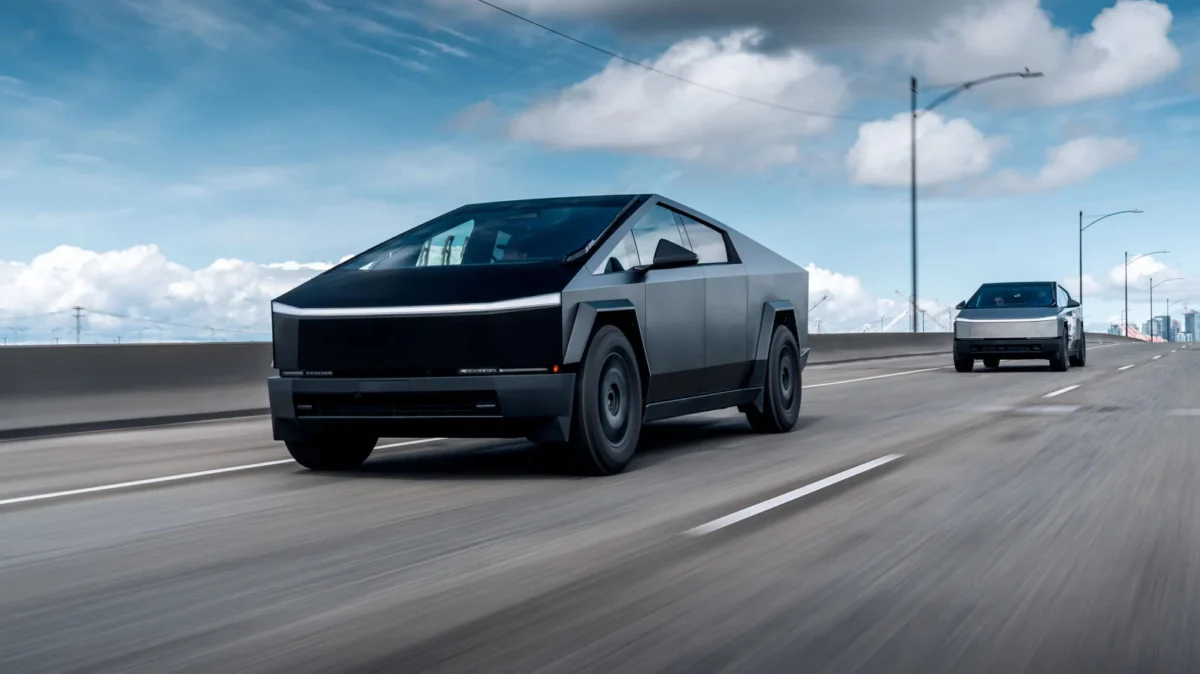
The sight of a Tesla Cybertruck on European roads remains an automotive rarity, a metallic anomaly that draws stares and smartphone cameras wherever it rolls. However, for a 50-year-old Swedish driver cruising along the A99 near Vaterstetten, east of Munich, this Sunday, the attention he drew was of a far less desirable nature. His journey, and his time behind the wheel of the angular, stainless-steel behemoth, came to an abrupt halt at the hands of the Hohenbrunn traffic police.
The issue was not the vehicle’s controversial design or its lack of a European-standard paint job—it was a fundamental misunderstanding of the driver’s licensing requirements for heavy electric vehicles. As the incident highlights, the Tesla Cybertruck exists in a regulatory "no-man’s-land" in Europe, where its size, weight, and lack of EU-standard safety features create significant hurdles for both owners and authorities.
The A99 Incident: A Routine Stop with High-Stakes Consequences
The incident, which was first reported by Bayerischer Rundfunk and corroborated by the Münchner Merkur, serves as a stark reminder that European road traffic regulations are unforgiving when it comes to vehicle classification.
The Swedish driver was piloting a Polish-registered Cybertruck when he was pulled over by the Hohenbrunn Traffic Police Inspectorate. Upon checking the driver’s credentials, officers discovered that he lacked the specific license class required to operate such a heavy vehicle. According to police reports, the Cybertruck in question had a permissible total mass of 4,200 kilograms (approximately 9,260 pounds).
In Germany, as in much of the European Union, the standard Class B driver’s license is capped at a permissible total mass of 3,500 kilograms. Because the Cybertruck exceeds this threshold, it is legally classified as a heavy vehicle, requiring a Class C1 license—the same category often used for small trucks. The police immediately prohibited the driver from continuing his journey. The vehicle was sidelined at the Hohenbrunn station, where it remains until a driver with the appropriate C1 credentials can retrieve it.
The Weighty Reality: Why the Cybertruck Hits Hard
To understand why the driver was stopped, one must look at the physics and the legal framework of vehicle weight classes. The Cybertruck, in its various configurations, is a massive machine. Even with an empty weight of approximately 3,100 kilograms, it sits perilously close to the standard 3.5-ton limit before a single passenger or piece of luggage is added.
While German law (specifically Section 6, Paragraph 3b of the Driver Licensing Ordinance) provides a narrow exemption for alternatively powered vehicles—allowing those with a Class B license to drive vehicles up to 4,250 kilograms—there are strict stipulations. This exemption generally requires that the extra weight be attributed solely to the electric propulsion system and that the load capacity does not exceed that of a comparable combustion-engine vehicle.
In this case, it appears the Cybertruck failed to meet the stringent criteria required to bypass the C1 requirement. The incident serves as a warning to international enthusiasts who import these vehicles: just because you can register the vehicle in a country like Poland does not mean you have the legal right to operate it under standard car licenses across all EU member states.
The Regulatory "Wall": Why the Cybertruck isn’t Sold in Europe
Beyond the driver’s license issue lies a much larger, structural problem: the Tesla Cybertruck is not officially sold in Europe, and for good reason. It currently lacks the EU-type approval required by Regulation (EU) 2018/858.
The primary roadblocks are safety-centric. European safety standards are notoriously rigorous, particularly regarding pedestrian protection. The Cybertruck’s rigid, razor-sharp stainless-steel exoskeleton is a direct contradiction to UN Regulation No. 26 (external projections) and UN Regulation No. 127 (pedestrian safety). These rules are designed to ensure that if a vehicle hits a pedestrian, the impact surface deforms to absorb energy. The Cybertruck, by design, is intended to be unyielding.
Furthermore, the vehicle lacks the mandatory speed-limiting technology required for vehicles exceeding 3.5 tons. Even the US military has faced rejection from the German Federal Ministry of Transport when inquiring about the possibility of using the vehicle. The Ministry indicated that a national individual permit—a "loophole" often used for rare imports—was not a viable path for the Cybertruck given its fundamental design characteristics. For Tesla to bring the truck to the European market, they would likely need to undergo a complete redesign of the front end, soften the exterior contours, and overhaul the pedestrian impact zones. From a business perspective, the costs of such a redesign likely outweigh the potential market share in Europe.
The Grey Market: How They Get Here Anyway
Despite the lack of official support, Cybertrucks are appearing on European roads. This is possible due to Section 46 of the Vehicle Registration Ordinance, which allows for the temporary use of foreign-registered vehicles. An individual can import a vehicle from another EU country and drive it in Germany for up to one year, provided it has a valid foreign registration, is not permanently stationed in Germany, and meets basic safety and roadworthiness standards.
There are anecdotes of "individual approvals" being granted in other jurisdictions. Reports from Wired in 2024 suggested that one Cybertruck in the Czech Republic may have been approved after the owner applied rubber strips to the edges of the vehicle to "soften" the exterior impact profile—a cosmetic fix that arguably circumvents the spirit, if not the letter, of the safety laws. Similarly, the Dutch transport authority, RDW, has received applications for individual inspections, though the outcome of such requests remains largely opaque.
Implications: A Looming Infrastructure Crisis
Beyond the legal and licensing hurdles, the Cybertruck poses a practical challenge for European infrastructure. The vehicle is gargantuan by local standards. With a width of approximately 2.20 meters (mirrors folded) and up to 2.40 meters (mirrors extended), it is a dominant presence on the road.
European highway lanes are often between 3.50 and 3.75 meters wide. A Cybertruck, at its widest point, occupies nearly 70% of a standard lane. This leaves very little room for error, especially in construction zones where lanes are frequently narrowed to two meters or less. The vehicle’s dimensions make it poorly suited for the tight, winding streets of historic European cities, and its weight puts strain on parking garages and road surfaces designed for lighter, smaller passenger cars.
The Path Forward: A Lesson for Enthusiasts
The incident on the A99 is more than just a bureaucratic hiccup; it is a symptom of a clash between American automotive ambition and European regulatory safety culture. For Tesla, the Cybertruck is a flagship of innovation and a statement of design. For European regulators, it is an unregulated, heavy, and potentially dangerous object that does not conform to the consensus on road safety.
As long as the Cybertruck remains uncertified for the European market, those who go to the extreme lengths of importing them must be prepared for the realities of the continent’s legal environment. This includes obtaining the appropriate heavy-vehicle licenses, accepting the limitations of their vehicle’s size on narrow infrastructure, and being prepared to prove to local authorities that their "grey-market" import meets the fundamental requirements for road safety.
For the 50-year-old driver in Bavaria, the lesson was expensive and inconvenient. For the rest of Europe, the Cybertruck remains a fascinating, albeit strictly prohibited, curiosity—a car that effectively "drives" the divide between the bold, unregulated spirit of the American frontier and the precise, safety-first architecture of the European Union. Whether Tesla will ever make the structural concessions necessary to bring the Cybertruck to Europe legally remains an open question, but for now, the message from the authorities is clear: if you want to drive a truck this big, you better have the license to back it up.