Executive Summary: A Career Defined by Integrity and Resilience
After 16 years of officiating at the pinnacle of German football, Bundesliga referee Tobias Welz is set to hang up his whistle this Saturday. The Wiesbaden native, a familiar face in the professional game since 2010, will oversee his final match in the German top flight at the Deutsche Bank Park in Frankfurt.
In a twist of scheduling fate that seems almost scripted, Welz’s swan song will see him officiate a high-stakes Europa League-deciding clash between Eintracht Frankfurt and VfB Stuttgart. The fixture brings with it a touch of irony, as it pits the veteran official against the Stuttgart side, whose star striker, Deniz Undav, was recently embroiled in a public verbal spat with the referee. As the curtain falls on a career spanning over three decades, Welz leaves behind a legacy defined by rigorous standards, occasional controversy, and a profound love for the "beautiful game."
Chronology: From the Fields of Wiesbaden to the Allianz Arena
To understand the man behind the whistle, one must look back at the trajectory of a career that began long before the bright lights of the Bundesliga.
The Early Years (1988–2009)
Born in Wiesbaden, Welz’s introduction to the craft was unconventional. At just twelve years old, he accompanied his father—also a referee—to a training seminar. What began as a supportive act of filial presence turned into a pivotal life moment when the young Welz unexpectedly sat for and passed the examination himself. By age 16, he was already officiating adult matches in the Bezirksliga, showcasing a maturity far beyond his years. His dedication was recognized by the German Football Association (DFB) in 2004, when he was brought into the national fold at the age of 22.
The Bundesliga Era (2010–2024)
Welz made his Bundesliga debut in 2010, a time when the modern era of VAR was still a distant dream. Over the subsequent 14 years, he navigated the transition from traditional officiating to the high-pressure, technology-assisted environment of the current era. His resume includes 157 Bundesliga appearances and 122 matches in the 2. Bundesliga, along with significant international experience in World Cup and European Championship qualifying matches.
The crowning achievement of his domestic career arrived in 2020, when he was selected to referee the DFB-Pokal final between Bayern Munich and Bayer Leverkusen. Though the match was played in the eerie silence of a pandemic-stricken stadium, Welz cites the occasion as a definitive highlight of his professional life.
Supporting Data: The Statistics of a Veteran
Referees are often judged by the binary outcome of their decisions, but a career’s worth of data paints a more nuanced picture of Welz’s longevity.
- Bundesliga Matches: 157
- 2. Bundesliga Matches: 122
- DFB-Pokal Final (2020): Bayern Munich 4–2 Bayer Leverkusen
- Primary Profession: Police Officer (Hesse State Police)
- Retirement Age: 48 (turning 49 shortly)
The regulation prohibiting referees from overseeing matches involving clubs from their home regional association was relaxed during the COVID-19 pandemic. This allowed Welz to officiate Eintracht Frankfurt’s 2-0 victory over Borussia Mönchengladbach earlier in 2024, marking his first and only previous time handling an Eintracht home match. Saturday’s assignment will be his second, providing a rare opportunity for a hometown referee to lead a high-profile game in his own backyard.
The Undav Conflict: A Case Study in Modern Scrutiny
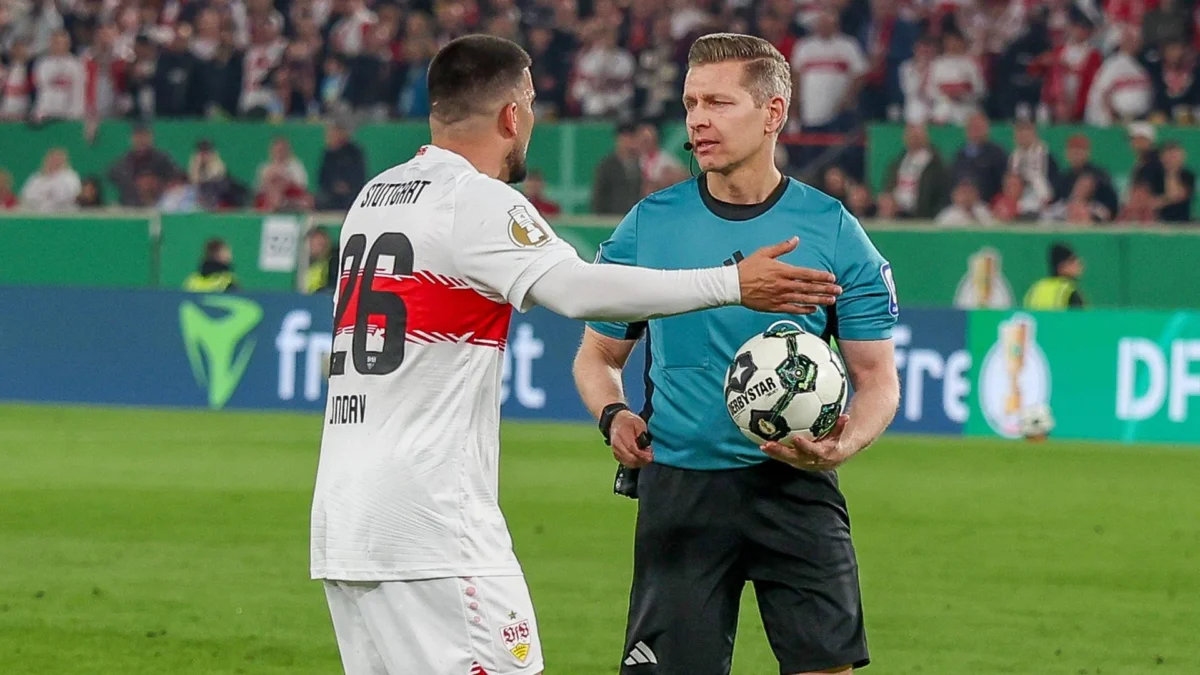
The narrative of Welz’s final weeks has been colored by a tense exchange with Stuttgart forward Deniz Undav. Following a contentious Pokal semi-final clash against SC Freiburg, an animated Undav took to the media to voice his frustrations.
"I am unhappy with the referee," Undav stated. "You can’t talk to him. He just screams at you." The striker’s comments, which included the candid admission, "I don’t like him anyway," went viral, sparking a broader debate about the relationship between players and officials.
While the incident highlighted the intense pressure under which modern referees operate, it also drew support for Welz from within the officiating fraternity. Fellow referee Patrick Ittrich publicly criticized Undav’s remarks as "incredibly disrespectful," highlighting the growing trend of players publicly delegitimizing officials in an era of social media immediacy. This friction serves as a microcosm of the challenges Welz has faced: maintaining authority in an age where every gesture and word is scrutinized by millions.
Official Responses and Reflections
As he prepares to depart, Welz has maintained a balanced perspective on his life’s work. In recent interviews, he described officiating as a "wonderful sport" that demands everything from the individual but rewards them in equal measure.
"I look back very positively on this long time," Welz remarked. "It is a profession that has demanded an extreme amount from me, but it has also given me an incredible amount back."
Regarding his post-retirement plans, Welz remains grounded. Having balanced his career as a DFB referee with his service as a police officer for the state of Hesse, he intends to focus on his law enforcement duties. He joked about the prospect of reality television stardom, specifically referencing the "Dschungelcamp" (the German version of I’m a Celebrity…Get Me Out of Here!), though he was quick to emphasize that such a career pivot is not on the horizon.
Implications: The Changing of the Guard
Welz’s departure is part of a larger structural shift within the DFB. He is one of four highly experienced referees—alongside Frank Willenborg, Patrick Ittrich, and the widely recognized Deniz Aytekin—who are stepping down this season.
This mass departure of veteran officials presents both a challenge and an opportunity for the Bundesliga. The loss of cumulative decades of "on-pitch wisdom" and conflict-resolution skills will be felt, but it also creates space for a new generation of referees to establish their authority.
For Tobias Welz, Saturday’s match in Frankfurt is not merely a professional obligation; it is a full-circle moment. Having spent his life in the service of the game, he will walk off the pitch for the last time under the floodlights of the Waldstadion. Whether the match concludes in controversy or calm, his legacy is secure: a career defined by duty, resilience, and an unwavering commitment to the rules of the game. As the final whistle blows, it will signal not just the end of a match, but the quiet, dignified closing of a significant chapter in German football history.