

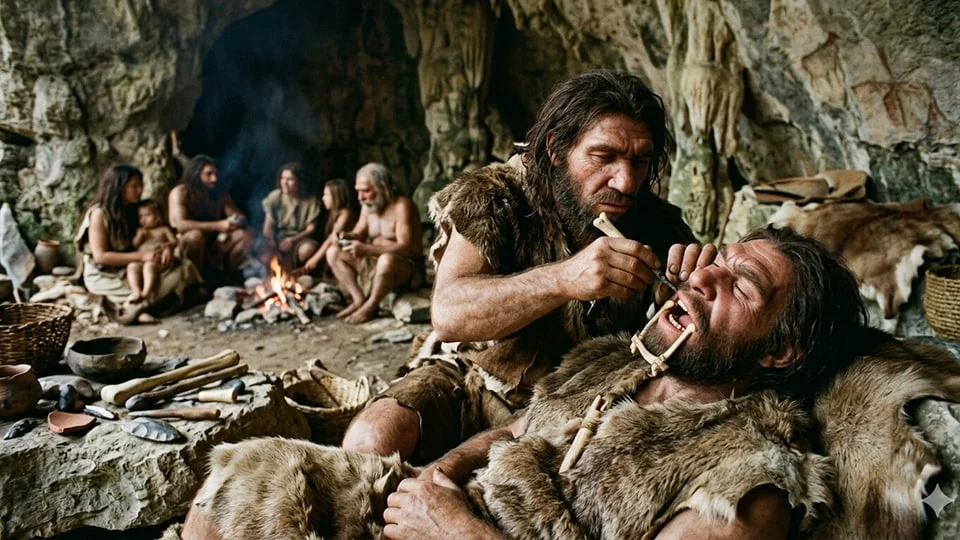
In a discovery that fundamentally alters our understanding of human evolution and medical history, researchers have uncovered evidence that Neanderthals—long stereotyped as primitive, brutish hominids—were performing sophisticated, invasive dental surgery as early as 60,000 years ago. An examination of a molar excavated from the Chagyrskaya Cave in the Altai Mountains of Western Siberia has revealed that these archaic humans possessed not only the manual dexterity required for complex procedures but also the cognitive capacity to identify sources of pain and execute targeted treatments to mitigate suffering.
The study, published in the open-access journal PLOS One, presents the earliest known instance of a "dentist" performing an invasive procedure on a living patient to treat dental caries (cavities). This finding pushes back the timeline of surgical intervention by tens of thousands of years and suggests that the intellectual divide between Homo sapiens and Neanderthals is far narrower than previously assumed.
Main Facts: The Chagyrskaya Discovery
The centerpiece of this revelation is a single, fossilized back molar recovered from the sediment of the Chagyrskaya Cave. Anthropologists, led by Alisa Zubova of the Museum of Anthropology and Ethnography in St. Petersburg, Russia, conducted a high-resolution analysis of the specimen, which dates back approximately 59,000 years.
Upon microscopic inspection, the team identified a deep, deliberate perforation in the center of the tooth’s occlusal surface—the chewing area. The hole was not the result of natural wear, nor was it a common dental decay pattern. It penetrated deep into the tooth, extending into the pulp chamber, where the nerves and blood vessels are located.
The researchers concluded that this was an intentional act of "caries mitigation." By drilling into the tooth, a Neanderthal practitioner likely sought to relieve the intense, throbbing pressure caused by an abscess or a severe infection within the pulp. By opening the cavity, they would have drained the infection and relieved the patient’s agony, marking a significant milestone in the history of medicine.
Chronology of the Investigation
The process of validating this discovery was a multi-year effort that combined archaeology, experimental replication, and forensic dentistry.
The Excavation and Initial Observation
The tooth was unearthed during ongoing excavations at the Chagyrskaya Cave, a site famous for its rich Neanderthal occupation layers. When researchers first noted the unusual anomaly in the molar, it was initially suspected to be a natural phenomenon. However, the precision of the hole’s placement prompted a closer investigation.
Forensic Replication
To prove that this hole was man-made, Zubova’s team turned to experimental archaeology. They gathered stone tools matching the specific types found within the same stratum of the Chagyrskaya Cave. Using these replica stone points—which were characterized by their sharp, needle-like tips—the team practiced drilling into modern human teeth.
The results were a match: the holes created by the researchers using the ancient tool-making techniques displayed the exact same diameter, depth, and microscopic striations (scratches) as the hole in the 59,000-year-old Neanderthal molar. This experimental confirmation provided empirical evidence that the procedure was indeed a physical intervention performed by another individual.
Peer Review and Publication
Following the replication phase, the data were subjected to rigorous scrutiny. The team documented the evidence of "invasive mitigation of dental caries" and submitted their findings to the scientific community. The subsequent publication in PLOS One solidified the claim as the oldest known example of such a complex, successful surgical intervention outside the Homo sapiens lineage.
Supporting Data: The Anatomy of a Procedure
The evidence for this dental surgery is not merely anecdotal; it is rooted in the physical reality of the tooth itself. The morphological analysis of the molar reveals several critical insights:
- Strategic Positioning: The hole was drilled in the exact location required to reach the pulp chamber. This indicates a high level of anatomical knowledge. Whoever performed the operation understood where the "pain" was originating and how to access it.
- Tool Compatibility: The stone tips used by the Neanderthals at this site were not just general-purpose scrapers; they were specialized tools. The use of these points for drilling implies that the Neanderthals had developed a "kit" of medical instruments.
- Healing and Success: Analysis of the surrounding tooth structure suggests that the patient survived the procedure for a significant amount of time afterward. This implies that the surgery was successful in its primary goal: the alleviation of acute pain.
Official Responses and Scientific Consensus
The scientific community has reacted to the publication with a mixture of excitement and re-evaluation. Paleoanthropologists have long known that Neanderthals were not the simpletons early 20th-century archaeology painted them to be. Evidence of the use of toothpicks—small splinters of wood or bone used to remove debris from between teeth—has been documented in several Neanderthal sites. Furthermore, chemical analyses of tartar on Neanderthal teeth have hinted at the use of medicinal plants, such as poplar (which contains salicylic acid, the active ingredient in aspirin) to manage pain.
However, the Chagyrskaya molar represents a quantum leap from "using a toothpick" to "performing surgery." Dr. Zubova’s team emphasizes that this discovery necessitates a new model of Neanderthal social behavior. It suggests a high degree of empathy and cooperative care, as such an operation would have required the patient to remain still while another individual performed a painful, invasive task.
Some skeptics initially raised the question of whether the hole could have been caused by persistent grinding of grit-laden food. However, the uniformity of the drill marks and the specific, inward-tapering geometry of the hole have largely silenced these theories, with the consensus shifting toward intentional medical intervention.
Implications for Human Evolution
The discovery at Chagyrskaya Cave has profound implications for how we view the evolution of human cognition and social structures.
The Empathy Factor
Medical intervention is, at its core, an act of empathy. It requires one individual to recognize the suffering of another and to take risks to alleviate that suffering. If Neanderthals were performing dental surgery, it suggests they had a sophisticated understanding of cause and effect, as well as a social structure that prioritized the health of its members.
Technical Proficiency
The ability to manipulate stone tools to perform a delicate task like drilling into a tooth requires exceptional fine motor skills. This challenges the long-held assumption that Neanderthals lacked the manual precision for complex, controlled tasks. It suggests that their tools were not just for hunting or butchery, but were part of a wider, more nuanced technological repertoire.
The Shared History of Medicine
Perhaps the most significant implication is that the history of medicine does not begin with the rise of modern humans. Instead, it appears to be a shared inheritance. The Neanderthals—our closest evolutionary cousins—were grappling with the same physical vulnerabilities as we are today. They experienced toothaches, they developed infections, and they found ways to fight back against the biology that caused them pain.
Conclusion
The 60,000-year-old molar from the Chagyrskaya Cave is more than just a fossil; it is a testament to the resilience and ingenuity of the Neanderthal people. By demonstrating that these ancient hominids were capable of performing surgical procedures to treat dental disease, researchers have opened a new chapter in the history of medicine.
As we continue to analyze the remnants of our ancestors, we are increasingly finding that the traits we once considered uniquely "human"—the ability to heal, to empathize, and to solve complex problems—were shared long before we stepped onto the stage of history. The Neanderthal dentist of the Altai Mountains reminds us that the struggle against disease is a timeless human endeavor, one that unites us across the vast expanse of deep time.













Leave a Reply